
Postmark has long been respected as a transactional email service. Its deliverability is genuinely excellent, and it has a clean, focused email API. But the context has shifted: ActiveCampaign acquired Postmark in 2022, and pricing changes since then have left many users frustrated. Developers who were already paying attention to cost are now actively evaluating alternatives.
If you're looking for the best Postmark alternatives, this guide compares the strongest options honestly, by use case, pricing, and technical fit. Some are cheaper. Some offer more. Some will be a better fit depending on your stack and volume. Read on to learn more.
The information in this article was last updated on April 27, 2026.
Table of Contents
Why developers are switching away from Postmark
Before getting into the alternatives, it's worth being direct about what Postmark does well and where it falls short.
Postmark's genuine strengths:
- Best-in-class inbox placement: 98.7% in independent testing, compared to SendGrid's 95.3%. That gap has real consequences for revenue.
- Strict customer vetting means clean shared IPs with a strong sender reputation, no bad neighbors degrading your deliverability rates.
- Fast email delivery: typically under 2 seconds for transactional messages.
- Clean, well-documented API with comprehensive documentation.
Where Postmark falls short in 2026:
- The free tier is 100 emails/month total, enough to verify your integration, not enough to test properly. Brevo's free plan offers 300 emails/day (9,000/month) by comparison.
- Paid plans start at $15/month for 10,000 emails. At moderate volume (50K/month), you're paying around $50/month, expensive for a transactional email service with no marketing tools included.
- Dedicated IP addresses require sending 300,000+ emails/month and add $50/month. Most competitors make dedicated IPs accessible earlier.
- Detailed logs and activity history default to 45 days (extendable at additional cost).
- Zero marketing tools: no email campaigns, no marketing automation, no drag-and-drop editor, no SMS.
- Unresponsive customer support is increasingly cited in recent reviews, a marked change from Postmark's pre-acquisition reputation.
If the only thing you care about is the highest possible transactional email deliverability and you have no other requirements, Postmark can still be justified. For everyone else, the market has genuinely caught up.
Our methodology at Brevo: How we tested
This article covers the best Postmark alternatives, including our own platform, Brevo. We strive to be objective. Our suggestions are based on our own research and experience. We do not earn commissions from any links in this article. To learn exactly how we evaluate tools, check out our dedicated methodology article.
Please note that the features listed here are just a selection of what each software offers. For exact pricing and a full, up-to-date feature list, check the providers' websites.
The best Postmark alternatives in 2026
1. Brevo, best all-in-one Postmark alternative
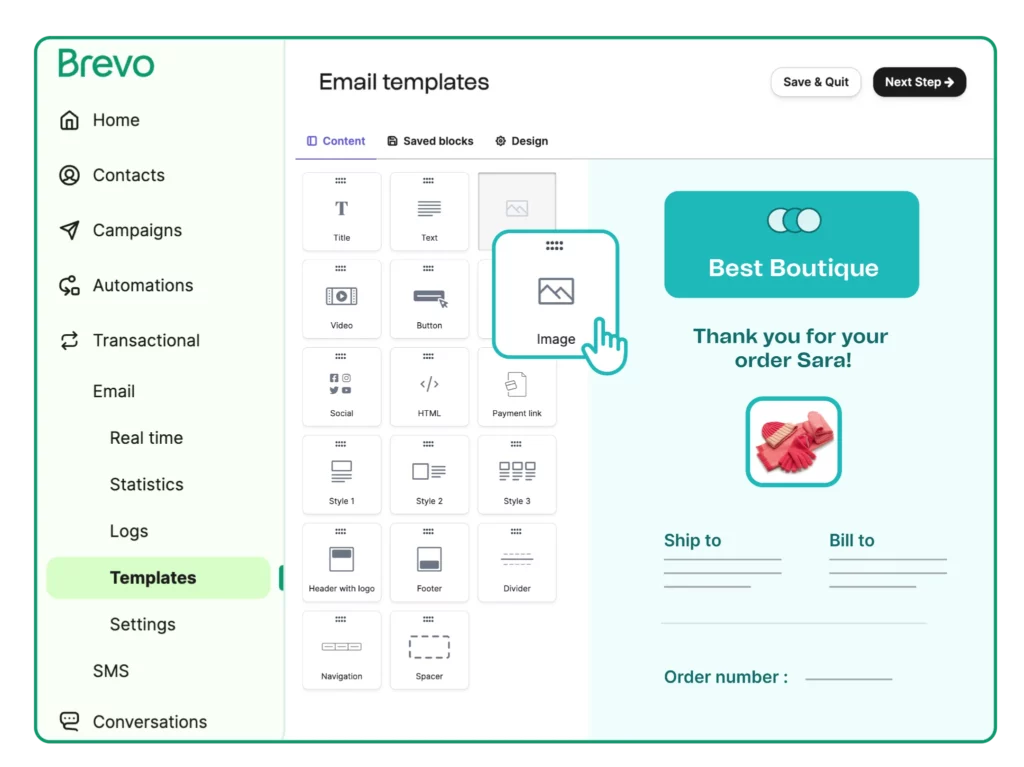
Best for: Teams who need reliable transactional email delivery and want to consolidate their email infrastructure rather than add separate marketing tools, CRM, or SMS on top.
Brevo is the most complete Postmark alternative for teams whose needs extend beyond pure transactional sending. Where Postmark is deliberately narrow, Brevo covers transactional and marketing emails natively, with a genuine email API, not a bolt-on.
Email API and SMTP relay
Brevo supports both REST API and SMTP relay (smtp-relay.brevo.com, port 587 recommended). For teams migrating from Postmark's SMTP setup, the switch is a single host and credentials change with no modifications to your sending logic.
Technical specs:
- 8 official SDKs: Python, Node.js, PHP, Ruby, Java, TypeScript, Go, C#
- Rate limit: ~600 emails/hour on paid plans; HTTP 429 with Retry-After header when exceeded
- Batch send: up to 1,000 personalized versions per API call
- Max throughput: 120,000 emails/minute
- Webhooks for real-time analytics: opens, clicks, bounces, inbound email parsing
- Unlimited detailed logs and activity retention (configurable period for compliance)
For a full guide on handling 429s and building resilient retry logic, see our guide to email API rate limiting.
Dedicated IPs and sender reputation
For high volume senders who need IP isolation, Brevo offers dedicated IP addresses as an add-on, accessible at lower volumes than Postmark's 300K/month minimum. This is useful for teams that need separation between transactional and marketing emails on separate sending infrastructure, or for those managing sender reputation carefully across multiple domains.
On shared IPs, Brevo maintains 99%+ reliable email delivery. That's not the same metric as Postmark's 98.7% inbox placement benchmark, but the practical difference is minimal for senders with proper SPF/DKIM authentication and a clean history.
Pricing
- Free: 300 emails/day (9,000/month), full API access, no credit card required
- Starter: $9/month for 5,000 emails/month
- Standard: $18/month, adds landing pages, A/B testing, marketing automation
- Pricing is based on email volume, not contact database size. Higher tiers include generous contact storage; lower entry-level tiers come with contact limits.
Brevo vs Postmark comparison
| Brevo | Postmark | |
|---|---|---|
| Free tier | 300/day (9,000/month) | 100/month total |
| Entry paid plan | $9/mo (5K emails) | $15/mo (10K emails) |
| $18/mo plan | Full feature suite + 5K emails | 10K emails, transactional-only |
| Dedicated IP addresses | Add-on | $50/mo, 300K/mo min |
| CRM | Included | Not available |
| SMS | Pay-as-you-go | Not available |
| Marketing automation | From Standard plan | Not available |
| Drag-and-drop editor | Yes | Limited |
| Detailed logs / retention | Unlimited | 45 days default |
| Customer support | Chat + email, all plans | Email, <3hr response |
The honest case for Brevo: if you're already paying for a separate marketing email service on top of Postmark, consolidating on Brevo almost always reduces total cost. You can explore Brevo's email API and transactional email features to see how the API maps to your existing setup.
Brevo's free plan covers 9,000 emails/month with full API access, enough to run a proper evaluation without pressure. No credit card needed.

Excellent first experience with their support — Free account review
"I've been using Brevo since its Sendinblue days, mainly for email marketing and SMTP relay with our office printer [...] The transition to Brevo brought noticeable improvements. What stands out is their customer support - even as a free account user, I received personalized, non-canned responses to my queries. This prompt and considerate support, especially for minor issues like the SMTP key length for our printer, is commendable."
Pat B.,
Sales and Marketing Director

SMTP & Transactional email provider
"We've been using Brevo (Sendinblue) as an SMTP for our transactional Woo emails since 2021 and intend to continue even longer. And here's why. Recently, our account was postponed and all our transactional emails stopped being sent. We couldn't understand the reason behind it and appealed for support. Hats off to the Brevo team, we've received it quickly. The support team found a spam bot activity and helped us resolve this issue by advising us on our steps. Again, we never experienced any issues with the service itself. But it's great to know that Brevo's quick assistance is there if something goes wrong."
Tatiana Lebedeva,
Brevo user
Several sales and marketing tools in one system
"We stumbled upon Brevo by accident as we were using a system just for sending marketing emails. We discovered quickly that Brevo offered multiple different digital sales and marketing tools to enhance both our manual branded client engagement tasks, but also offered automation tools to aid our day to day sales efforts. Brevo has allowed us to move away from three other, separate systems and we now use Brevo for all our outbound sales and marketing endeavours. This has saved us a lot of time and money and has increased our output. The system is easy to use and the support is excellent and prompt."
Stephen Day,
Brevo user
2. Mailtrap, best Postmark alternative for high-volume deliverability and analytics
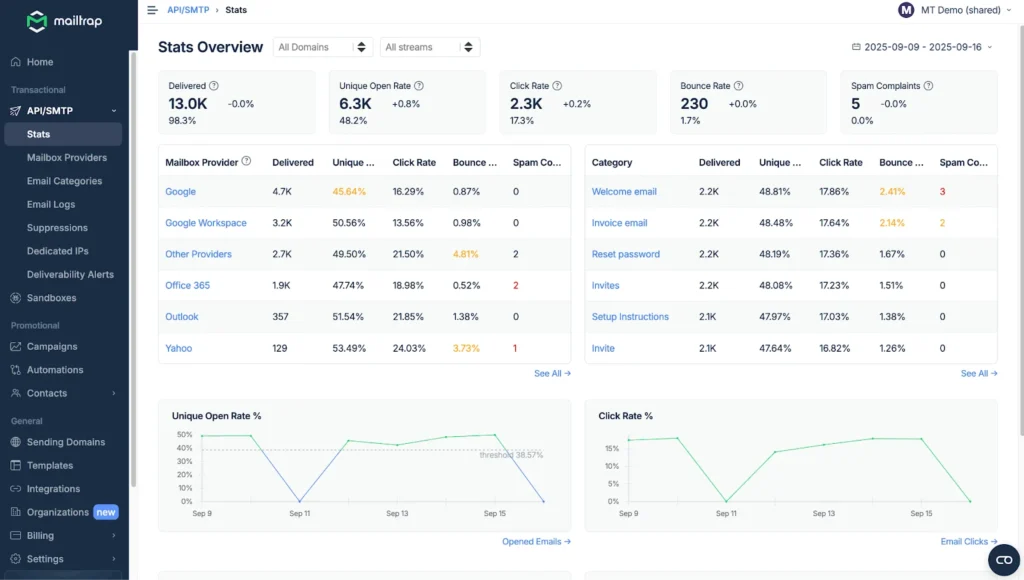
Best for: Product and engineering teams with large or growing sending volumes who want Postmark-level deliverability discipline, deeper analytics, and a cost curve that stays manageable as volume increases.
Mailtrap is an email API and SMTP platform built for companies with high sending volumes, with deliverability and analytics as its core focus. Like Postmark, it separates transactional and bulk sending into dedicated streams. Unlike Postmark, it pairs that with broader tooling: a drag-and-drop email marketing suite, an Inbound Email API with AI Agent Inbox routing, and pricing that stays flatter as volume grows.
Key facts:
- Free plan: 4,000 emails/month (150/day) — Postmark's is 100/month total
- Basic: $15/month for 10,000 emails, matching Postmark's entry price
- Business: $85/month for 100,000+ emails, dedicated IP and automatic warmup included
- Gap widens at scale: $30 vs. Postmark's $100 at 100,000 emails/month
- Separate transactional and bulk streams, plus a bulk-aware email API
- SDKs for Node.js, PHP, Ruby, Python, Elixir, Java, Go, and .NET
- ISO 27001 and SOC 2 Type II certified, GDPR compliant
Versus Postmark: Mailtrap matches Postmark on stream separation and SPF/DKIM/DMARC, and starts at the same $15/month for 10,000 emails. It pulls ahead with a free tier 40 times larger, dedicated IPs from the Business plan instead of Postmark's 300,000-email minimum, and per-email costs that drop further past 50,000 sends. With Mailtrap, you can observe the performance of your emails through helicopter-view dashboards and drill-down reports. There, you’ll be able to see your opens, deliveries, unsubscribes, bounces, and how your emails are doing with each provider.
3. Resend, best Postmark alternative for developer experience
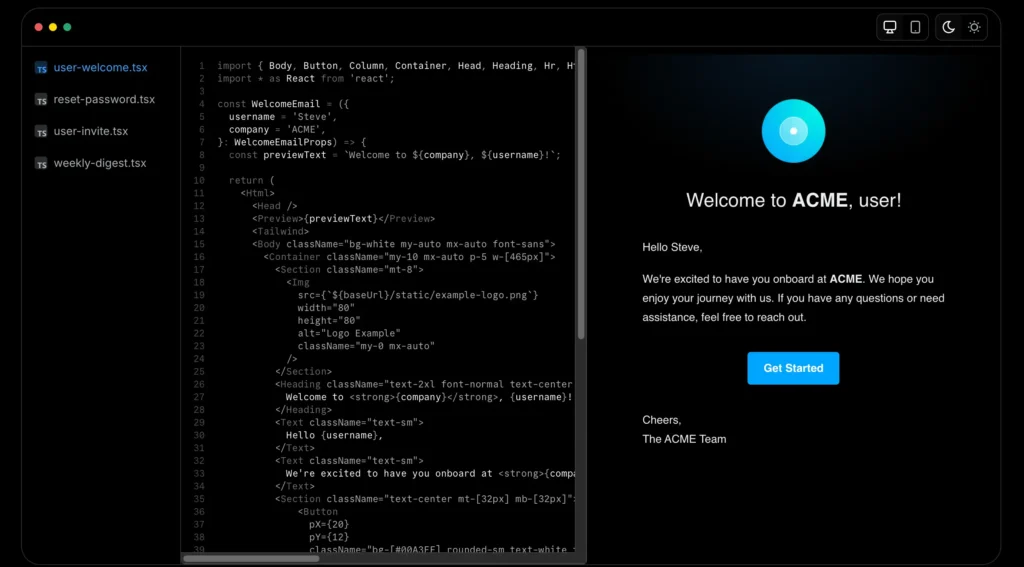
Best for: Frontend and full-stack developers building React applications who prioritize a modern, minimal API and code-first email templates.
Resend is the developer-favorite Postmark alternative, and the reputation is earned. The API is deliberately simple, the React Email integration is first-class, and the documentation reads like it was written by engineers for engineers.
Key facts:
- Free plan: 3,000 emails/month, 30x more generous than Postmark's 100/month free tier
- Pro plan: $20/month for 50,000 emails
- Scale plan: $90/month for 100,000 emails
- Pay-as-you-go overage billing available on paid plans for volume spikes
- Dedicated IP addresses available as a $30/month add-on (Scale plan and above)
- React Email integration: write email templates in JSX with full type safety
- SDKs for Node.js, Python, Ruby, PHP, Go, Elixir, Java, .NET
- Inbound email processing added in 2025
What Resend doesn't cover: Marketing campaigns, contact management, CRM, SMS. It's a focused transactional email service. If you need transactional and marketing emails under one roof, Resend requires additional tools.
Versus Postmark: Resend is a strong like-for-like alternative at the email API level. The free tier is far more useful for development. For React developers, the developer experience is meaningfully better, email templates are first-class code, not a separate system. Postmark still leads on deliverability benchmarks based on track record, but Resend's real-world deliverability is sufficient for most production use cases.
Read more: The best email API services compared.
4. Amazon SES, best for high-volume cost optimization
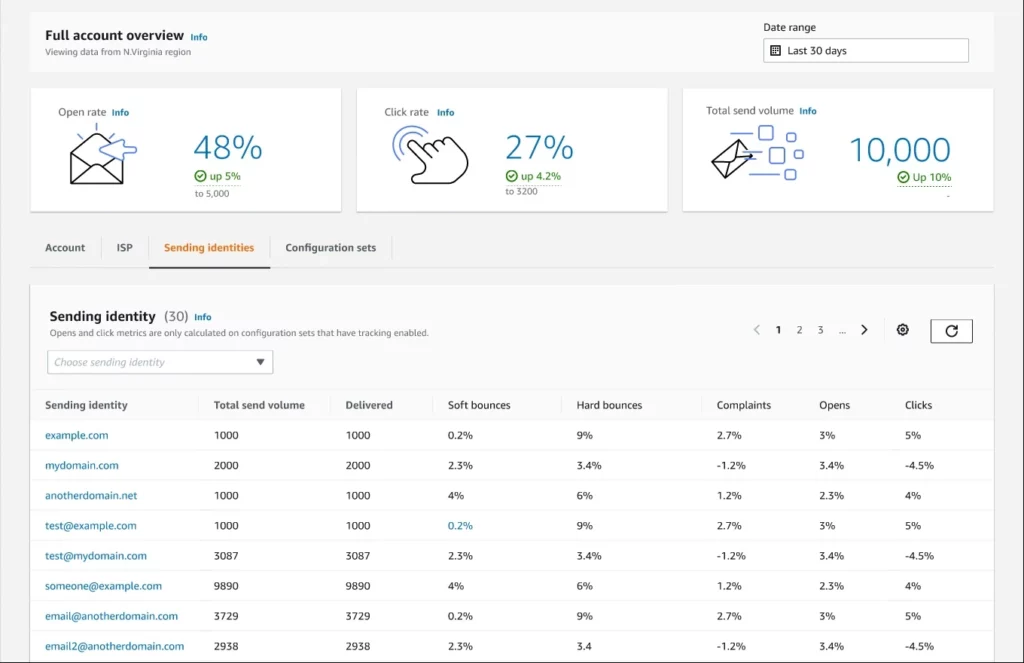
Best for: Technical teams at scale (500K+ emails/month) already invested in AWS who have engineering capacity to manage email infrastructure.
Amazon SES is the most affordable email service provider on a per-email basis: $0.10 per 1,000 emails. That's $50 for 500,000 emails, versus roughly $650 with Postmark at the same volume. For high volume senders, the economics are genuinely compelling.
The $0.10/1K headline rate is not the full story.
Real cost breakdown:
- Base: $0.10/1,000 emails
- Virtual Deliverability Manager: +$0.07/1,000 (strongly recommended for inbox placement monitoring)
- Dedicated IP addresses (standard): +$24.95/month per IP
- Data transfer: +$0.12/GB outbound
- SNS notifications (bounce and spam complaints handling): additional fees
- AWS technical support: $29-$100/month minimum
True costs run 40 to 70% above the headline rate before engineering time.
Operational overhead:
SES starts every new account in sandbox mode: 200 emails/day, verified addresses only. Production access requires a formal request that can be rejected. Once live, automatic suspension triggers if spam complaints exceed 0.1% or bounce rate exceeds 5%, and manual review can take days.
There are no email templates, no drag-and-drop editor, no marketing automation, no built-in bulk email tools. Bounce handling, MAIL FROM configuration, CloudWatch monitoring, SNS webhooks, and IP warmup for dedicated IPs are all your team's responsibility.
Verdict on SES: Right for SaaS companies sending millions of system notifications with dedicated backend engineers already on AWS. Not the right Postmark alternative for most product teams where the original appeal was reliable delivery without infrastructure management overhead.
Read more: The best transactional email services compared.
5. SendGrid, best Postmark alternative for enterprise scale
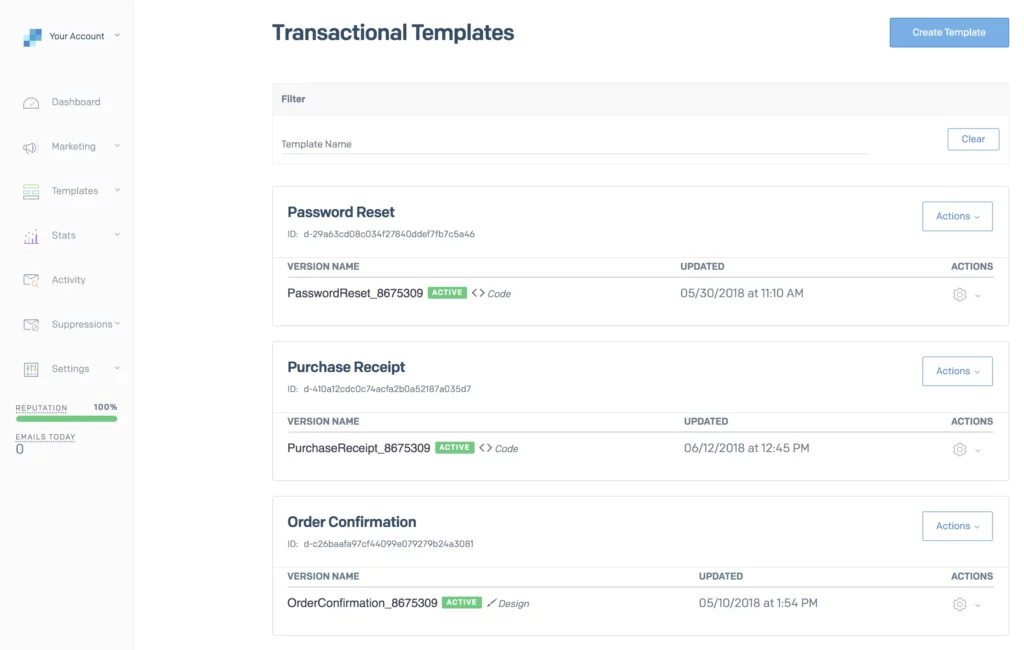
Best for: Mid-size to enterprise companies that need a well-documented, battle-tested transactional email service for both transactional messages and marketing campaigns at scale.
SendGrid is one of the most established names in transactional email, now owned by Twilio. It handles both transactional and marketing emails natively, which puts it closer to Brevo in scope, though it's more complex and typically more expensive at equivalent feature levels.
Key facts:
- Free plan: 100 emails/day (no expiry)
- Essentials: $19.95/month for 50,000 emails
- Pro: $89.95/month for larger volumes with priority support
- Both transactional messages and marketing emails supported natively
- Comprehensive documentation and a large ecosystem of integrations
- Deliverability: ~95.3% inbox placement, notably below Postmark's 98.7%
- Dedicated IP addresses available on Pro and Enterprise plans
- Real-time analytics, detailed logs, email templates, drag-and-drop editor included
Versus Postmark: SendGrid is cheaper at moderate volume (50K for ~$20 vs Postmark's ~$50). The feature set is broader. The tradeoff is platform complexity, the product has grown substantially since the Twilio acquisition, and some teams find it harder to navigate than Postmark's simplicity. Deliverability is the most meaningful concern: at 95.3% vs 98.7%, the gap is real for high-stakes transactional messages like password resets and order confirmations.
Read more: The best SendGrid alternatives.
6. Mailgun, best Postmark alternative for inbound email and advanced API needs
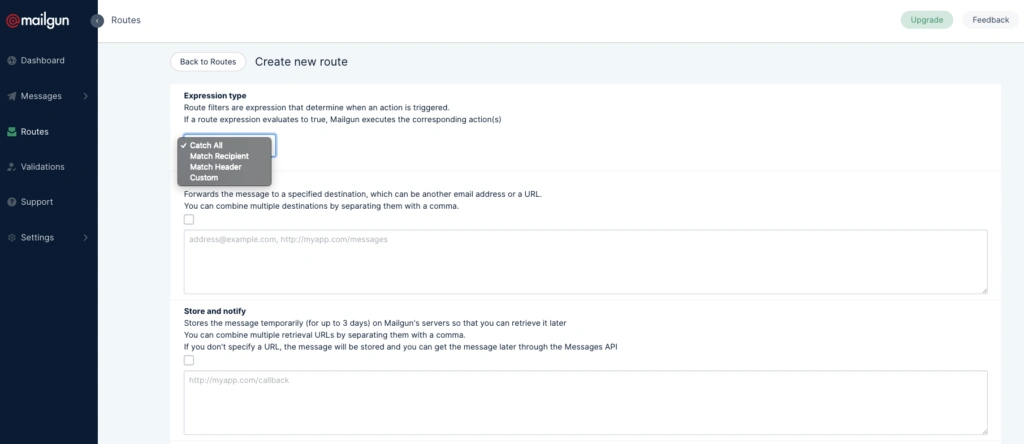
Best for: Developers who need powerful API capabilities, strong inbound email parsing, or advanced routing, particularly for helpdesk and support ticket systems.
Mailgun is a developer-focused email service provider with particular strength in inbound email processing. If your application needs to receive, route, and parse incoming email programmatically, Mailgun's inbound capabilities significantly exceed Postmark's.
Key facts:
- Foundation plan: $15/month for 10,000 emails
- Scalable plans for higher volume with lower per-email rates
- Powerful API with comprehensive documentation
- Strong inbound email parsing via webhooks, best-in-class for complex routing
- Detailed logs and real-time analytics included
- No full marketing automation suite or marketing campaigns
- Some users report unresponsive customer support since the Sinch acquisition
Versus Postmark: Similar entry pricing, but Mailgun's inbound email capabilities are a genuine differentiator. If you don't need inbound routing, there's no compelling reason to choose Mailgun over Brevo or Resend for a standard Postmark alternative.
Read more: The best Mailgun alternatives.
7. MailerSend, best free tier for small businesses and early-stage products
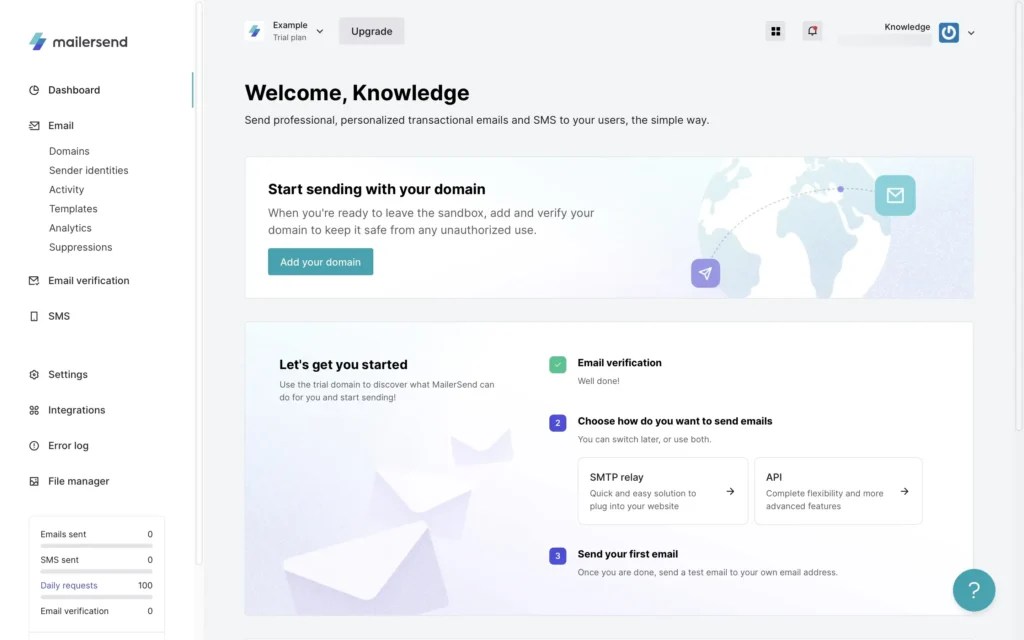
Best for: Small businesses, startups, and early-stage products that need a clean transactional email API with a generous free plan and approachable setup.
MailerSend is a transactional email service from the MailerLite team. It's more approachable than SES, less expensive than Postmark, and ships with email templates and a drag-and-drop editor built in, useful for teams without dedicated backend engineers.
Key facts:
- Free plan: 3,000 emails/month (100/day), genuinely useful for development and low-volume production
- Paid plans scale for growing sending needs
- Drag-and-drop email template editor included
- Real-time analytics and detailed logs on all plans
- Dedicated IP addresses available on higher tiers
- Good customer support reputation compared to larger providers
Versus Postmark: For small businesses that find Postmark's 100/month free tier too restrictive to evaluate properly, MailerSend is a more accessible entry point. Less raw API power, but better out-of-the-box tooling for non-technical teams.
8. Mandrill (Mailchimp Transactional), for existing Mailchimp users only

Mandrill is Mailchimp's transactional email add-on, purpose-built for existing Mailchimp users who want transactional messages handled within the same ecosystem as their marketing campaigns.
For teams already using Mailchimp, Mandrill integrates cleanly with existing contact data and automations. For everyone else, it's not a recommended Postmark alternative: Mandrill requires a paid Mailchimp subscription to access, effectively making it more expensive than purpose-built transactional services for new users. Deliverability and support quality are adequate but not differentiated.
Verdict: Only consider Mandrill if you're an existing Mailchimp user with no appetite for switching email service providers. For net-new setups, any of the options above offer better value.
Read more: The best Mandrill alternatives.
How to choose the right Postmark alternative
Choose Brevo if:
- You want to consolidate transactional and marketing emails on one platform
- You need CRM, SMS, automation, or landing pages alongside transactional sending
- You want a more generous free tier for development (300/day vs Postmark's 100/month)
- You're a small business or growing team that wants one support team, one bill, one sending infrastructure
Choose Mailtrap if:
- You're a product or development team sending transactional email at volume, and want separate infrastructure so a marketing campaign never delays a password reset or payment confirmation
- You need in-depth analytics — drill-down reports by mailbox provider, category, and domain, with logs retained up to 30 days
- Compliance is non-negotiable: Mailtrap is ISO 27001 and SOC 2 Type II certified and GDPR compliant
- Your dev team wants to manage sending directly from Claude, Cursor, or VS Code via MCP server integration, rather than switching to a separate dashboard
Choose Resend if:
- You're building a React application and want code-first email templates
- Developer experience is the primary decision criterion
- Transactional-only works, and you have separate tools for marketing campaigns
Choose Amazon SES if:
- You're a high volume sender (500K+ emails/month) with dedicated engineering resources
- You're already on AWS and cost per email is the overriding priority
Choose SendGrid if:
- Enterprise-scale transactional and marketing emails under one roof is the requirement
- Priority support and a large integration ecosystem matter
- You have existing SendGrid integrations elsewhere in your stack
Choose Mailgun if:
- Inbound email processing is a core use case
- You need advanced API-level routing capabilities
Choose MailerSend if:
- You're a small business or early-stage product that finds Postmark's 100/month free tier too restrictive to properly evaluate
- You want template tooling and a drag-and-drop editor out of the box, without needing a dedicated backend engineer
- You're prioritizing approachable setup and support over raw API power
Choose Mandrill if:
- You're already a paying Mailchimp user and want transactional email in the same ecosystem as your marketing campaigns
- Switching providers isn't something you're looking to do right now
- You're fine paying for a Mailchimp subscription just to unlock transactional sending
Stay on Postmark if:
- Maximum inbox placement on transactional messages is non-negotiable and worth the premium
- You genuinely need transactional email service only, no marketing tools, ever
- You've evaluated the post-acquisition product direction and are satisfied
Quick pricing comparison
| Provider | Free tier | Entry paid plan | 50K emails/mo |
|---|---|---|---|
| Postmark | 100/mo | $15/mo (10K) | ~$50/mo |
| Brevo | 9,000/mo (300/day) | $9/mo (5K) | ~$25/mo |
| Mailtrap | 4,000/mo (150/day) | $15/mo (10K) | $20/mo |
| Resend | 3,000/mo | $20/mo (50K) | $20/mo |
| Amazon SES | Pay-as-you-go | $0.10/1K | ~$5/mo + infra |
| SendGrid | 100/day | $19.95/mo (50K) | $19.95/mo |
| Mailgun | Trial only | $15/mo (10K) | ~$35/mo |
| MailerSend | 3,000/mo | Low-volume free | ~$25/mo |
| Mandrill | None — requires a paid Mailchimp plan | $20/block (25K emails), on top of Mailchimp Standard | ~$40/mo in blocks + Mailchimp plan cost |
Prices as of April 2026. Amazon SES figures exclude infrastructure add-ons (Virtual Deliverability Manager, dedicated IPs, support plan).
Migrating from Postmark to Brevo
For teams choosing Brevo as their Postmark alternative, the technical migration is straightforward. Brevo supports both REST API and SMTP relay, so you can switch incrementally.
SMTP migration: Update your SMTP server to smtp-relay.brevo.com on port 587, swap the credentials, and your sending logic requires zero changes.
REST API migration: Brevo's transactional send endpoint (/smtp/email) maps closely to Postmark's structure. The official SDKs for Python and PHP handle authentication, retry logic with exponential backoff, and rate limit handling automatically.
Before your first send, make sure your domain is authenticated. SPF/DKIM is required for reliable inbox placement with Gmail, Yahoo, and Microsoft, all three enforce DMARC. Brevo can auto-detect your domain provider and configure the necessary DNS records without manual steps. Dedicated IP addresses can be added later when your volume justifies IP isolation.
For a broader look at how email API providers compare, see Brevo's email API overview and the best email API services comparison.
Read more: The best free SMTP servers compared.
Final word
Postmark earned its reputation on deliverability and simplicity. For a narrow use case, transactional-only, maximum inbox placement, no other requirements, it still delivers.
For most teams re-evaluating their email service provider in 2026, the calculus looks different. Post-acquisition pricing changes, a 100/month free tier that's genuinely too restrictive for development, and the complete absence of marketing tools make Postmark harder to justify against alternatives that have closed the gap on the fundamentals.
Brevo is the best Postmark alternative for teams that need a complete platform: reliable transactional email service, marketing emails, CRM, and SMS from one place, with a more generous free plan and lower cost at almost every volume level. Resend is the answer for developer experience and React-first stacks. Amazon SES is the answer for high volume senders who need to optimize cost and have the engineering resources to manage the infrastructure.
Brevo's free plan covers 9,000 emails/month with full email API access, enough for a complete technical evaluation. No credit card required.