
You described your app to Lovable, Bolt, or Cursor, and it works. Then a real user signs up and never gets the confirmation email. Password resets, receipts, and login links all depend on a transactional email API, and the default setup that AI builders give you is usually meant for testing, not production.
This guide compares the best transactional email APIs for apps built with AI tools. For each one, we cover the free tier, the entry price, how well it works with AI builders, and when to pick it. Pricing and features were checked against each provider's own pages.
The information in this article was last updated on October 1, 2026.
Table of Contents
- Best transactional email APIs at a glance
- What an AI-built app needs from an email API
- Our methodology at Brevo: How we tested
- The 8 best transactional email APIs for AI-built apps
- What about the email built into Lovable?
- How to connect a transactional email API to your app
- Common email mistakes in AI-built apps
- Which transactional email API should you choose?
Best transactional email APIs at a glance
| API | Best for | Prices start at | Trustpilot rating |
|---|---|---|---|
| Brevo | Transactional and marketing email in one platform | Free plan; paid from $9/month | 3.9/5 |
| Resend | Developer experience | Free plan; paid from $20/month (50,000 emails) | 2.0/5 |
| Postmark | Deliverability-critical email | Free plan; paid from $15/month (10,000 emails) | 2.2/5 |
| Mailgun | Inbound routing | Free plan; paid from $15/month (10,000 emails) | 4.1/5 |
| Mailtrap | Testing before sending | Free plan; paid from $15/month (10,000 emails) | 3.6/5 |
| Amazon SES | Lowest cost at scale | $0.16 per 1,000 emails (Essentials plan) | 2.3/5 |
| SMTP2GO | Simple SMTP setup | Free plan; paid from $15/month (10,000 emails) | 4.8/5 |
| SendGrid | Twilio ecosystem | 60-day trial; paid from $19.95/month (50,000 emails) | 1.2/5 |
Here is how each API handles free usage, AI builders, and MCP:
| API | Free tier | AI builder support | MCP server |
|---|---|---|---|
| Brevo | 9,000 emails/mo (300/day) | Native Lovable connector | Yes |
| Resend | 3,000 emails/mo (100/day) | Bolt default, Lovable guide, Replit | Yes |
| Postmark | 100 emails/mo | API key setup | Yes |
| Mailgun | 100 emails/day | API key setup | Yes |
| Mailtrap | 4,000 emails/mo (150/day) | Lovable guide | Yes |
| Amazon SES | AWS credits for new customers | Manual setup | — |
| SMTP2GO | 1,000 emails/mo (200/day) | SMTP setup | — |
| SendGrid | 60-day trial | Replit integration | Docs search only |
If you want a broader comparison that isn't focused on AI-built apps, see our guides to the best email API services and the best transactional email services.
What an AI-built app needs from an email API
AI builders generate working code fast, but they make assumptions about email that break once real users arrive. Before comparing providers, check these four points:
- A production sending limit. Supabase, the backend behind many Lovable and Bolt apps, limits its built-in auth email to 2 messages per hour and only sends to your own team. Supabase recommends custom SMTP for anything beyond testing.
- Your own domain. Test domains only send to your own address. Real users need email from a domain you verified with SPF, DKIM, and DMARC, which Gmail and Yahoo now require from bulk senders.
- Server-side API keys. The key must live in a backend function or secret store, never in frontend code the browser can read.
- Room to grow into marketing. Most apps eventually send onboarding sequences, product updates, or newsletters. Some tools only handle transactional email, so plan for that early.
Our methodology at Brevo: How we tested
This article covers the best transactional email APIs for AI-built apps including our own platform, Brevo. Our suggestions are based on our own research and testing. We don't earn commissions from any links on this page. To learn exactly how we evaluate tools, check out our dedicated methodology article.
Please note that the features listed here are just a selection of what each software offers. For exact pricing and a full, up-to-date feature list, check the providers' websites.
The 8 best transactional email APIs for AI-built apps
1. Brevo
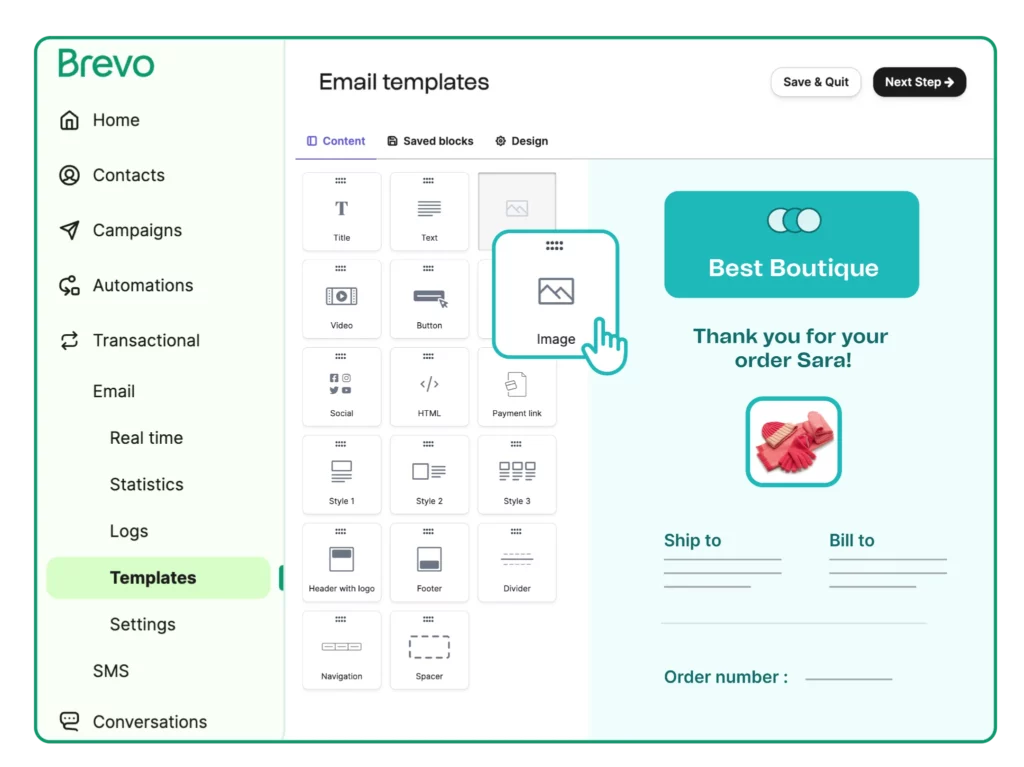
Brevo is an AI-powered customer platform with a full transactional email API. You can send through a REST API or through SMTP relay (smtp-relay.brevo.com, port 587), with official SDKs in the main languages AI builders generate, including Node.js and Python.
Why it fits AI-built apps: Lovable has an official Brevo connector. You paste a Brevo API key into Lovable's Connectors, then describe what you want, for example: "Use Brevo and build a store that sends order confirmation emails and shipping updates after checkout." The connector lets your app send transactional and marketing emails, manage contacts and lists, and trigger SMS or WhatsApp messages if they are enabled on your Brevo account.
- Free tier: 300 emails per day with full API and SMTP access, webhooks, and real-time tracking. No credit card needed.
- Paid plans: from $9/month (Starter).
- Testing: a sandbox mode (X-Sib-Sandbox: drop header) validates API requests without delivering email.
- AI tools: an official MCP server connects Brevo to Claude Desktop, Cursor, Windsurf, and VS Code, so your coding assistant can check templates, contacts, campaigns, or CRM deals.
- Limitations: the free plan caps you at 300 emails per day, so a launch or traffic spike can push you to a paid plan quickly. Marketing automation on Starter covers up to 2,000 contacts; the Standard plan removes that cap.
- Best for: apps that will need both transactional email and marketing (onboarding sequences, newsletters, SMS) and want one account and one API key for all of it.

Exceeding Expectations: A Five-Star Experience with Brevo
I recently had the pleasure of using Brevo's services, and I must say, my experience was nothing short of exceptional, meriting a full five stars. From the outset, the team at Brevo demonstrated unparalleled professionalism and dedication to customer satisfaction. Their attention to detail and commitment to providing tailored solutions truly set them apart in their field.
Bob,
Brevo user
Several Sales and Marketing Tools in One System
We stumbled upon Brevo by accident as we were using a system just for sending marketing emails. We discovered quickly that Brevo offered multiple different digital sales and marketing tools to enhance both our manual branded client engagement tasks, but also offered automation tools to aid our day to day sales efforts. Again, we never experienced any issues with the service itself. But it's great to know that Brevo's quick assistance is there if something goes wrong.
Stephen Day,
Brevo user
Brevo has most of the tools a small business needs
Brevo has most of the tools a small business needs for marketing and sales at a very reasonable price, without limiting your list growth. It has email marketing, CRM, transactional emails, SMS, live chat, Meta ad management, and WhatsApp messages. All this in a package that's easy to use and grows with your business.
Mor Mester,
Email Marketing Expert
Great range of features
We’ve been using Brevo ourselves for more than five years, and we’ve been really happy with it. It offers a great range of features (especially the automations) and makes creating beautiful emails very easy.
Robert Brandl,
Founder of EmailTooltester
2. Resend
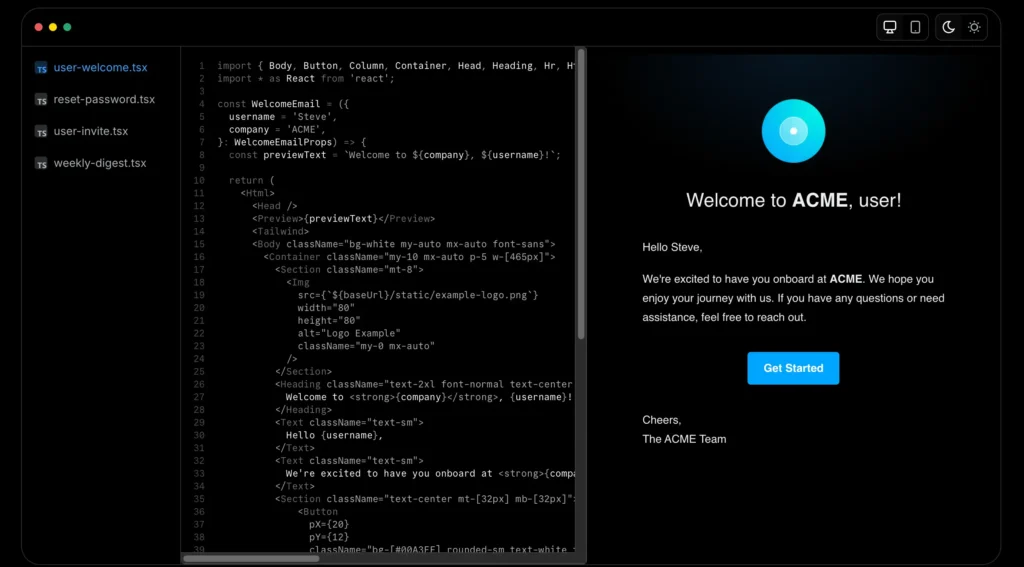
Resend is a developer-focused email API. Its team maintains React Email, an open-source library for building emails as React components. It is the provider AI builders reach for most often: Bolt's documentation says it typically uses Resend when you ask for email without naming a provider, and Replit lists it among its Agent integrations.
- Free tier: 3,000 emails per month, capped at 100 per day.
- Paid plans: Pro from $20/month for 50,000 emails. Marketing email is billed separately, by contacts.
- AI builder notes: Resend's Lovable guide stores the API key as a Supabase secret, so it never reaches the browser. Until you verify your own domain, the app can only send to your own address.
- Best for: developers on React or Next.js who want clean docs and component-based templates.
3. Postmark
Postmark focuses on fast, reliable delivery of transactional email. It separates transactional and broadcast traffic into different message streams and IP ranges, so a marketing campaign can't hurt your password reset delivery. If you're weighing it against other options, see our list of Postmark alternatives.
- Free tier: 100 emails per month.
- Paid plans: Basic from $15/month for 10,000 emails, then $1.80 per extra 1,000.
- AI builder notes: no native connector in AI builders, but any tool that generates backend code can call its API. An official MCP server with 24 tools is available.
- Best for: apps where login links and password resets must arrive in seconds, and that send little or no marketing email.
4. Mailgun
Mailgun is a long-standing email API with strong inbound features: it can receive email, parse it, and forward it to your app through routes and webhooks.
- Free tier: 100 emails per day, with 1 custom domain and 1 inbound route.
- Paid plans: Basic from $15/month for 10,000 emails, with 5 inbound routes. Full inbound routing starts on the Foundation plan ($35/month).
- AI builder notes: API key setup in any builder, plus an official MCP server.
- Best for: apps that need to receive and process email, such as support inboxes or reply-by-email features.
For other providers with similar features, see our Mailgun alternatives.
5. Mailtrap
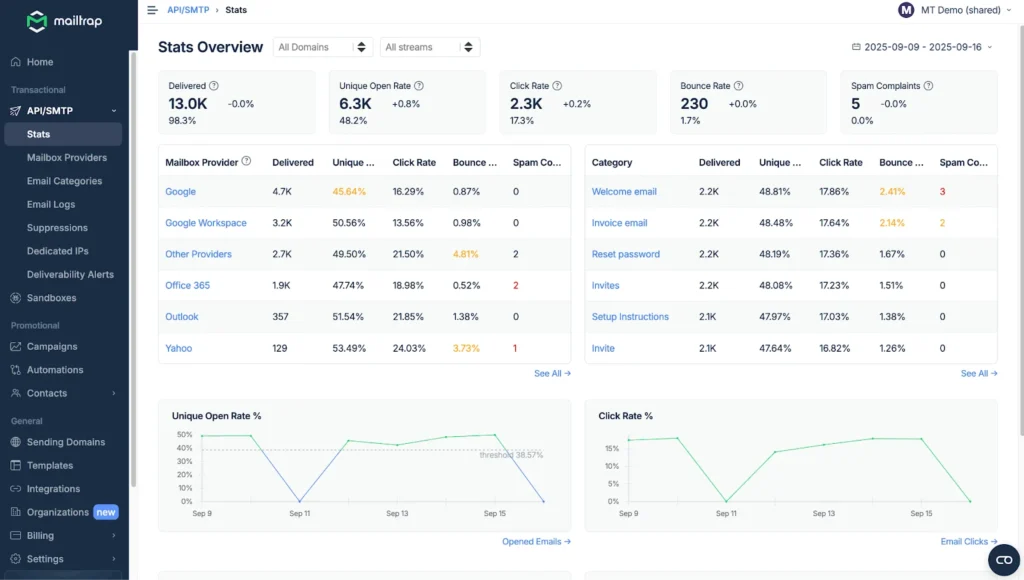
Mailtrap combines an email sandbox for testing with a sending API. You can check how your emails look and behave before any real user receives them.
- Free tier: 4,000 emails per month (150 per day) for sending, plus a free sandbox with 50 test emails per month.
- Paid plans: Basic from $15/month for 10,000 emails.
- AI builder notes: Mailtrap publishes a Lovable guide: verify your domain, ask Lovable to store the API token in Lovable Cloud, then tell it to use Mailtrap for all project emails. An official MCP server is also available.
- Best for: teams that want to test every email flow before launch.
6. Amazon SES
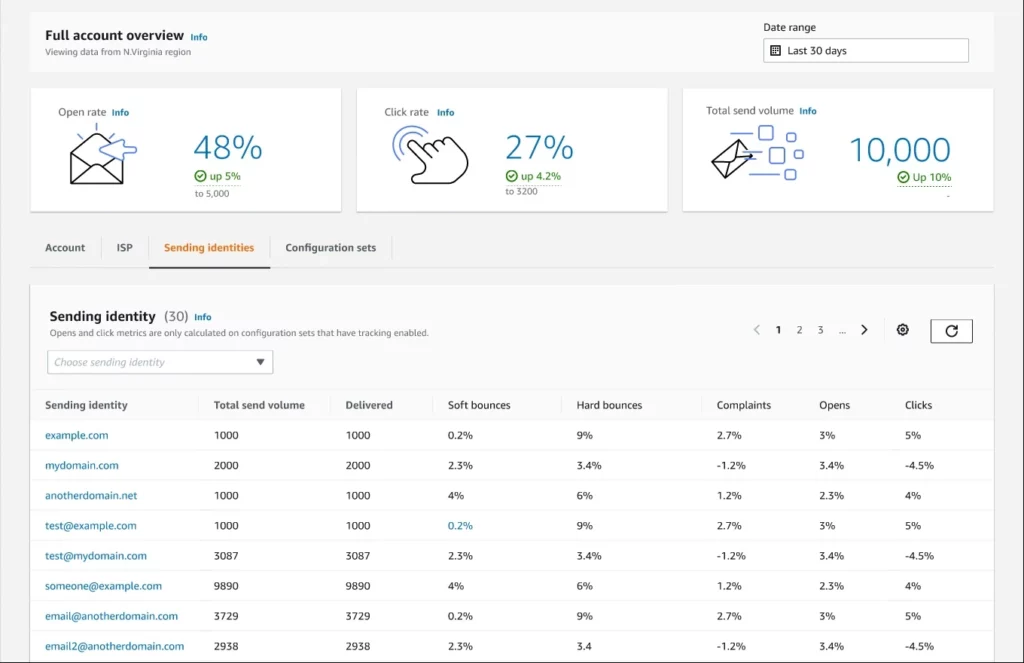
Amazon Simple Email Service has one of the lowest unit prices on this list, but it is raw infrastructure: no visual template editor, no marketing tools, and more setup work. Bounce, complaint, and delivery notifications go through Amazon SNS, and SMTP connections must use TLS (ports 587, 465, or 2587). Our guide to Amazon SES alternatives covers easier options.
- Free tier: new AWS customers get AWS Free Tier credits (up to $200) that can cover SES usage.
- Paid: new accounts start on the Essentials plan at $0.16 per 1,000 emails, with no monthly fee, plus $0.12 per GB of attachments. Accounts created before July 2026 may keep the older rate of $0.10 per 1,000.
- AI builder notes: new accounts start in a sandbox that only sends to verified addresses, up to 200 messages per day. You must request production access from AWS before real users can receive email.
- Best for: high-volume apps with engineering time to spare and an existing AWS setup.
7. SMTP2GO
SMTP2GO is a straightforward SMTP and API service. Because it works over standard SMTP, you can plug it into Supabase Auth or any framework without writing API code. It supports ports 587, 2525, 8025, and 80 (plus SSL on 465), and webhooks report deliveries, opens, clicks, bounces, and spam complaints.
- Free tier: 1,000 emails per month (200 per day).
- Paid plans: Starter from $15/month for 10,000 emails.
- AI builder notes: no native connector in AI builders. Paste its SMTP settings into Supabase Auth or your framework, or call its API from a backend function.
- Limitations: the free plan allows 1 webhook and caps sending at 25 emails per hour until you verify your sender domain. A dedicated IP starts on the Professional plan ($75/month).
- Best for: simple apps that only need reliable SMTP for auth and notification emails.
See our list of free SMTP servers for other options.
8. Twilio SendGrid
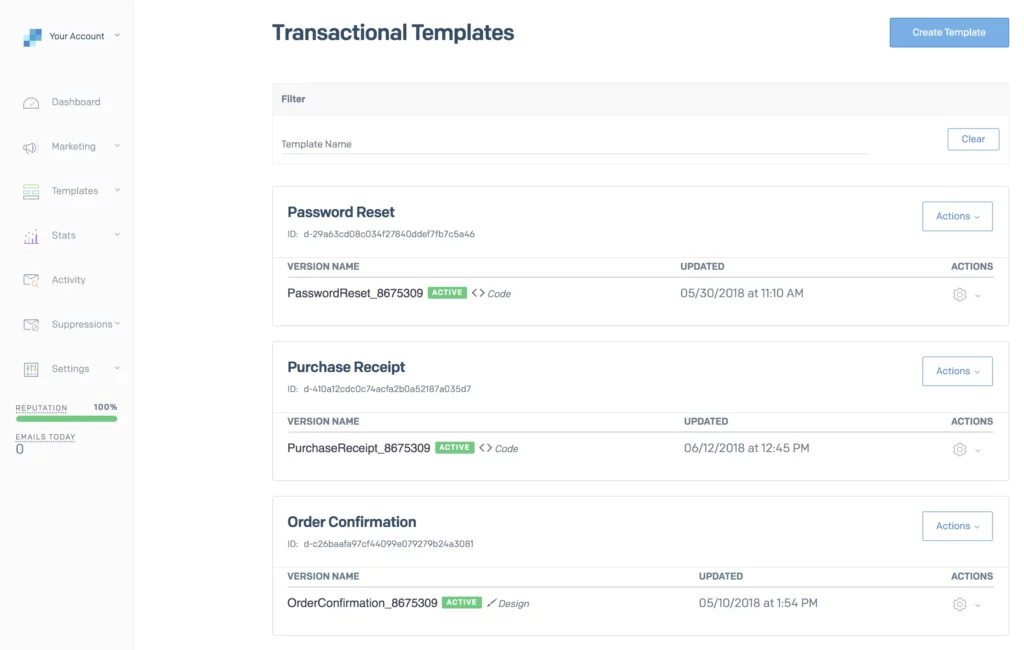
SendGrid is one of the most widely known email APIs and part of Twilio, which also offers SMS and voice APIs. It has official libraries for Node.js, Python, PHP, Ruby, Java, Go, and C#, event webhooks for delivery tracking, and an Inbound Parse Webhook on all paid plans. Dedicated IPs start on the Pro plan ($89.95/month).
- Free tier: no permanent free plan for new accounts. You get a 60-day trial at 100 emails per day.
- Paid plans: Essentials from $19.95/month for 50,000 emails.
- AI builder notes: listed among Replit's Agent integrations. There is no official SendGrid MCP server for sending email; Twilio's official MCP server only searches its documentation, including SendGrid's.
- Best for: teams already using Twilio for SMS or voice.
Related: our comparison of SendGrid alternatives.
What about the email built into Lovable?
Lovable now includes its own email system on paid plans: up to 50,000 transactional emails per month per workspace, sent from your domain, with DNS records handled for you. For signups, password resets, and order confirmations, that may be all you need at first.
Two limits are worth knowing. Hourly caps depend on your plan (for example, 100 app emails per hour on Pro). And marketing email, such as newsletters, promotions, or product announcements, is not supported. Once your app needs those, you need an email platform that handles both, like Brevo's email marketing alongside its transactional API.
How to connect a transactional email API to your app
Option 1: Use your AI builder's connector
If your AI builder offers a native connector for your email provider, this is usually the simplest way to get started. For example, Lovable has a native Brevo connector, so you can connect your account and ask the builder to add transactional emails to your app without writing the API integration yourself.
Option 2: Call the API from a backend function
If your builder doesn't offer a native connector, you can have it generate a server-side function that calls the provider's API. This works with tools such as Bolt, Replit, Cursor, or Claude Code and gives you more control over how and when emails are sent. Keep the API key in a server-side secret, never in frontend code that users can access.
Option 3: Use SMTP
If your authentication system or framework already supports SMTP, you may not need to add API calls to your application at all. You provide the SMTP host, port, username, and password or SMTP key, and the system sends emails through your provider. This is particularly useful for services such as Supabase Auth that support custom SMTP configuration.
Common email mistakes in AI-built apps
- The API key ends up in the browser. AI builders sometimes place keys in frontend code. In Vite-based apps, any environment variable prefixed with VITE_ is exposed to the client. Keep email keys in server-side secrets only.
- The domain was never authenticated. Without SPF, DKIM, and DMARC, emails land in spam or get rejected. Gmail, Yahoo, and Microsoft now require authentication for bulk senders. Our guide to SPF, DKIM, and DMARC walks through the setup.
- The sender was never verified. Most providers reject API calls from a sender address you haven't verified. Verify it before the first test.
- Transactional and marketing traffic share one stream. If a newsletter triggers spam complaints, password resets can suffer. Use separate subdomains or streams for each type of email, and follow email deliverability best practices.
- Nobody tests the flows. Send every email (signup, reset, receipt) to a test inbox before launch, and check links and rendering on mobile. Our guide to testing transactional emails in staging shows how to do it without spamming real users.
Which transactional email API should you choose?
- You want transactional and marketing email in one place: Brevo.
- You want the smoothest developer experience on React or Next.js: Resend.
- You only send critical transactional email: Postmark.
- Your app needs to receive email: Mailgun.
- You want to test every flow before launch: Mailtrap.
- You send at very high volume and have AWS experience: Amazon SES.
- You only need SMTP for auth and notification emails: SMTP2GO.
- You already use Twilio for SMS or voice: SendGrid.
If your AI-built app will grow from receipts to onboarding emails and newsletters, Brevo covers both with one account. The free plan includes 300 emails per day with full API access, no credit card needed.