
A guest's preferences, stay history, and loyalty status shouldn't live in three different systems that don't talk to each other. That's what a CRM for hotels actually solves: one place where front desk, sales, and marketing can all see the same guest, instead of front desk knowing about the allergy and marketing not knowing the guest exists.
This guide compares six CRM options for hotels, each best suited to a different property type and need, so the choice matches how your hotel actually operates rather than which vendor has the biggest sales team.
Table of Contents
Our methodology at Brevo: How we tested
This article covers the best hotel CRMs including our own platform, Brevo. Our suggestions are based on our own research and testing. We don't earn commissions from any links on this page. To learn exactly how we evaluate tools, check out our dedicated methodology article.
Please note that the features listed here are just a selection of what each software offers. For exact pricing and a full, up-to-date feature list, check the providers' websites.
Hotel CRM options compared at a glance
| Tool | Best for | Free plan | Starting price* | Trustpilot rating |
|---|---|---|---|---|
Brevo | Affordable all-in-one guest communication | Yes | $9/mo | 4.1 |
Revinate | Hospitality-specific guest data unification | No | Quote on request | 2.8 |
Cloudbeds Guest Marketing | Hotels already on Cloudbeds PMS | No | Quote on request | 3.6 |
Pipedrive | Visual sales pipeline for group/event bookings | No | $24/user/mo | 4.4 |
Zoho CRM | Larger hotel groups needing customization | Yes (3 users) | $20/user/mo | 3.9 |
HubSpot | Hotel groups already using the HubSpot ecosystem | Yes | $10/mo | 1.7 |
*monthly billing
Full detail on each tool, including honest limitations, is below.
Quick tip
Want to know how other companies use Brevo to build strong customer relationships? We’ve put together a wide range of case studies for you that show how it’s done. In one of them, Trusted Shops reveals how newsletters helped the company reactivate 21% of its inactive contacts.
What is a CRM for hotel management?
Customer relationship management (CRM) software for hotels centralizes guest data: contact details, stay history, room and amenity preferences, loyalty status, and communication history, so any department can access the full picture instead of working from whatever fragment they happen to have.
For hotel management specifically, this usually covers guest profile management, group and event booking pipelines, loyalty program tracking, and VIP guest identification, on top of the marketing and communication use cases (pre-arrival emails, post-stay follow-ups) covered elsewhere.
The category is growing quickly: the hotel CRM software market was valued at $2.57 billion in 2024 and is projected to reach $5.59 billion by 2031, a roughly 10% annual growth rate, as more hotels move off spreadsheets and generic contact lists. That growth reflects a pattern that holds across CRM users generally, not just hospitality: 94% of customers are more likely to purchase again from a source they've already used, which is the retention logic that loyalty programs and guest segmentation are ultimately built around.
The term overlaps confusingly with property management systems (PMS), which is worth clearing up before comparing tools.
If you're still working on your CRM strategy, we wrote a dedicated article that walks you through all the necessary steps.
CRM vs. PMS: What's the difference?
A property management system runs the operational side of a hotel: reservations, room inventory, check-in and checkout, folios, housekeeping status. A CRM runs the relationship side: who the guest is, what they prefer, how they've been marketed to, whether they're a loyalty member.
Some PMS platforms, like Cloudbeds, sell a CRM as an add-on that pulls directly from their own reservation data. Others, like Revinate, are CRM-first and integrate with whichever PMS a hotel already runs. General-purpose CRMs like Pipedrive, Zoho, HubSpot, and Brevo aren't tied to any specific PMS at all, they connect to one via integration rather than owning the reservation data themselves.
Neither approach is automatically better. A PMS-native CRM (Cloudbeds) has less integration friction but locks you into that PMS ecosystem. A standalone CRM has more setup work to sync reservation data but works regardless of which PMS you're on, or if you switch PMS providers later.
The 6 best CRM options for hotels
This isn't a strict ranking where #1 beats #6 at everything, it's ordered by which hotels each tool actually fits best.
1. Brevo — Best for affordable all-in-one guest communication
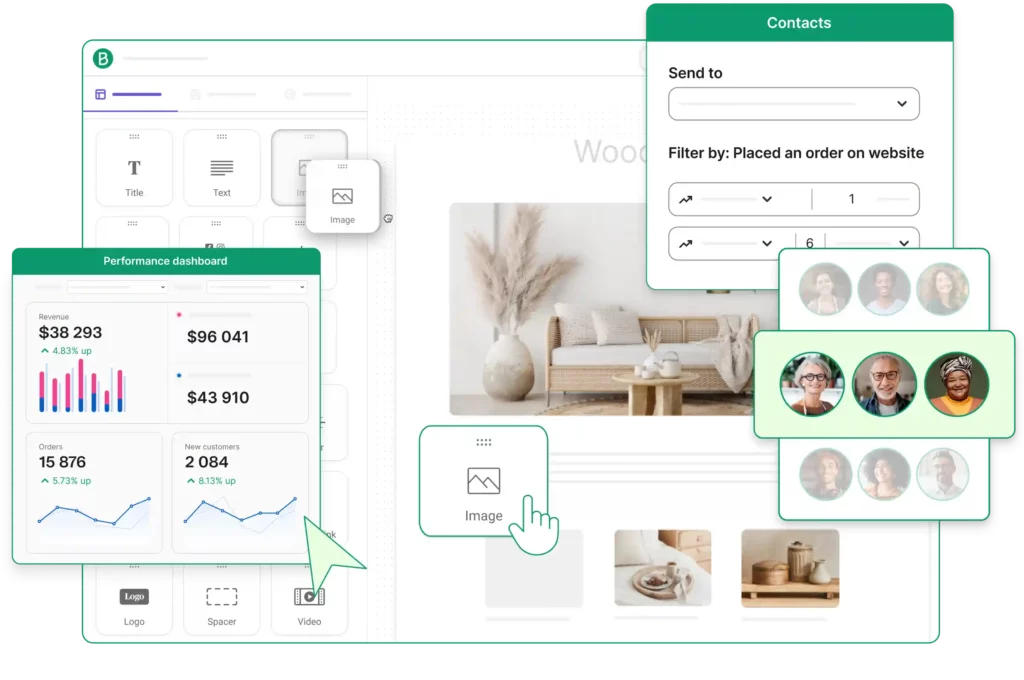
Brevo combines CRM, email, and SMS in one system, which matters for hotels because guest communication and guest data management are usually the same job, not two separate ones. Guest profiles hold preferences, stay history, and loyalty status, and that same data can trigger automated pre-arrival emails, post-stay review requests, and SMS alerts without connecting a separate marketing tool.
The free plan covers 300 emails a day and up to 100,000 contacts with no credit card required, useful for hotels with a large historical guest database but a smaller number of guests actively being marketed to each month, since Brevo prices by email volume rather than contacts stored.
Paid plans start at $9/month. Unlimited pipelines are included in the Sales Essentials add-on for $31/month. SMS runs on pay-as-you-go credits, useful for same-day operational messages (room ready, late checkout offers) that email is too slow for.
Best for: hotels, especially independent and small-group properties, that want guest data and guest communication in one affordable system without committing to a hospitality-specific platform's pricing or contract terms.
Honest limitation: Brevo doesn't integrate natively with as many PMS platforms as hospitality-specific tools like Revinate or Cloudbeds do, and it has no built-in reservation or folio data of its own. Guest data needs to be synced in from your PMS, typically via a general integration tool, rather than pulled automatically the way Revinate or Cloudbeds Guest Marketing do.
2. Revinate — Best for hospitality-specific guest data unification
Revinate is a CRM and guest data platform built specifically for hotels, connecting natively to more than 30 PMS platforms (Oracle, Agilysys, Amadeus, and others) to unify guest data across a hotel's reservation, POS, spa, and folio systems into a single guest profile. This depth of hospitality-specific integration is Revinate's core strength, and it's genuinely hard for a general-purpose CRM to match.
Pricing isn't published. Revinate Marketing sells in three tiers (Starter, Pro, Custom), quote-based and scaled to hotel size and guest database size, and the company spans mid-market to enterprise hotel groups rather than solo properties.
Best for: hotels and hotel groups with multiple connected systems (PMS, spa, POS) that want them unified into one guest view without building that integration themselves.
Honest limitation: no published pricing, and its core strength is email and guest-data unification rather than a broader multichannel product. It's a heavier commitment than a small independent property may need, and it's also the tool on this list with the smallest public review footprint (3 reviews on Trustpilot), making outside sentiment harder to verify than for the more widely reviewed tools here.
If you're a small hotel, check out our separate article on the best CRM software for small business.
3. Cloudbeds Guest Marketing — Best for hotels already on Cloudbeds PMS
Cloudbeds Guest Marketing is a CRM add-on to the Cloudbeds property management system, not a standalone product. It deduplicates guest profiles automatically, pulls stay history and lifetime spend directly from PMS reservation data, and lets hotels build segmented, automated campaigns (pre-arrival,cloudb post-stay, OTA guest win-back) without a separate data sync step, since the CRM and the reservation system already share the same data model.
Neither Cloudbeds PMS nor the Guest Marketing add-on publishes standard pricing. Base Cloudbeds PMS plans have been reported in the roughly $108 to $320+/month range depending on tier and property size, with Guest Marketing priced separately as an add-on. SMS and WhatsApp messaging live in a separate Cloudbeds module (Guest Experience), not in Guest Marketing itself.
Best for: hotels already running Cloudbeds as their PMS that want a CRM layered directly on top of existing reservation data, without a separate integration step.
Honest limitation: only available to Cloudbeds PMS customers, so it's not an option to evaluate independently of a broader PMS switch. Some recent customer feedback also points to slower support response times as a recurring theme, worth factoring in given how central guest communication is to this use case.
4. Pipedrive — Best for a simple, visual sales pipeline for group and event bookings
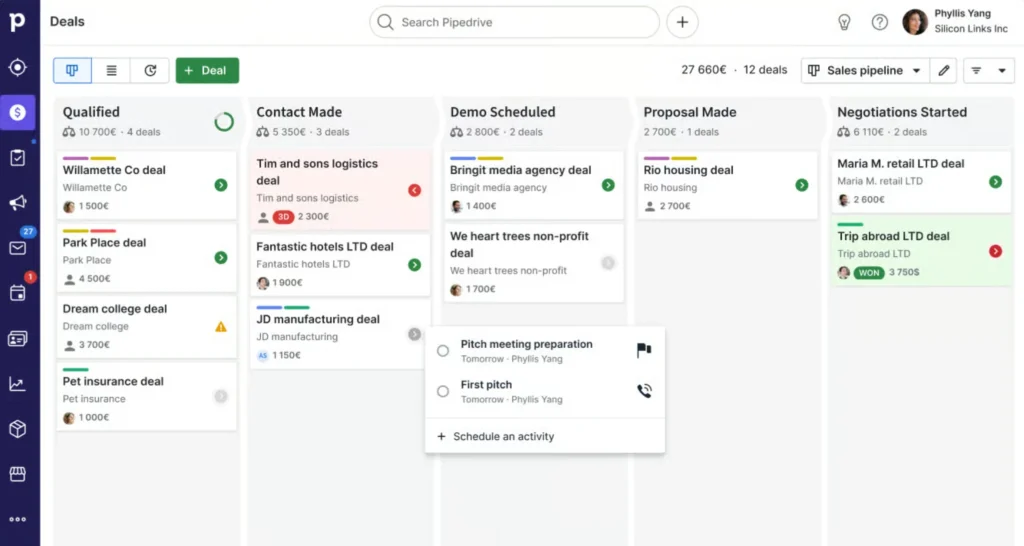
Pipedrive is a general sales CRM, not hospitality-specific, but its visual pipeline is a genuinely good fit for hotels managing group bookings, weddings, and event sales, which behave more like a traditional B2B sales process (inquiry, proposal, contract, deposit) than an individual guest reservation does. It doesn't include marketing automation or guest journey emails out of the box; that requires the separate Campaigns add-on, and there's no native SMS.
Pipedrive has no permanent free plan, only a 14-day trial. Paid plans run from $24/user/month (Lite, billed monthly) up to roughly $99/user/month for Ultimate, with add-ons like lead capture and email campaigns priced separately.
Best for: hotel sales teams handling group, wedding, and event bookings who want a clear visual pipeline for that sales process specifically, separate from day-to-day individual guest communication.
Honest limitation: it's not built for guest journey automation (pre-arrival, post-stay), and per-user pricing plus add-on costs can add up for a hotel sales team of any size.
Related: The best Pipedrive alternatives.
5. Zoho CRM — Best for larger hotel groups needing deep customization at low cost
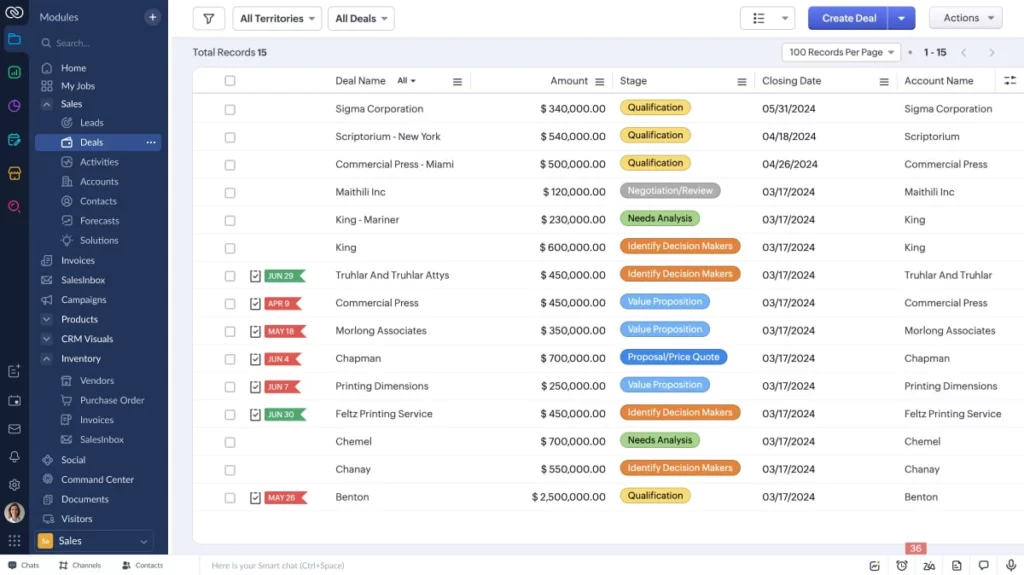
Zoho CRM is a general-purpose CRM with a genuinely low starting price relative to its feature depth, and it's been adopted by hospitality brands (Minor Hotels and travel platform Agoda are both cited Zoho customers) for managing sales processes across multi-property or B2B travel-partner relationships. Its free tier supports up to 3 users, and paid plans run from $20/user/month (Standard) up to $50/user/month (Enterprise), all billed annually. Marketing automation runs on workflow rules natively, with deeper automation available through the separate Zoho Marketing Automation product.
Best for: larger hotel groups or multi-property operators that want extensive customization (custom modules, workflows, reporting) and are willing to spend setup time to get there, in exchange for one of the lowest per-seat costs among full-featured CRMs.
Honest limitation: the customization that makes Zoho powerful also makes it the most complex tool on this list to configure well, and full marketing automation isn't native to the core CRM, it lives in a companion product.
Do you want to know how Zoho compares to other CRMs? Read more in our article about the best Zoho alternatives.
6. HubSpot — Best for hotel groups already using the HubSpot ecosystem
HubSpot's free CRM is genuinely capable, unlimited users, up to a million contacts, and it's the name most likely to come up if a hotel's sales or marketing team has used it before at another company. The appeal is a single platform spanning marketing, sales, and service with one shared customer record, useful for multi-property groups running both B2B (travel partners, event sales) and guest marketing through the same team.
HubSpot becomes significantly more expensive once you move beyond the free CRM. While the free plan is generous, full marketing automation requires Marketing Hub Professional, which starts at $890/month for 3 seats, a substantial jump compared with most tools in this comparison, and Professional and Enterprise tiers carry mandatory one-time onboarding fees on top of that.
Best for: larger hotel groups or multi-property operators already relying on the broader HubSpot ecosystem elsewhere in the business, where unifying hotel guest data into the same system justifies the additional cost.
Honest limitation: it's generally best suited to organizations that already use HubSpot and can justify the cost jump past the free tier, rather than hotels evaluating a CRM from scratch. Customer reviews are mixed, with some praising the breadth of features and unified data model, and others reporting frustration with pricing complexity, contract terms, and onboarding costs.
Related: Discover the 10 best CRM software in 2026.
How to choose a CRM for your hotel
A few questions worth working through before booking a demo:
Do you need PMS-native integration, or is a general CRM enough?
If your PMS already offers a CRM add-on (like Cloudbeds Guest Marketing) and you're happy with that PMS long-term, the native option removes an integration step. If you might switch PMS providers, or already run a PMS without its own CRM, a standalone tool like Brevo, Revinate, or a general CRM avoids being locked into that ecosystem.
Is your bigger gap guest communication or sales pipeline?
Guest journey emails, loyalty communication, and review requests are a different problem than tracking a group booking or wedding inquiry through a sales process. Some tools (Brevo, Revinate, Cloudbeds Guest Marketing) are built around the former; others (Pipedrive, Zoho, HubSpot) are built around the latter and treat marketing as an add-on or a separate paid tier.
What's your actual guest database size versus how many you actively market to?
Hotels often carry years of past guest contacts but only email a fraction of them monthly. A platform priced by contacts stored costs more for that pattern than one priced by email volume sent.
How many properties are you managing, and does your team already use a broader marketing/sales platform elsewhere in the business?
A single independent hotel has different needs than a multi-property group. Multi-property operators generally need a CRM that can segment and report across properties, and if the wider organization already runs on a platform like HubSpot or Zoho, that existing investment is worth weighing against the cost of adding a separate, hospitality-specific tool.
Read more: How to choose CRM software for your business.
Getting started
If your hotel already has a PMS handling reservations and you mainly need guest data and communication in one place without hospitality-specific enterprise pricing, setting up a basic guest profile system in Brevo, synced from your PMS, covers most of the value described above.
Explore Brevo's sales features and its customizable deal pipelines for group and event bookings, or see Brevo's pricing plans for full plan details.
The free plan supports up to 100,000 contacts and 300 emails a day with no credit card required, enough to test the workflow before committing further.