
Email marketing helps dropshipping businesses build trust by reducing shipping anxiety and maintaining consistent communication.
Because customers buy from your store, not your supplier, the quality of communication often determines whether they buy again. However, dropshipping presents unique challenges that require a different approach to retention.
This guide explores what dropshipping email marketing is, common mistakes to avoid, and the campaigns, automations, and metrics that matter most.
Read on to learn how to build an email strategy that supports long-term growth for your dropshipping store.
- What is dropshipping email marketing?
- How does dropshipping marketing work?
- Why is email marketing important for dropshipping businesses?
- Unique email marketing challenges dropshippers face
- Common dropshipping email marketing mistakes
- Building an email list for your dropshipping store
- Email marketing automations for dropshipping stores
- Email marketing metrics dropshipping stores should track
- How to choose an email marketing platform for your dropshipping store
- Ready to grow your dropshipping business with email marketing?
What is dropshipping email marketing?
Dropshipping email marketing uses email campaigns and automated workflows to acquire and retain customers. It helps stores build trust with first-time buyers, recover abandoned carts, keep customers informed about orders, and drive repeat purchases.
While many email marketing best practices apply to all e-commerce businesses, dropshippers face unique challenges, including longer shipping times, lower initial brand trust, and one-time purchase behavior.
Email marketing plays a critical role in addressing these challenges throughout the customer journey.
How does dropshipping marketing work?
Unlike traditional e-commerce, dropshipping allows you to sell products without purchasing inventory upfront.
When a customer places an order on your store website, the order is forwarded to a supplier, who packages and ships the product directly to the customer. This chain allows merchants to focus on marketing, customer acquisition, and retention rather than inventory management.
There are several ways to run a dropshipping business:
- Some merchants use Shopify Collective to sell products from other Shopify brands.
- Others rely on third-party dropshipping apps such as DSers, Zendrop, AutoDS, and Spocket to source products and automate fulfillment.
- More established businesses may choose to work directly with manufacturers, wholesalers, or private suppliers for greater control over pricing and product quality.
Regardless of which fulfillment model you choose, customers buy from your store and not your supplier. That means you are responsible for setting expectations and creating a positive customer experience.
This is where email marketing becomes particularly important.
Why is email marketing important for dropshipping businesses?
Email marketing helps dropshipping stores recover lost sales, reduce reliance on paid ads, build trust, and improve long-term profitability:
Recover revenue from abandoned carts
Email marketing gives merchants a direct way to communicate with customers, so when a customer abandons their cart, you can bring them back with your emails.
In dropshipping, customers may need more reassurance before purchasing from an unfamiliar store, or they might choose a more established marketplace even if the product is the same. Your abandoned cart recovery automation helps build trust.
Reduce dependence on paid ads
Many dropshipping businesses rely heavily on paid advertising to acquire customers. While ads can drive growth, they also make revenue more expensive and less predictable, especially for stores that rely on Meta, Google, or social media ads.
Email gives you an owned channel, allowing you to continue engaging customers without paying for every click or visit.
Build trust and stronger customer relationships
Most customers discover dropshipping stores through ads and may have concerns about product quality and delivery times.
Email marketing helps address these concerns by allowing you to share customer testimonials and FAQs, establish shipping timelines, and engage in a two-way conversation with customers to clarify any questions.
Improve long-term profitability
Because margins are often tight for dropshipping stores, sustainable growth depends on getting more revenue from existing customers.
Email marketing supports retention by allowing you to target existing customers with personalized experiences after their first purchase.
This makes growth more efficient over time.
Unique email marketing challenges dropshippers face
While many email marketing best practices apply to all e-commerce businesses, dropshipping introduces a unique set of challenges.
Longer delivery times, lower brand recognition, and reliance on third-party suppliers can make customer retention more difficult. Understanding these challenges is the first step toward building an effective email strategy.
Longer shipping times can create customer anxiety
Most dropshipping businesses do not manufacture or stock products themselves. Instead, orders are fulfilled by third-party suppliers, who may be located overseas.
This means that products may pass through multiple stages before reaching the customer and require more logistics than traditional e-commerce businesses.
Since dropshipping stores rely on external suppliers and international shipping, delivery timelines can be longer and less predictable. Ben Metcalfe, founder of Blackfire Marketing, recommends a simple rule:
"Whenever a new phase of the delivery process is met, an automated email should go out. It helps keep people calm and informed."
Without regular communication, customers may assume something has gone wrong, leading to frustration and avoidable support requests.
Customers don’t trust unfamiliar stores
Unlike brands that have spent years building recognition or used multiple marketing channels due to large budgets, dropshipping stores are relatively new and have limited funds.
Customers may be encountering the store for the first time and have little information to judge product quality, shipping reliability, and return policies, so their overall trust level is low. Metcalfe also identifies the following as a culprit for low trust:
"The issue dropshipping stores find themselves in is that they're not building a brand or a community and simply selling products via generic templates that don't look branded."
Customers need reassurance throughout the buying journey that they are dealing with a legitimate business.
Thin margins make constant discounting unsustainable
Many dropshipping stores rely heavily on paid advertising to acquire customers and have limited control over manufacturing costs. After accounting for product costs, shipping fees, customer acquisition fees, and other logistics-related costs, there may be little to no room for flash sales.
Competing on brand presence is harder
Many dropshippers sell products that are also available elsewhere. Without strong brand recognition or exclusive products, building loyalty becomes more difficult.
Email helps stores differentiate themselves through education in the form of FAQs, UGC, reviews, tutorials, and more product education so that the customer, when offered the same product on multiple dropshipping websites, chooses your store.
Inventory availability can change quickly
Because suppliers manage inventory, stock levels can change unexpectedly. Products that are available one day may become unavailable the next, creating friction in the customer experience.
Customer support volume is often higher
Longer fulfillment timelines and limited visibility into order status can increase customer inquiries. Questions about shipping delays, returns, and delivery estimates can quickly overwhelm small teams.
Turning one-time buyers into repeat customers is harder
Many dropshipping businesses spend significant resources acquiring first-time customers, but those customers may have little incentive to return if the products are readily available elsewhere or are purchased infrequently.
Without strong brand loyalty or ongoing engagement, turning one-time buyers into repeat customers becomes more difficult.
Common dropshipping email marketing mistakes
The challenges above are inherent to the dropshipping model. However, many stores make the problem worse by treating email primarily as a promotional channel instead of a relationship-building tool.
When setting up email marketing for your dropshipping store, avoid the following:
Treating every subscriber the same
Not every subscriber is at the same stage of the customer journey. The messaging should differ accordingly. Kriszta Grenyo, the COO of Suff Digital, a digital marketing agency, explains:
"A returning customer should not be in the same email sequence as a customer who has abandoned their cart. A little personalization can go a long way."
Sending the same message to everyone can lead to lower engagement and missed opportunities to create more relevant experiences.
Going silent after the purchase
Many dropshipping stores focus heavily on acquiring customers but neglect communication after checkout. Grenyo points out a reframe that dropshipping stores should adopt:
"The sale shouldn't end when checkout does, that's simply where the relationship begins. One retention strategy I've seen work time and time again is through building a community through email and social media."
Customers who do not hear from a brand after purchasing are less likely to become repeat buyers.
Using discounts as the only retention strategy
Many stores rely on promotions to drive repeat purchases. Dropshipping stores are tempted to offer discounts to grow revenue, as Grenyo observes:
"One mistake I see Shopify dropshipping stores make is using email as a discount machine rather than a trust machine."
But often, dropshipping stores resort to discounting due to a lack of trust, as Rachid Wehbi, founder and CEO of Sell The Trend, an AI + e-commerce platform for dropshipping businesses, explains:
“Unlike dropshipping stores, traditional eCommerce stores have stronger brand equity. This allows stores to build brand loyalty by utilizing email campaigns to educate and inform customers about product stories. Most dropshipping stores skip the loyalty-building step and prefer the “20% off” email approach.”
Overusing discounts can train customers to wait for the next sale rather than build genuine loyalty.
Setting vague product shipping expectations
Trying to hide long delivery windows often creates more problems than it solves. Grenyo suggests the following solution:
"One of the easiest ways I've seen our successful dropshipping clients build trust is by being transparent with the customer. Overcommunicating is never a bad thing when discussing shipping times and returns. Customer service can make or break small businesses with little to no recognition."
Customers are generally more accepting of delays when expectations are communicated clearly.
Failing to build trust through email
Trust is one of the biggest differentiators for dropshipping stores. Metcalfe uses this rule for trust-building:
"The formula is typically KLT (Know, Like, Trust). By providing different social proof cues, you can build trust and attention that will eventually translate into sales. This is typically done by being informative and helpful rather than sending spam and sales-related content."
But what does trust entail? Wehbi puts it simply:
"Trust emails for dropshipping stores should answer the questions customers are already asking: Who is this store? Can I trust the quality of this product? What is the expected delivery time? Is this product returnable?"
Wehbi further expands, “Email campaigns that communicate product benefits, include helpful customer testimonials, establish clear shipping guidelines and expectations, and share product selection rationales, provide guarantees, and include FAQs, are all effective trust emails.”
Brands that use email to educate and reassure are more likely to earn repeat business.
Buying email lists instead of building one
Purchased lists often lead to poor engagement, deliverability issues, and spam complaints.
Building an engaged email list organically may take longer, but it creates a healthier foundation for long-term growth.
Building an email list for your dropshipping store
Unlike fulfillment or inventory management, email list cleaning and building do not change much when you are running a dropshipping business.
The same fundamentals apply:
Attract visitors → Give them a reason to subscribe → Create opportunities to stay in touch
Since many shoppers compare products across multiple stores before buying, capturing an email address allows you to continue the conversation long after they leave your site, whether or not they make a purchase.
Here are four ways to build an email list:
Use lead magnets to encourage signups
A lead magnet is something visitors receive in exchange for joining your email list. This could be a checklist, tutorial, or any other useful digital product.
Many stores give a first-order discount, like in the case of Best Choice Products:
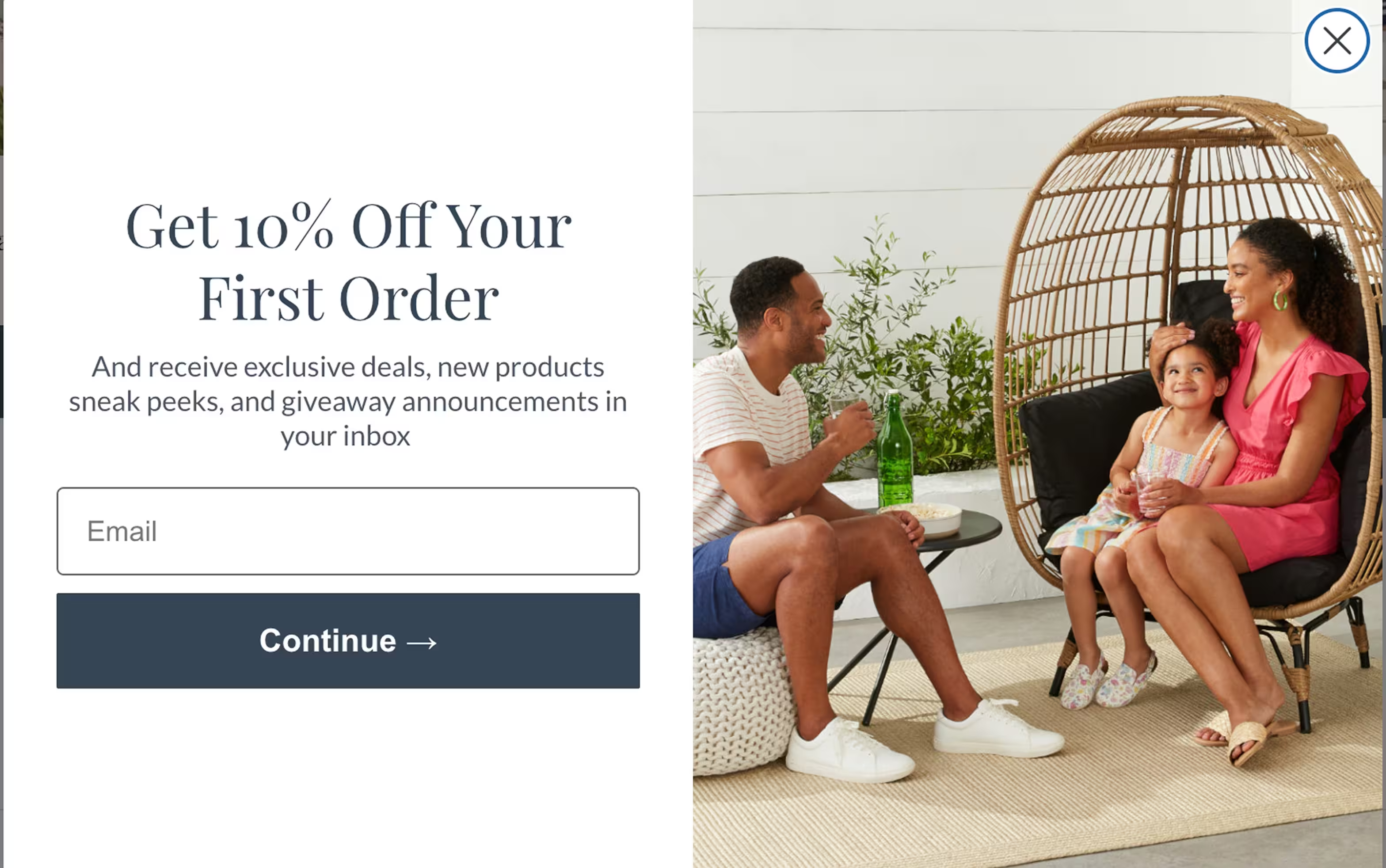
Depending on your niche, it could also be a buying guide, product recommendations, a quiz, or early access to new launches.
The goal is not simply to grow your subscriber count, as that will leave you with a long list of inactive contacts. The actual goal is to capture interested shoppers before they leave and give yourself another opportunity to convert them later.
Add lead generation forms throughout your store website
Popups, embedded forms, sticky bars, and exit-intent forms create multiple opportunities for visitors to subscribe. Here is an example by Notebook Therapy of a pop-up box that asks visitors for their email addresses in exchange for entry in a contest:
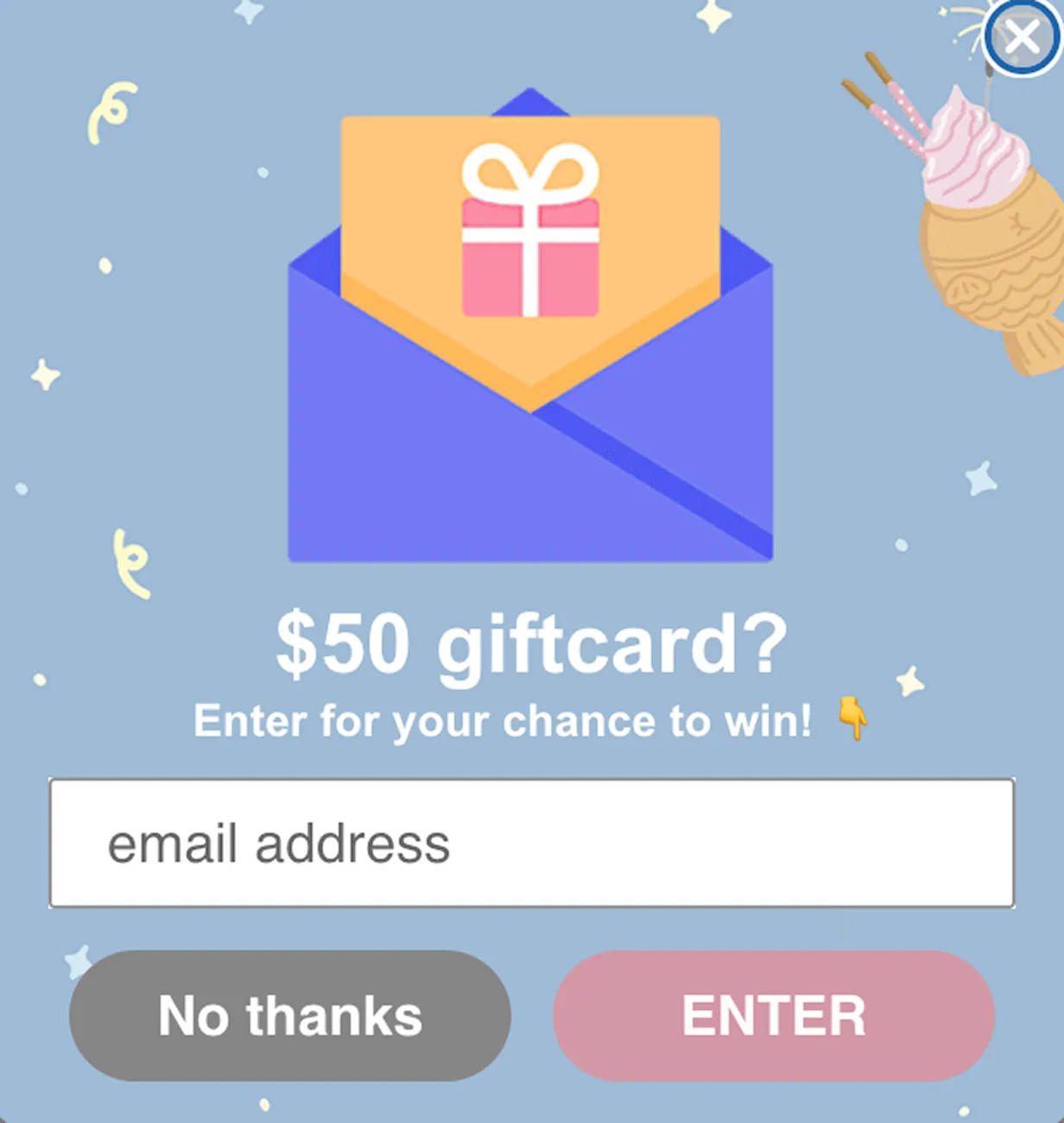
Sprinkle them across high-visibility portions of your website to capture attention (and email addresses!).
Convert social media traffic into subscribers
Many dropshipping stores rely heavily on platforms like Instagram, TikTok, Facebook, Pinterest, and paid ads to drive traffic.
Not every visitor who clicks through is ready to make a purchase. Send social media traffic to landing pages, quizzes, giveaways, or newsletter signup forms.
You will then turn social media visitors into subscribers you can nurture over time.
Capture email addresses at checkout
Checkout is often the easiest place to collect subscriber information because customers are already engaged and completing a purchase. Beyond order updates, marketing opt-ins allow you to continue building the relationship after the first purchase.
This is what you see on Sage & Sill’s checkout page:
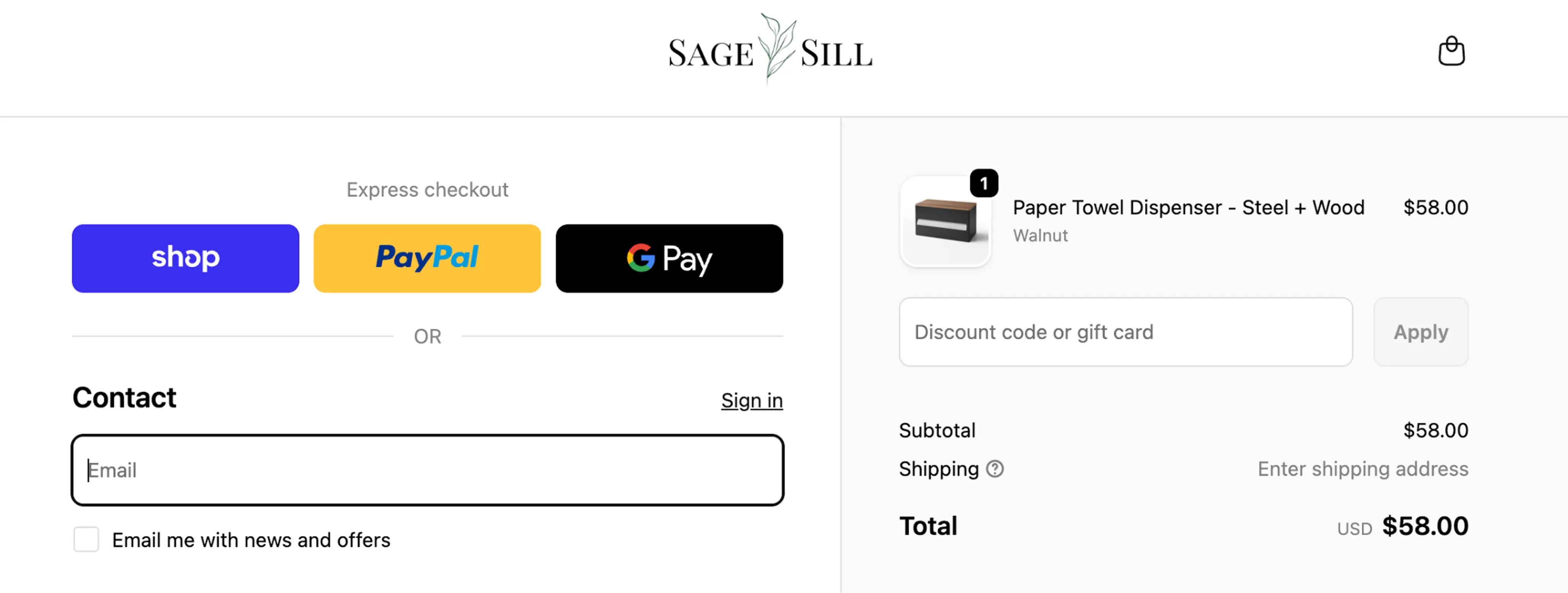
When placing the order, the first field the customer needs to fill in is the email address. The “email me with news and offers” option is right under it, so the customer can actively opt in to receiving marketing communications.
Once your store grows, here are other methods of growing your email list:
- Using referral rewards to encourage signups
- Offering exclusive content through member-only community signups
- Including signup forms in blog content
- Including QR codes on delivery packages that lead to email signup
Email marketing automations for dropshipping stores
Since we have established that email marketing for dropshipping stores means bridging communication gaps between your dropshipping store and customers, the next question is: which emails are most effective at increasing your store’s revenue?
While the exact workflows depend on your products and audience, most dropshipping stores benefit from the following email marketing automations:
| EMAIL AUTOMATIONS FOR DROPSHIPPING STORES | TRIGGER | GOAL |
|---|---|---|
| Welcome series | A visitor subscribes to your email list | Introduce your brand or founders to build trust from the outset and set expectations |
| Abandoned cart recovery | A shopper adds a product to their cart but does not complete checkout | Recover lost revenue |
| Order confirmation | A customer completes a purchase | Reassure customers and confirm order details |
| Shipping updates | Changes in order status or fulfillment milestones (order has been packed, order has been shipped, order is out for delivery, and so on) | Reduce customer anxiety |
| Post-purchase emails | The order has been delivered. | Help the customer make the most out of your product with product education, tutorials, UGC content, and tips |
| Review request emails | The order has been delivered, and a certain time has passed by, during which the customer must have tried the product and may want to share their experience | Collect reviews and build trust for social proof |
| Back-in-stock emails | An out-of-stock product becomes available again | Recover demand and notify interested shoppers |
| Win-back campaign | A customer has not purchased from you in 90 days or more. | Re-engage inactive customers and encourage repeat purchases |
| Cross-sell/Upsell product recommendations | A customer purchases a product that has complementary products | Recommend related products to increase average order value |
Although these email automations are common across e-commerce, the following three automations are particularly important for dropshipping businesses:
- Welcome emails
- Shipping updates
- Post-purchase communication
With a welcome email, you share your story with your customers or provide more background about your store the moment they sign up, helping them form a good first impression.
Keeping customers informed throughout the fulfillment process reduces uncertainty associated with dropshipping, and post-purchase education improves customer experience.
Together, they can offset the main challenges dropshipping stores face.
Email marketing metrics dropshipping stores should track
Tracking email performance helps you understand what is working and where customers are dropping off.
While engagement metrics such as open rates (which indicate whether subscribers find your email subject lines clickworthy and whether your sender reputation is healthy) and click-through rates (which track customer engagement) are useful, dropshipping stores should pay particular attention to metrics that reflect retention:
- Conversion rate: Shows how many subscribers complete a purchase after clicking on an email
- Revenue per recipient: Helps quantify revenue across campaigns
- Cart recovery rate: Measures the effectiveness of abandoned cart emails
- Repeat purchase rate: Indicates how well your retention efforts are working
- Unsubscribe rate: Can signal irrelevant content or a harmful send frequency
- Delivery rate: The percentage of sent emails accepted by the receiving mailbox provider. A delivered email may still be placed in spam or junk.
- Inbox placement rate: The percentage of emails that reach the inbox rather than the spam or junk folder. This generally requires separate inbox-placement data or testing.
Tracking these email marketing metrics regularly helps you understand what is working, so you can make informed decisions about your email strategy, rather than following an email calendar that adds noise rather than value to your subscribers’ inboxes.
How to choose an email marketing platform for your dropshipping store
The success of your dropshipping email marketing strategy depends as much on the platform you choose as the campaigns you send.
Your email software should do more than run promotional campaigns.
It should help you recover abandoned carts of unsure shoppers, build trust among new customers, and encourage repeat purchases, all without requiring constant manual effort.
When evaluating email marketing platforms, look for:
- Customer segmentation capabilities
- Automated customer journeys
- Transactional and post-purchase communication tools
- Multi-channel capabilities such as email, web push notifications, and SMS
- Pricing that scales with your subscriber list
If you are using Shopify Collective, DSers, Zendrop, AutoDS, or another dropshipping solution, remember that these tools help you source and fulfill products.
You will still need a dedicated marketing platform to automate customer communication and build long-term customer relationships.
Brevo brings email marketing, automation, customer segmentation, transactional emails, and reporting together in a single platform, making it easier to manage the customer experience as your store grows.
The right choice depends less on how you source products and more on the type of customer experience you want to create. A platform that meets your needs today should also support your retention strategy as your business grows.
Ready to grow your dropshipping business with email marketing?
Email marketing can help dropshipping stores do more than send promotions. With the right email strategies, you can create better customer experiences.
With Brevo, you can build and segment your email list and create automated customer journeys. Once sales start coming in, you can send transactional and post-purchase emails to help with customer retention.
Our ready-made email templates and automation workflows will shrink the execution timeline, and the analytics dashboard will help you track and scale your email marketing as your dropshipping store grows.
Looking for an email marketing platform that helps build a sustainable dropshipping business? Start with Brevo for free!


