
Last updated: May 20, 2026
Amazon SES is, on paper, the cheapest way to send email at scale: $0.10 per 1,000 emails. If you're running high-volume infrastructure on AWS and have a backend team to manage it, it's genuinely hard to beat on cost.
But most teams evaluating Amazon SES alternatives aren't leaving because of price. They're leaving, or never starting, because SES is infrastructure, not a product. There's no user-friendly interface worth using, no marketing tools, no meaningful customer support, and a setup process that can block your first production send for days. The engineering overhead frequently costs more than the savings.
This guide covers the best Amazon SES alternatives in 2026, with honest comparisons by use case—whether you need something simpler, more powerful, or both.
Table of contents
Why teams look for Amazon SES alternatives
SES's limitations are well-documented among developers who've run it in production.
The sandbox problem
Every new SES account starts in sandbox mode: 200 emails/day, verified recipient addresses only. To reach production, you submit a manual request to AWS that can be rejected with minimal explanation. Approval can take hours or days, which is a real problem for teams with a launch deadline.
Suspension risk
SES will automatically suspend your email sending if your bounce rate exceeds 5% or your spam complaint rate exceeds 0.1%. No warning, no grace period. Getting reinstated requires a manual review that can take days. For any production application, this is a significant operational risk that none of the SES alternatives covered here share.
The true cost of SES
The $0.10/1,000 headline rate doesn't survive contact with a real setup. To run it properly, you often need:
- Virtual Deliverability Manager: +$0.07/1,000 (recommended for any serious sender)
- Dedicated IP (standard): +$24.95/month per IP
- Data transfer: +$0.12/GB outbound
- SNS notifications: Additional fees for bounce and spam handling
- AWS technical support: $29–$100/month minimum
True all-in costs typically run 40% to 70% above the headline rate, and that's before accounting for engineering time.
No product features
SES has no email templates, no drag-and-drop editor, no marketing automation, no CRM, and no SMS. Everything is your team's responsibility to build and maintain. For SaaS companies sending millions of system notifications with a dedicated infrastructure team already on AWS, SES makes sense. For most others, the Amazon SES alternatives below offer a better total deal.
If you're specifically running SES through Sendy and want to compare hosted options, see our guide to Sendy alternatives.
The best Amazon SES alternatives in 2026
1. Brevo: Best all-in-one SES alternative
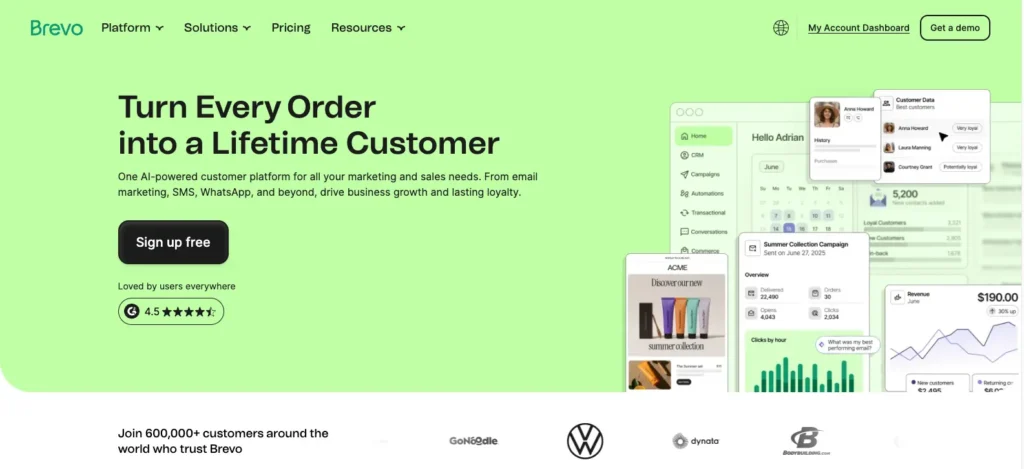
Best for: Teams who want reliable email delivery without SES's setup complexity, especially those who also need marketing automation, CRM, or SMS.
Brevo is the most complete AWS SES alternative for teams whose requirements extend beyond raw email infrastructure. Unlike Amazon SES, which is a primitive you build on top of, Brevo is a finished product—a comprehensive marketing platform with a full email API, SMTP relay, marketing tools, and actual customer support.
Setup vs SES Getting to your first production send on SES typically involves sandbox approval, bounce handling via SNS, and manual DKIM/SPF management. Most teams spend several days here. With Brevo, you authenticate your domain, and you're ready to send. The process takes under 30 minutes, with no sandbox approval required.
Technical capabilities:
- REST API & SMTP relay: Fast integration with 8 official SDKs (Python, Node.js, PHP, etc.).
- Automatic handling: Bounce and spam complaint handling is automatic—no need to wire up SNS webhooks.
- High throughput: Max throughput of 120,000 emails/minute.
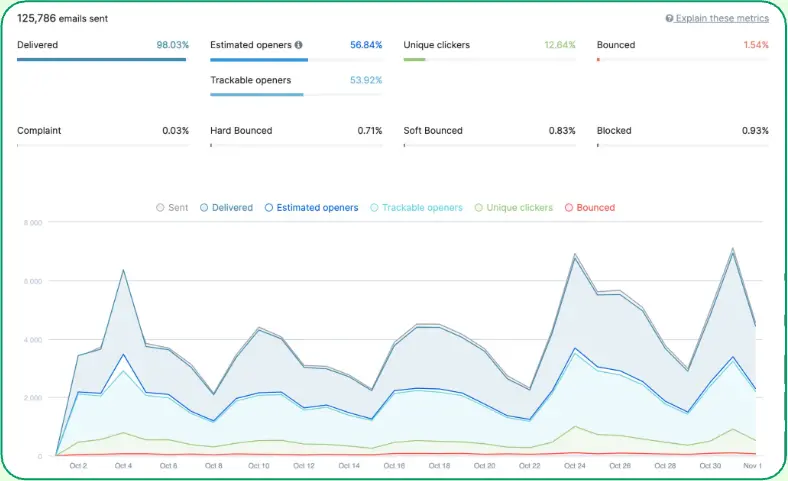
- Deliverability: 99%+ email deliverability rate with built-in sender reputation monitoring.
2. Postmark: Best for maximum deliverability
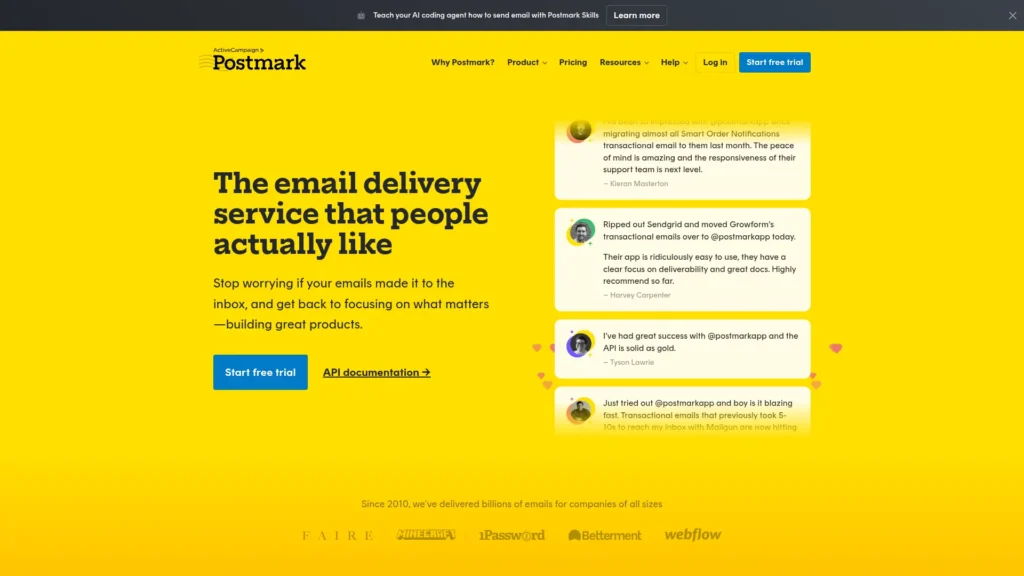
Best for: Teams where inbox placement is the overriding priority and who are willing to pay a premium for the industry's best transactional email deliverability.
Postmark is the opposite of SES: premium-priced, opinionated, and built for one purpose—getting transactional emails to the inbox.
- Free tier: 100 emails/month (testing only).
- Paid plans: Start at $15/month for 10,000 emails.
- Deliverability: Consistently ranks as best-in-class for inbox placement.
- Tradeoff: At high volume, Postmark becomes expensive fast (500K emails/month costs roughly $650 vs SES's $50 base rate).
3. Resend: Best for developer experience

Best for: Developers building modern applications who want a clean email API and React-native email templates without any sandbox friction.
Resend is the developer-favorite Amazon SES alternative. It’s designed for the way modern teams work, featuring React Email templates in JSX and an API that is a joy to use.
- Free plan: 3,000 emails/month with production access from day one.
- DX focus: Write responsive templates in JSX; no SNS infrastructure to build.
- Tradeoff: No marketing campaigns or CRM; it is purely a transactional service.
Building an app with Lovable or Cursor? See the best transactional email API options for AI-built apps.
4. SendGrid: Best for enterprise scale
Best for: Mid-size to enterprise companies that need a battle-tested service for both transactional and marketing campaigns at massive scale.
Owned by Twilio, SendGrid is a robust AWS SES alternative for teams that need a comprehensive marketing platform with a strong infrastructure backbone.
- Free plan: 100 emails/day.
- Pro: $89.95/month with dedicated IPs and priority support.
- Verdict: It removes the operational burden of SES but has grown significantly in complexity over the years.
5. Mailgun: Best for inbound email & advanced APIs
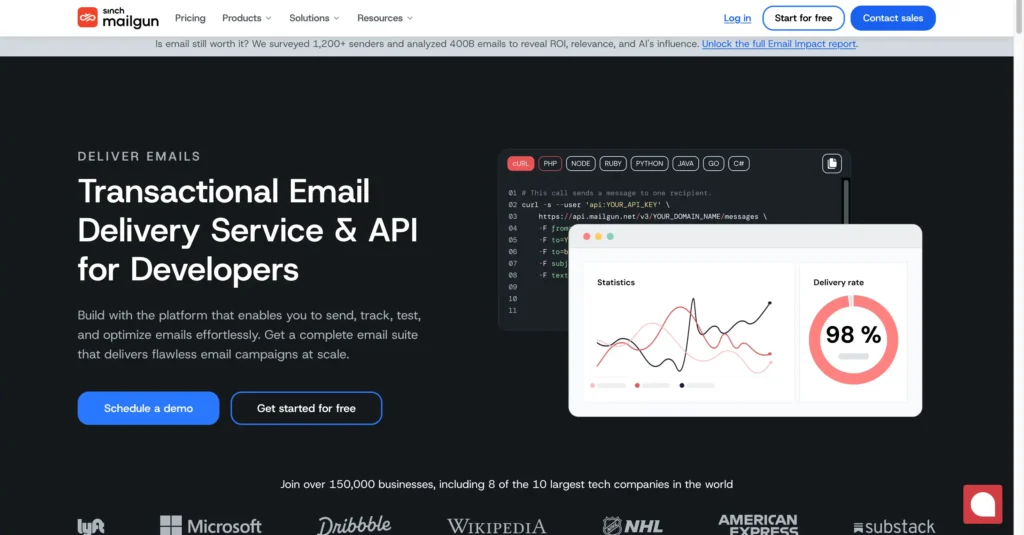
Best for: Developers who need powerful inbound email processing for support ticket systems and two-way email workflows.
Mailgun offers most of SES's API flexibility with far less operational overhead. It is particularly strong at inbound routing, which SES does not offer natively.
- Paid plans: Start at $15/month for 10,000 emails.
- Key feature: Best-in-class inbound email routing and parsing via webhooks.
6. SMTP2GO: Best for simplicity
Best for: Small businesses and non-technical users who need reliable delivery with zero infrastructure management.
SMTP2GO is a managed service known for its user-friendly interface and genuinely responsive customer support—a stark contrast to the AWS support experience.
- Free plan: 1,000 emails/month.
- Highlight: Real-time reporting and built-in spam testing before you send.
7. Mailchimp Transactional (ex Mandrill)
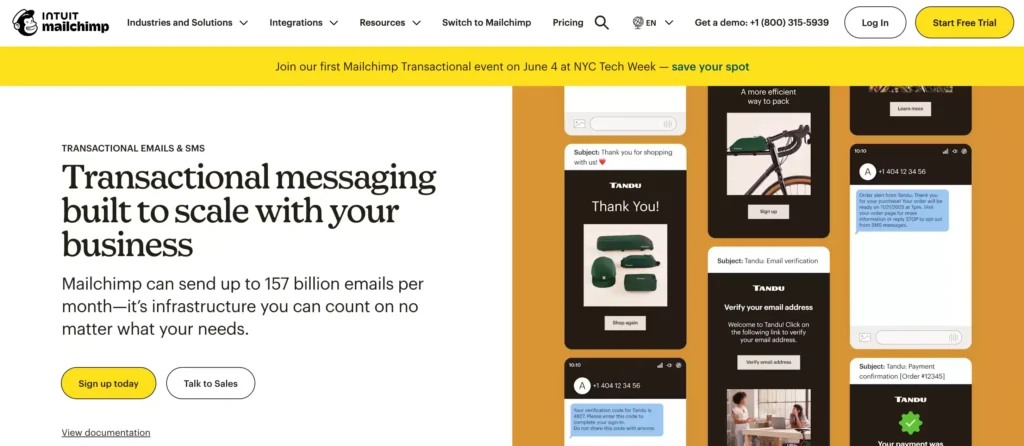
Best for: Existing Mailchimp users who want to keep their transactional data in the same ecosystem.
Mailchimp Transactional (rebranded from Mandrill in 2025) is Mailchimp's transactional email service. It covers the basics well: reliable API and SMTP relay, webhook support, detailed delivery analytics, and template management.
The catch is the pricing structure. It is not included in any Mailchimp marketing plan. It is a separate add-on, billed at $20 per block of 25,000 emails per month, and only available on Standard and Premium tiers. That means you are effectively paying twice: once for marketing, once for transactional.
For teams already deep in the Mailchimp ecosystem, the unified dashboard may justify the extra cost. For everyone else, cheaper and more flexible alternatives exist.
Honest cost comparison at real sending volumes
The $0.10/1,000 SES rate is misleading. Here is how costs compare at realistic volumes, with SES calculated as base rate + Virtual Deliverability Manager + one dedicated IP + minimum AWS support.
| Provider | 50K emails/mo | 250K emails/mo | 1M emails/mo |
|---|---|---|---|
| Amazon SES (realistic) | ~$45-55/mo | ~$85-110/mo | ~$175-240/mo |
| Brevo | ~$25/mo | ~$65/mo | ~$299/mo |
| Resend | $20/mo | ~$150/mo | ~$500/mo |
| SendGrid | $19.95/mo | ~$90/mo | Custom |
| Postmark | ~$50/mo | ~$250/mo | ~$650/mo |
| Mailgun | ~$35/mo | ~$100/mo | Custom |
Migrating from Amazon SES to Brevo
Moving off SES is considerably simpler than setting it up.
- SMTP Relay: Point your application at
smtp-relay.brevo.comon port 587. It’s a direct credential swap if you were using SES via SMTP. - REST API: Brevo’s
/smtp/emailendpoint accepts a similar payload structure to SES’sSendEmailAPI. - Authentication: Brevo configures SPF and DKIM automatically once you add the DNS records. No manual MAIL FROM or CloudWatch setup is required.
- Suppression Management: Brevo processes bounces and spam complaints automatically. This removes the most significant operational burden of SES.
Final Word
Amazon SES is real infrastructure for teams with real infrastructure expertise. At scale, the cost advantage is genuine. But for most growing businesses, the better Amazon SES alternative is a managed service that handles deliverability, bounces, and support for you.
Brevo's free plan covers 9,000 emails/month with full API access and no sandbox restrictions.Start sending for free today.