
Most companies now treat a customer data platform (CDP) as essential infrastructure. Yet only 22% of marketers report high utilization of their CDP's capabilities, according to Gartner's 2025 Magic Quadrant for Customer Data Platforms. The tool gets bought. The value often gets left on the table.
That gap usually starts at the buying stage. Teams pick a CDP that doesn't match their size, skills, or existing stack.
This guide compares ten of the best customer data platforms on the market. You'll see what each does well, who it suits, and how to narrow your options before committing budget or engineering time.
The information in this article was last updated on Juli 24, 2026.
Table of Contents
At a glance: Comparing the best customer data platforms
| CDP | Best for | Standout feature | Pricing | G2 rating |
|---|---|---|---|---|
| Brevo | Growing businesses, ecommerce | Built-in email, SMS, WhatsApp, chat activation | Custom quote | 4.6 |
| Twilio Segment | Technical, custom stacks | 550+ pre-built connectors, API-first | Free tier; paid from $120/mo | 4.5 |
| Salesforce Data 360 | Enterprises on Salesforce CRM | Native CRM sync, Einstein AI | From ~$60,000/year | 4.3 |
| Bloomreach | Ecommerce, retail | AI product recommendations & search | Custom quote | 4.6 |
| Tealium AudienceStream | Complex, multi-source enterprises | Real-time identity resolution, strong compliance | Custom quote | 4.4 |
| Adobe Real-Time CDP | Adobe Experience Cloud users | Deep Adobe suite integration | Custom quote | 4.1 |
| ActionIQ | Enterprise data governance | Composable decisioning layer | Custom quote | 4.1 |
| mParticle | Product-led, B2B companies | Mobile & product-data unification | Custom quote | 4.4 |
| RudderStack | Warehouse-native data teams | Activates data without duplicating it | Free tier; paid from $265/mo | 4.7 |
| Maestra | Ecommerce, DTC brands | All-in-one CDP + loyalty + site personalization | From $1,300/month | 4.7 |
What is a customer data platform (CDP)?
A CDP, or customer data platform, pulls customer data from every channel — web, app, email, CRM, point of sale — to create unified customer profiles. It then makes those profiles available across your marketing and sales tools in real time.
That's the core difference from a plain database: a CDP doesn't just store the data, it activates it. Segments update automatically, campaigns trigger off real behavior, and every channel works from the same customer view instead of its own silo.
Read more: What is a customer data platform?
CDP vs. CRM vs. DMP
All three tools work with customer data, but they solve different problems.
- A CRM (customer relationship management system) tracks customer relationships — deals, contacts, and support interactions.
- A DMP (data management platform) collects third-party, often anonymous data to power ad targeting.
- A CDP sits apart from both: it unifies known, first-party data into one profile you can activate across every channel.
Most companies end up using a CDP alongside a CRM, not instead of it — the CDP feeds the CRM (and every other tool) a single, consistent view of the customer.
For a full breakdown of the differences, see our dedicated article CRM vs CDP.
What to look for in a CDP
Not every customer data platform solves the same problem. Before comparing vendors, get clear on what your team actually needs.
Embedded vs. standalone CDPs
Customer data platforms come in two basic shapes.
An embedded CDP lives inside a broader marketing platform — the same tool that sends your campaigns also unifies your data. Brevo works this way: no separate integration layer, no extra vendor to manage. It suits teams that want data unification and activation in one place.
A standalone CDP is a dedicated tool that sits alongside your existing stack. It connects to your CRM, your email platform, and everything else via APIs and connectors. This gives more flexibility to mix and match best-in-class tools, but it also means more integration work and more vendors to maintain.
Neither is objectively better. It depends on how much of your stack you want one vendor to own.
Other criteria to weigh
- Data unification and identity resolution. How well does the platform merge duplicate profiles across devices and channels?
- Activation channels. Can you act on the data directly, or does every action require exporting to another tool?
- Integrations and APIs. Does it connect natively to the tools you already use, or will your team need custom development for key integrations?
- AI and personalization. Does the platform surface predictive analytics — like churn risk or next-best-action recommendations — or just store the data?
- Data security and compliance. Does the platform support GDPR, CCPA, and consent management out of the box, or does that require extra configuration?
- Ease of setup. Can your marketing team run it, or does every change need engineering support?
- Pricing accessibility. Are costs published, or does everything require a custom quote and a sales call?
Good to know
David Raab, who coined the term "CDP" in 2013, says many factors matter when choosing a CDP — but his research points to one clear priority: integration capabilities, followed by features and usability. Read more in our interview with David Raab.
Our methodology at Brevo: How we tested
This article covers the best customer data platforms including our own platform, Brevo. Our suggestions are based on our own research and testing. We don't earn commissions from any links on this page. To learn exactly how we evaluate tools, check out our dedicated methodology article.
Please note that the features listed here are just a selection of what each CDP software offers. For exact pricing and a full, up-to-date feature list, check the providers' websites.
Comparison of the 10 best CDPs
Each platform below is evaluated on the same criteria: features, pros, cons, and pricing transparency. Here's where each one stands out.
Brevo — Best CDP for growing businesses and ecommerce brands
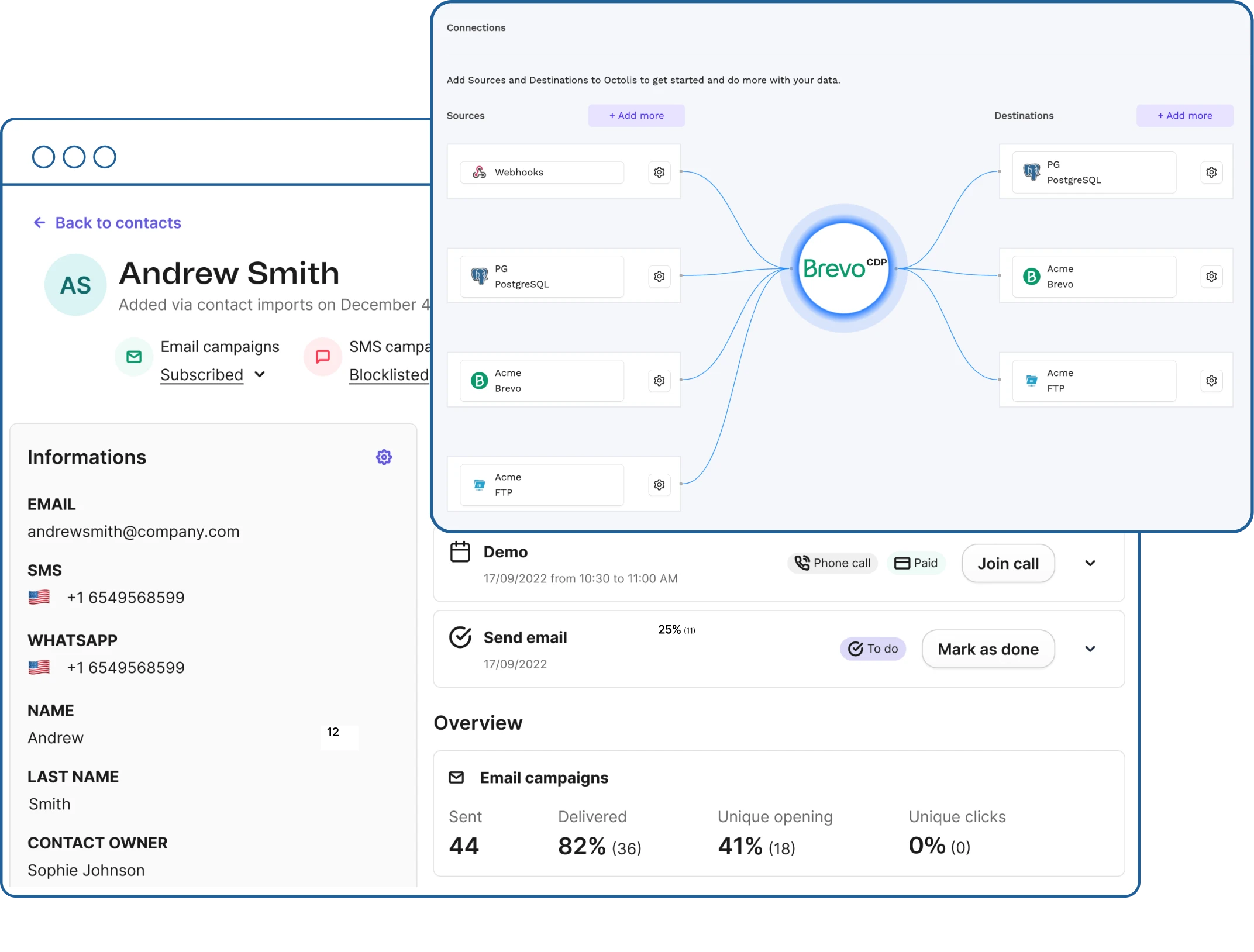
Brevo's customer data platform is built into its broader marketing platform, so unifying customer data and activating it across channels happen in the same place. It suits growing businesses and ecommerce brands that want one platform instead of stitching a CDP into a separate marketing stack.
Key features
- Unifies data from your website, POS, and CRM into one customer profile
- Built-in scoring models (RFM, customer lifetime value, purchase cycles) ready to use out of the box
- Native activation across email, SMS, WhatsApp, and live chat — no separate integration needed
- AI-assisted content generation and send-time optimization
- 300+ native connectors for ecommerce, CRM, POS, and BI tools
Pros
- No separate vendor or integration layer to manage — data and activation live in one platform
- Fast to set up for marketing teams without dedicated data engineers
- Scales from SMB to larger multichannel teams without switching tools
Cons
- Some advanced configurations (multi-dimensional segmentation, complex dashboards) have a learning curve
- CDP features are only available on Enterprise plans, with select options on Professional
Price
Custom quote, based on data volume, profiles, and connectors — available on Enterprise plans, with some features on Professional.
Related: How Brevo CDP's smart segments enhance email marketing conversion.
Twilio Segment — Best for technical teams building a custom data stack
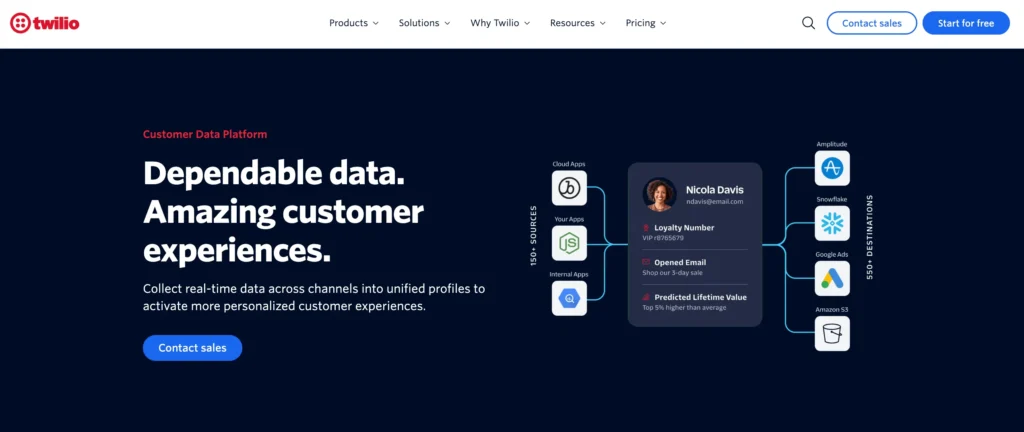
Twilio Segment takes an API-first approach: your engineering team wires it into your existing tools rather than working inside one all-in-one platform. It's built for companies that want to own their data architecture and connect it to 550+ pre-built destinations.
Key features
- API-first data collection across web, mobile, servers, and connected devices
- 550+ pre-built destinations for marketing, analytics, and advertising tools
- Reverse ETL and warehouse connectors (Snowflake, BigQuery, Redshift)
- Real-time event collection and identity resolution
- Add-on modules (Unify, Engage) for deeper profile unification and journey orchestration
Pros
- Highly flexible for teams that want to build a custom-fit data stack
- Large, mature integration ecosystem covers most common marketing and analytics tools
- Scales from early-stage startups (free tier) to large enterprises
Cons
- Requires engineering resources to get real value — not built for marketing teams to run solo
- Native activation is thinner than platforms built around campaigns; most activation happens through connected tools, not Segment itself
- Costs can climb quickly once you're past the free tier and adding modules like Unify or Engage
Price
Free for up to 1,000 monthly tracked users (MTUs). Team plan starts at $120/month for up to 10,000 MTUs. Business/Enterprise plans are custom-quoted.
Still looking for the right CRM? Our article on the best CRM software helps you decide.
Salesforce Data 360 — Best CDP for enterprises already running on Salesforce CRM
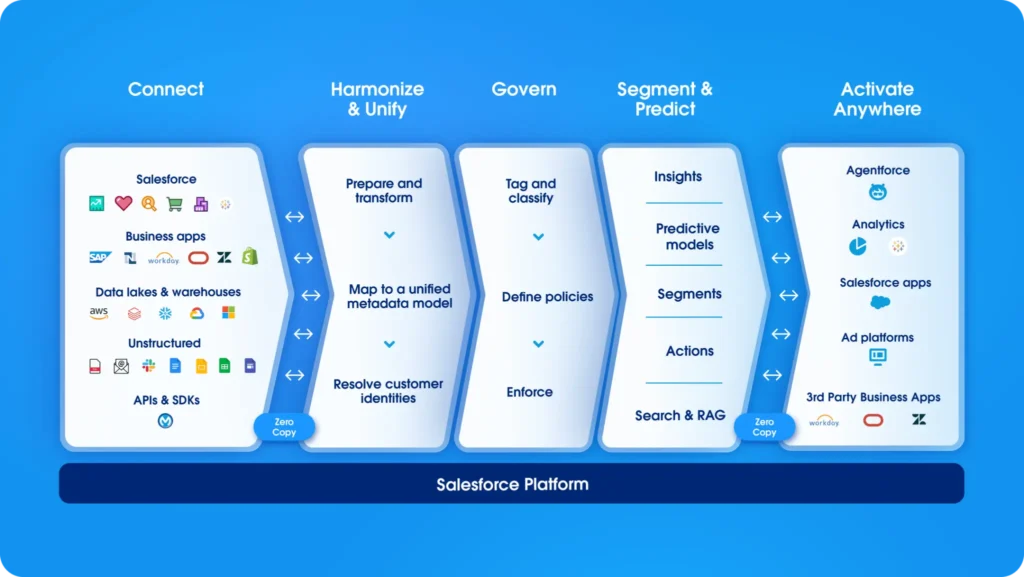
Salesforce Data 360 (formerly Data Cloud) is built to unify data at enterprise scale and feed it directly into Salesforce's CRM, Marketing Cloud, and Einstein AI tools. It's the natural fit for large organizations already standardized on Salesforce, less so for anyone starting from scratch.
Key features
- Zero-copy integration with data warehouses like Snowflake and Databricks — no duplicating data
- Native, deep integration with Salesforce CRM and Marketing Cloud
- Identity resolution using exact and fuzzy matching rules
- Einstein AI for predictive scoring and campaign recommendations
- GDPR-focused governance: consent management, access controls, data masking
Pros
- Best-in-class fit for teams already living in the Salesforce ecosystem
- Deep AI capabilities baked into the same platform as your CRM
- Flexible, usage-based pricing model that scales with actual consumption
Cons
- Steep cost relative to data volume, especially for smaller teams
- Requires technical resources to manage credits, storage, and deployment
- Much of the value depends on being deep in the Salesforce ecosystem already — less compelling if you use a different CRM
Price
Consumption-based — Data Service Credits priced at $500 per 100,000 credits, plus storage at $23/TB per month. An entry-level Data 360 Starter package is available from $60,000/year.
Related: 9 out-of-the-box Salesforce alternatives.
Bloomreach — Best CDP for ecommerce and retail brands focused on product discovery
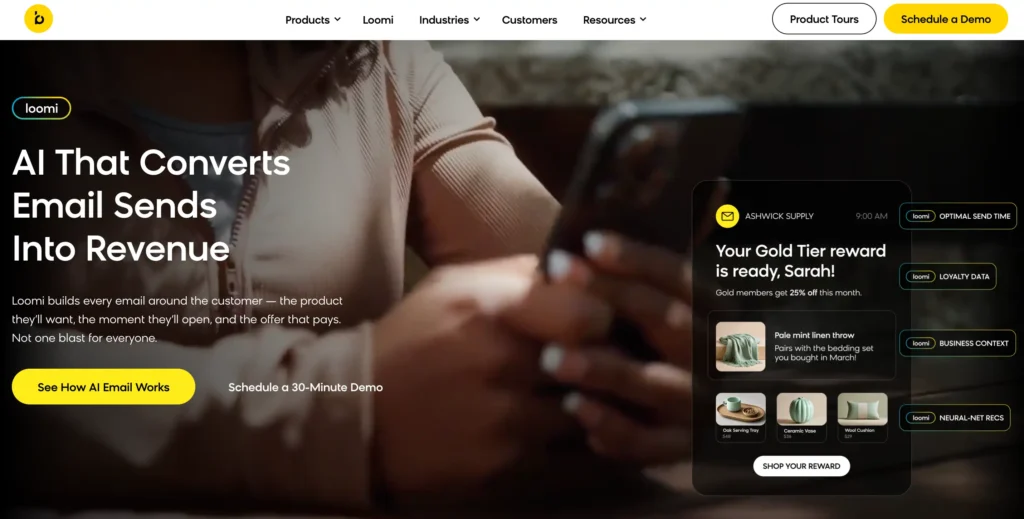
Bloomreach Engagement combines CDP capabilities with marketing automation and product discovery tools, built specifically for ecommerce and retail use cases. It suits brands that want customer data and product/search personalization working together rather than as separate systems.
Key features
- Unifies online and offline customer data into a single profile
- AI-powered product recommendations and search (via Loomi AI)
- Drag-and-drop journey builder for omnichannel campaigns across 13+ channels
- Real-time triggers, segments, and conditions for automated flows
- Customizable, real-time reporting and dashboards
Pros
- Strong fit for ecommerce brands that want data unification and product personalization in one platform
- Flexible module structure — can run as a standalone CDP or add marketing automation layers
- Proven at enterprise scale, with large retail and CPG customers
Cons
- Pricing is entirely custom and sales-led — no published self-serve tiers, which makes upfront budgeting harder
- Reviewers note that some of Bloomreach's features have a steep learning curve
- Implementation and professional services costs add meaningfully to the platform fee
Price
Custom quote only — Bloomreach doesn't publish self-serve pricing; all tiers route through a sales conversation.
Related: 11 best ecommerce CRMs compared.
Tealium AudienceStream — Best CDP for large enterprises with complex, multi-source data
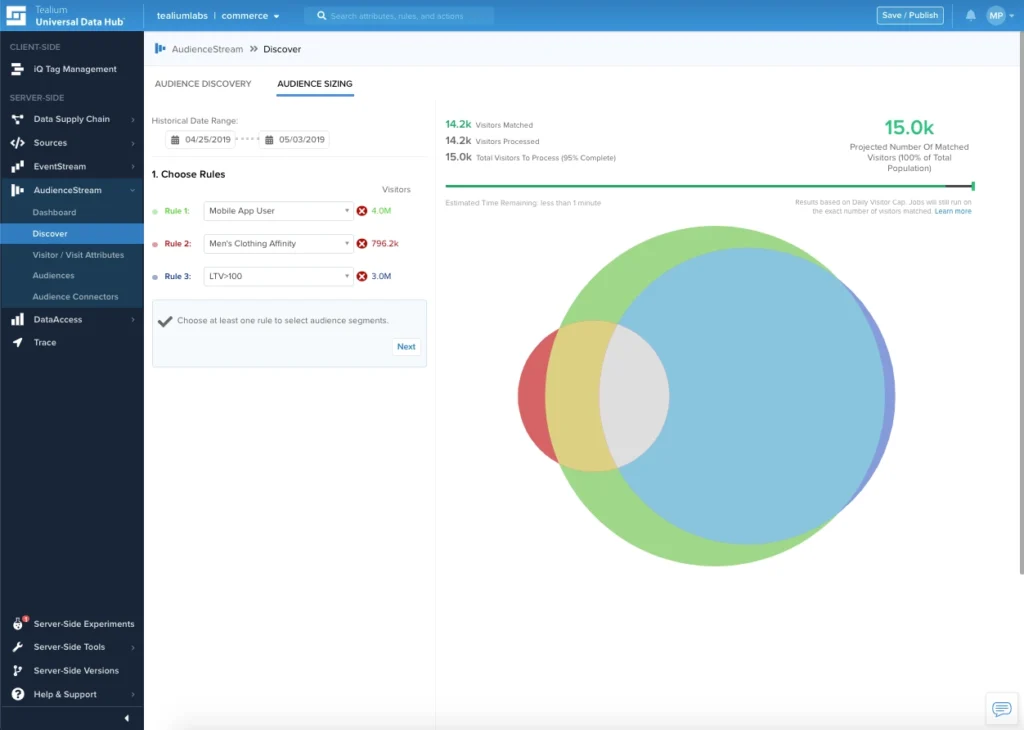
Tealium AudienceStream CDP is built around real-time identity resolution across a large number of data sources, with strong governance and compliance built in. It suits large enterprises managing complex data environments and strict regulatory requirements more than smaller teams looking for a quick setup.
Key features
- Patented visitor stitching for accurate, real-time customer profiles
- Event-based data collection and orchestration (via the connected EventStream product)
- Integrations across email, marketing automation, advertising, social, and CRM platforms
- Machine-learning add-ons (Predict ML) for predictive audience scoring
- Compliance capabilities including HIPAA support and private cloud deployment options
Pros
- Strong real-time identity resolution across a wide range of sources
- Purpose-built for regulated industries and complex data governance needs
- Modular add-ons (Predict ML, Data Connect, AIStream) let you extend capabilities over time
Cons
- Pricing is metered strictly on event volume, so costs scale quickly and with little flexibility as usage grows
- No published self-serve pricing — every plan routes through a sales conversation
- New premium modules are priced and negotiated separately, which can make total cost harder to predict upfront
Price
Custom quote, metered by event volume — Tealium doesn't publish self-serve pricing, and full Customer Data Hub deployments (EventStream + AudienceStream) reportedly run well into six figures annually at scale.
Adobe Real-Time CDP — Best CDP for enterprises already invested in Adobe Experience Cloud
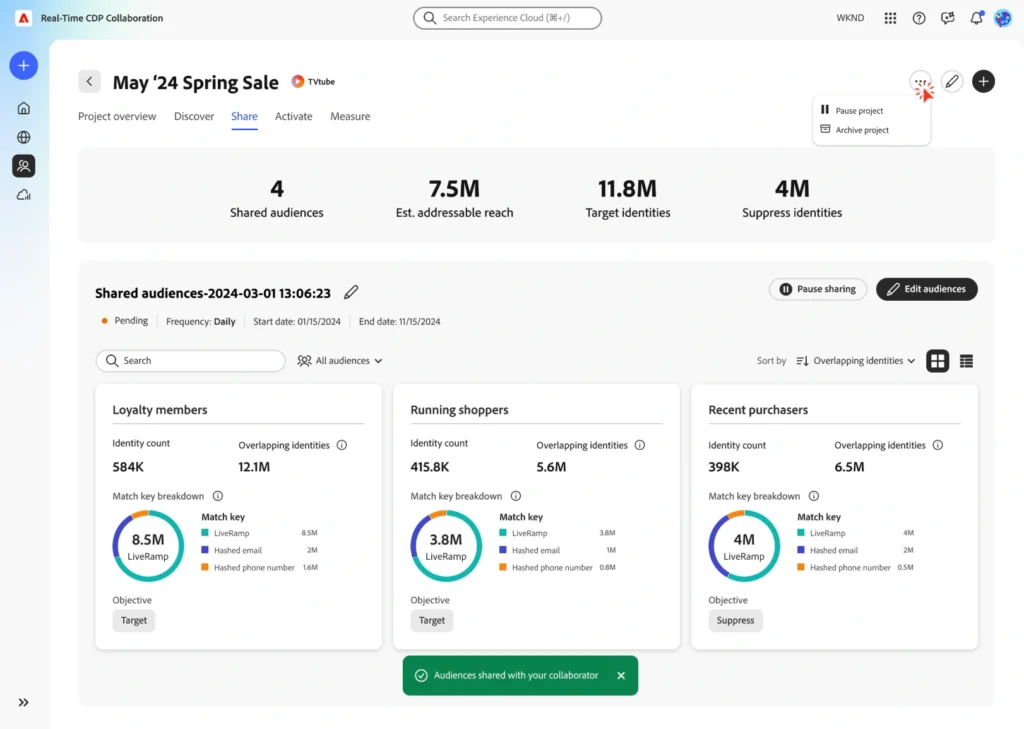
Adobe Real-Time CDP is built on Adobe Experience Platform and designed to unify B2B and B2C customer profiles in real time for activation across Adobe's own marketing tools and external destinations. It's not a standalone product — it's part of the broader Adobe Experience Platform, so it fits best for organizations already using Adobe Journey Optimizer or Customer Journey Analytics.
Key features
- Unifies known and pseudonymous data from online and offline sources into real-time profiles
- Separate B2C, B2B, and combined B2B2C editions depending on your business model
- Real-time audience segmentation and AI-powered insights via Adobe AI
- Deep integration with the wider Adobe Experience Cloud (Journey Optimizer, Customer Journey Analytics)
- Enterprise-grade data governance and privacy controls
Pros
- Best-in-class fit for teams already running on Adobe Experience Cloud
- Handles both B2C and B2B use cases through dedicated editions
- Strong AI-driven segmentation and personalization
Cons
Price
Custom quote, priced by number of profiles managed across B2C, B2B, or combined editions. Adobe doesn't publish self-serve pricing.
ActionIQ — Best CDP for enterprise teams needing centralized data governance across many stakeholders
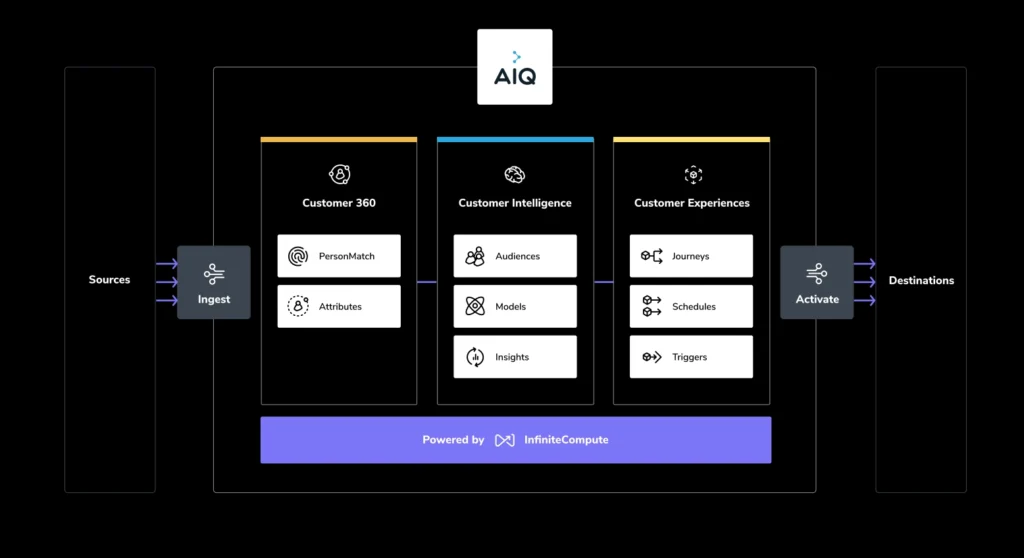
ActionIQ (acquired by Uniphore in 2024) is a composable CDP built for large enterprises managing complex, multi-brand data environments. It's designed around data governance and access control rather than being the simplest or fastest CDP to set up.
Key features
- Composable architecture — data stays in place in your existing warehouse rather than being duplicated into ActionIQ
- Identity resolution combining known and anonymous customer data
- Self-service audience building designed for non-technical marketers
- Role-based access controls, audit trails, and governance policies for enterprise compliance
- Native AI capabilities added following the 2024 Uniphore acquisition
Pros
- Strong fit for large organizations with complex governance and multi-brand requirements
- No-code audience building despite the platform's enterprise-scale complexity
- Composable model avoids duplicating data that already lives in your warehouse
Cons
- Requires some knowledge of SQL, making it less intuitive than simpler drag-and-drop platforms
- Reporting and analytics capabilities are seen by some G2 reviewers as less robust than alternatives
Price
Custom quote — no self-serve or published pricing available.
mParticle — Best CDP for product-led and B2B companies unifying app and product usage data
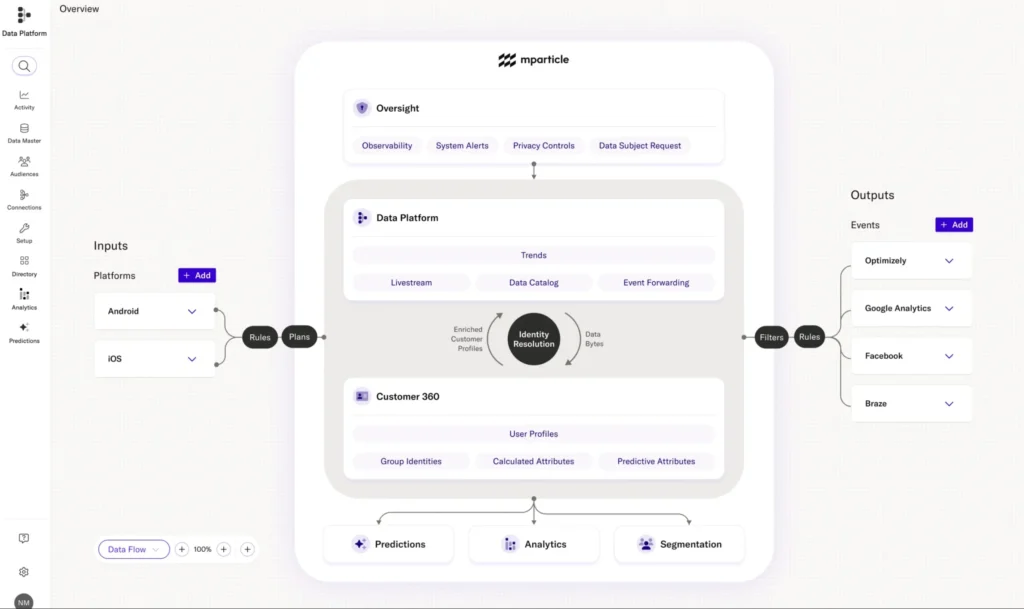
mParticle (acquired by Rokt in January 2025) is a CDP built around real-time event streaming and identity resolution across apps, websites, and server-side sources. It suits companies with strong engineering resources that need to unify complex product usage data, more than teams looking for a simple, marketer-run tool.
Key features
- IDSync identity resolution across devices, apps, and channels
- Data Planning tools that catch tracking/data-quality errors at collection time
- Audiences module for segmentation and activation
- Cortex AI/ML-powered predictions for audience targeting
- Broad integration library connecting to marketing, analytics, and data warehouse tools
Pros
- Real-time event streaming architecture, well-suited for time-sensitive, mobile-first data collection
- Built for unifying complex product usage data
Cons
- A steep learning curve — reviewers describe so many layered features, integrations, and complex rules that it becomes difficult for mid-sized or smaller brands to use effective (G2)
- Success with the platform depends heavily on having a clear strategy and technically skilled staff to run it well
Price
Custom quote — no published pricing available.
Rudderstack — Best CDP for warehouse-native data teams
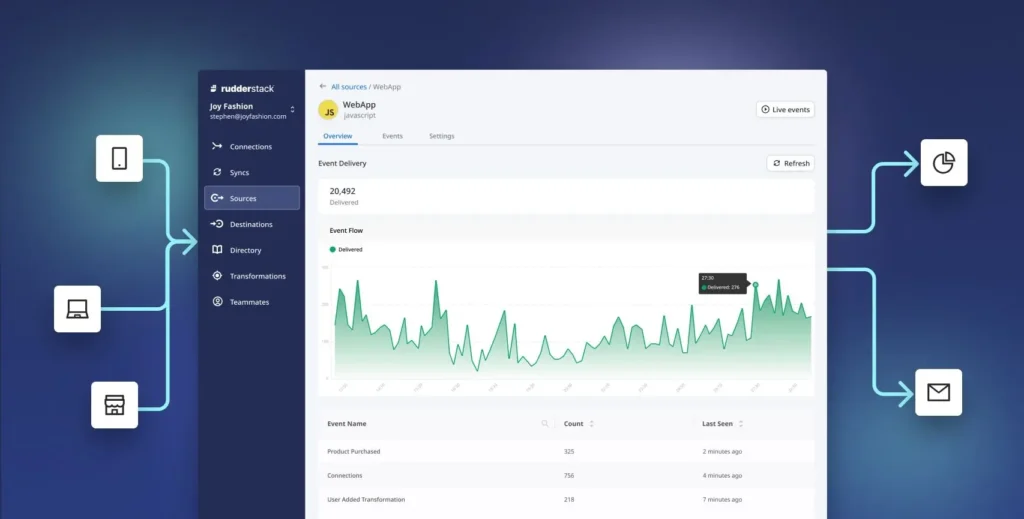
Rudderstack is an open-source, warehouse-native CDP: your customer data stays in your own data warehouse (Snowflake, BigQuery, Redshift) rather than being duplicated into a separate system. It suits data engineering teams that want full control over their data pipelines.
Key features
- Warehouse-native architecture — activates data directly from your existing warehouse instead of copying it
- Event streaming, ETL, and reverse ETL pipelines in one platform
- Both cloud-hosted and self-hosted (open-source) deployment options
- 200+ cloud destinations and 16+ SDK sources
- Segment API compatibility, making migration from Twilio Segment straightforward without re-instrumenting tracking code
Pros
- Security-conscious teams can self-host and audit exactly how their data is processed
- G2 reviewers praise strong customer support and an intuitive interface
- Generally lower cost than most CDP tools on this list, especially for teams already invested in a cloud data warehouse
Cons
- Not built for marketing teams to run independently — getting real value typically requires ongoing data engineering support
- Smaller integration catalog than Segment's, which may matter for teams needing niche or less common destinations
Price
Free tier includes 250,000 events/month. Growth plan starts at $265/month for 1 million events/month. Enterprise plans are custom-quoted based on volume.
Maestra — Best for ecommerce brands that want a CDP with activation built in
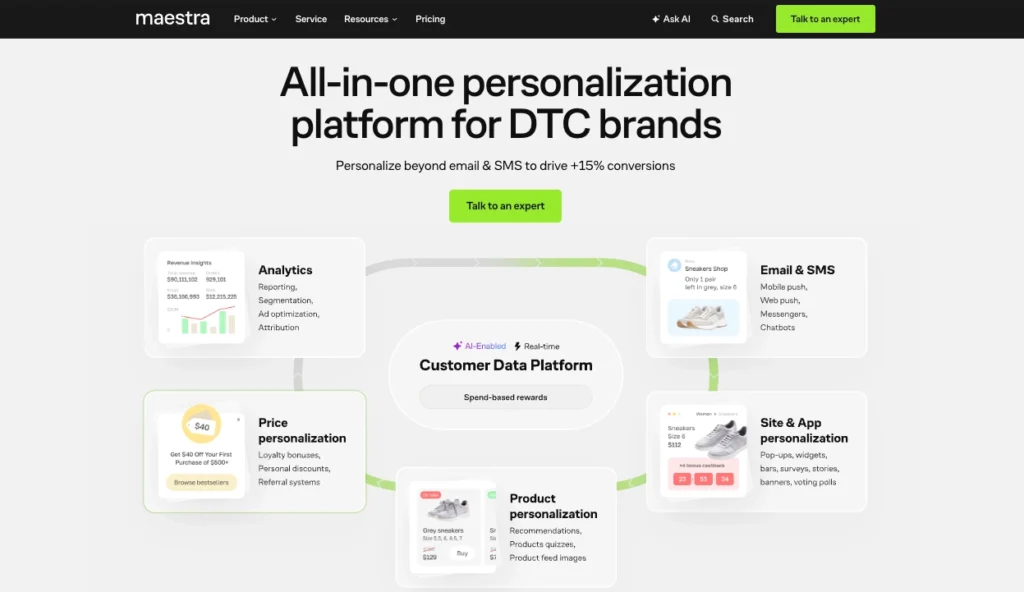
Maestra is a customer data platform built for DTC. It unifies site, app, purchase, and messaging behavior into a single profile that updates in real time. Activation lives in the same system. Omnichannel communications, on-site personalization, AI recommendations, and loyalty programs act on the profile directly. A segment fires in campaigns the moment it updates, without pushing lists to a separate marketing tool.
Maestra suits mid-market and enterprise brands that want customer data and marketing consolidated in one platform. Every account comes with a dedicated forward-deployed marketer who migrates your data, wires up integrations, and designs your segments and flows, then runs ongoing optimization with you through a shared Slack channel and weekly meetings.
Key features
- AI-enabled, real-time platform with identity resolution
- Segmentation with RFM, computed fields, nested segments, and custom attributes
- Built-in activation: email, SMS, push, site personalization, recommendations, loyalty
- Full-funnel analytics with configurable attribution
- 150+ integrations, custom ones built for free
- SOC 2 Type II, ISO 27001, GDPR, CCPA, and HIPAA compliant
- Scales from 30K to 65M customer records, processing up to 2M requests per minute
- A forward-deployed marketer at no extra cost (shared Slack channel, weekly Zoom calls)
Pros
- Data and activation in one system. No syncing or tech tickets
- Hands-on service that's standard, not enterprise-only. A dedicated specialist does the heavy lifting on every plan
Cons
- No free plan or trial
- Activation-first, not a neutral pipe that routes raw data to dozens of separate tools
Price
The CDP starts at $1,300/month, with the first 100K active profiles and hands-on service included. Storing profiles is free, you pay only for active ones. Billing is month-to-month with no lock-in, and starts only after the Maestra team completes your full migration.
If you're comparing broader engagement tools rather than pure data platforms, see our guide to the best customer engagement platforms.
How to choose the right CDP for your business
The right customer data platform depends less on features and more on who's going to run it, and what your data infrastructure already looks like.
SMBs, start-ups, and ecommerce brands usually do best with an embedded CDP like Brevo, where data unification and activation live in the same platform. You get value fast without hiring a dedicated data team, and you avoid stitching together a separate CDP, email tool, and CRM.
Mid-market teams with some technical resources have more room to choose based on specific needs — Bloomreach or Maestra if product discovery, personalization, and ecommerce execution are the priority (Maestra especially if you also want loyalty and site personalization bundled in), or a warehouse-native option like Rudderstack if a data or engineering team already owns the stack.
Large enterprises with complex, multi-brand, or highly regulated data environments tend to need the governance depth of Tealium AudienceStream, ActionIQ, or Salesforce Data Cloud (especially if already running Salesforce CRM) or Adobe Real-Time CDP (if already in Adobe Experience Cloud).
Technical, API-first teams building a custom data stack are the classic fit for Twilio Segment or mParticle — both give engineering teams full control over data architecture, at the cost of needing that engineering resource to get real value out of the platform.
If you're not sure which category you fall into, the simplest test is this: do you have a dedicated data engineering team who'll own the CDP day to day, or does it need to be run by marketers? That answer alone rules out more than half the list.
Good to know
David Raab, who coined the term "CDP" in 2013, says many factors matter when choosing a CDP — but his research points to one clear priority: integration capabilities, followed by features and usability. Read more in our interview with David Raab.
In sum: The top CDPs for every business
When choosing a customer data platform, you'll want to consider the following features:
- Data unification and identity resolution
- Activation channels across email, SMS, and other touchpoints
- Integrations and APIs with your existing tools
- Data security and compliance (GDPR, CCPA)
Some of the top CDPs include:
- Brevo: Best for SMEs, start-ups, scale-ups, and ecommerce brands
- Twilio Segment: Best for technical teams building a custom data stack
- Salesforce Data Cloud: Best for enterprises already running on Salesforce CRM
- Bloomreach: Best for ecommerce and retail brands focused on product discovery
- Tealium AudienceStream: Best for large enterprises with complex, multi-source data
- Adobe Real-Time CDP: Best for enterprises already invested in Adobe Experience Cloud
- ActionIQ: Best for enterprise teams needing centralized data governance across many stakeholders
- mParticle: Best for product-led and B2B companies unifying app and product usage data
- Rudderstack: Best for warehouse-native data teams
- Maestra: Best for ecommerce brands that want a CDP with activation built in
Unify your customer data and launch personalized email, SMS, and WhatsApp campaigns with Brevo. Sign up free, then unlock full CDP features on Professional or Enterprise.