
AWeber has been a fixture in email marketing for more than 20 years, and that longevity is part of its appeal: reliable delivery, 24/7 support by phone, free list migration, and a genuinely free plan for small lists. But two things push people to look for AWeber alternatives in 2026.
First, in December 2024 AWeber raised prices by 50 to 150% and removed all grandfathered plans, so long-time users watched their bills jump overnight. Second, like most legacy tools, AWeber charges by subscriber count, including people who have unsubscribed and contacts duplicated across lists. You can end up paying for an audience you can't even email.
If either of those is your reason for switching, the timing is good. The email marketing market has never been more competitive, and many tools now offer stronger automation, better free tiers, and more modern editors than AWeber.
This comparison covers the best AWeber alternatives for 2026: what each one is best for, what it actually costs, its free plan, and where it beats AWeber (and where it doesn't).
The information in this article was last updated on 05.08.2026.
Table of Contents
- Why look for an AWeber alternative?
- Key features to look for in an AWeber alternative
- The best AWeber alternatives at a glance
- 1. Brevo, best all-in-one AWeber alternative
- 2. MailerLite, best for value and a clean editor
- 3. Kit (formerly ConvertKit), best for creators
- 4. GetResponse, best all-in-one on a budget
- 5. ActiveCampaign, best for advanced automation
- 6. Mailchimp, best for brand familiarity
- 7. Constant Contact, best for beginners and events
- More AWeber alternatives worth knowing
- AWeber vs the alternatives: how billing models differ
- Best AWeber alternatives by use case
- How to choose the right AWeber alternative
- Why Brevo is a strong alternative to AWeber
- Getting started
Why look for an AWeber alternative?
To be fair, AWeber still does several things well, and you should weigh those before you move. It has a long deliverability track record, offers phone support even on lower tiers, and will migrate your existing lists for free. For a straightforward newsletter, it remains a reasonable choice.
The reasons people leave are specific rather than vague dissatisfaction. Three come up again and again, and each is easy to check against your own account.
The 2024 price increase
The December 2024 change raised prices between 50 and 150% and eliminated grandfathered pricing, so users who had been on old rates for years suddenly paid far more. For anyone reviewing their email marketing budget, that hike alone is often the trigger to compare alternatives.
Per-subscriber billing
AWeber prices by the number of subscribers you store, and it counts unsubscribed contacts and duplicates across lists toward that total. Unless you clean your list by hand, you pay for people who will never open another email. Several AWeber alternatives either price by emails sent instead, or at least exclude unsubscribed contacts from the count.
Automation and interface
AWeber's automation, advanced segmentation, and split testing are limited on lower tiers, and its editor, while functional, feels dated next to newer tools with a modern drag-and-drop editor. Marketers who want advanced automation workflows or a more intuitive interface often find better options elsewhere.
Key features to look for in an AWeber alternative
Before comparing email marketing tools, it helps to know which key features actually matter for your email marketing. The best AWeber alternatives share a core set of capabilities, and a few criteria separate a good fit from an expensive mistake:
- Billing model. Does the tool charge per subscriber, per contact, or per email sent? This is the single biggest cost factor for a growing list.
- Free tier or free trial. A real free tier lets you test with your own list before paying; some tools offer only a short free trial.
- Automation capabilities. Basic autoresponders are standard. Branching automation workflows, advanced segmentation, email marketing automation, and behavior triggers are not, and they're where the best AWeber alternatives pull ahead.
- Editor and templates. Pre-designed templates save hours on every campaign, and an intuitive drag-and-drop experience matters for anyone who isn't technical.
- Landing pages and forms. Customizable signup forms and the ability to create landing pages and capture leads turn a mailing tool into a growth tool.
- Analytics. Advanced reporting and advanced analytics on campaign performance help you optimize campaigns rather than guess.
- Extras you'll actually use. SMS marketing, web push notifications, and ecommerce tools matter for some businesses and are noise for others.
- Customer support. Phone support, live chat, and onboarding help vary widely by plan and platform.
- Integrations. Seamless integration with the tools you already use keeps your email marketing connected to the rest of your stack.
Match those to how you work, and the best AWeber alternative for your email marketing usually becomes obvious.
The best AWeber alternatives at a glance
The best AWeber alternatives range from simple email marketing tools to full email marketing platforms, so we've grouped them by what they do best. Because pricing changes often, treat every figure here as a 2026 snapshot and confirm on the provider's site before you buy.
| AWeber alternative | Best for | Free plan | Starting price (2026) | Trustpilot rating |
|---|---|---|---|---|
| Brevo | All-in-one (email + SMS + CRM) | 9,000 emails/mo, 100k contacts | $9/mo (Starter) | 4.0/5 |
| MailerLite | Value and a clean editor | 2,500 emails/mo, 250 contacts | $12/mo (Comfort) | 4.1/5 |
| Kit (formerly ConvertKit) | Creators and newsletters | Unlimited emails, 10,000 contacts | $39/mo (Creator) | 4.2/5 |
| GetResponse | All-in-one on a budget, webinars | 2,500 emails/mo, 500 contacts | $19/mo | 4.4/5 |
| ActiveCampaign | Advanced automation and CRM | No free plan (free trial) | $15/mo | 2.8/5 |
| Mailchimp | Brand familiarity, integrations | 500 emails/mo, 250 contacts | $13/mo (Essentials) | 2.6/5 |
| Constant Contact | Beginners and event marketing | No free plan (free trial) | $12/mo (Lite) | 3.9/5 |
Each of these email marketing platforms is worth a closer look. All of them handle the core job of sending email campaigns and marketing campaigns to your list, but they differ sharply on automation, pricing, and extras like SMS marketing and transactional emails.
A few double as full email marketing software suites, while others focus narrowly on newsletters. Whichever you pick, the goal is to run your email marketing more effectively than AWeber lets you today.
1. Brevo, best all-in-one AWeber alternative
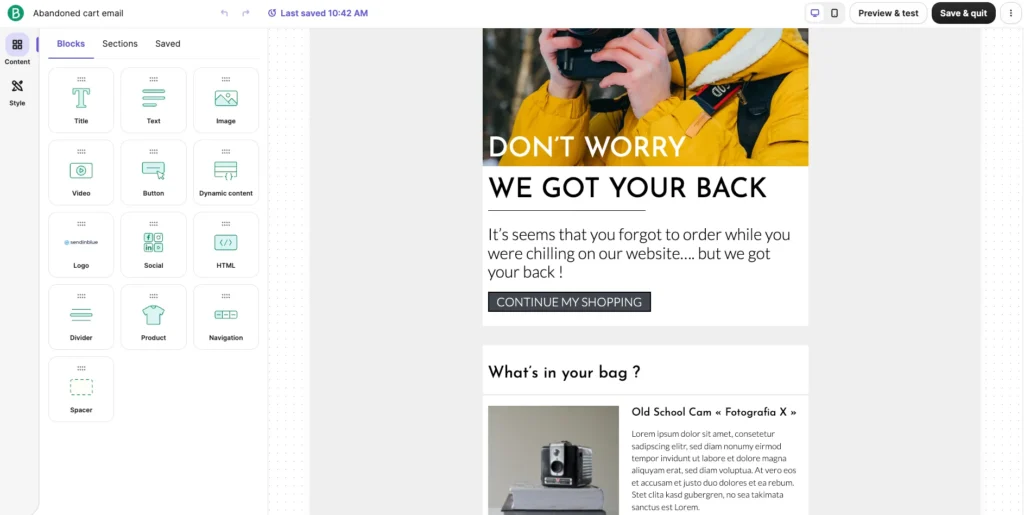
Brevo is the closest thing to a like-for-like upgrade if AWeber's pricing is what's pushing you out, because it changes the billing model entirely. Unlike AWeber, Brevo charges by the number of emails you send rather than the number of subscribers you store, and it lets you keep up to 100,000 contacts on the free plan. For anyone with a large list they email occasionally, that difference alone can cut the bill sharply.
It's also far more than an email tool. Brevo bundles email and SMS marketing, a CRM, marketing automation, and landing pages in one platform, so it fits businesses that want to grow past newsletters without stitching separate tools together.
Brevo's automation workflows cover welcome series, abandoned carts, and date-based reminders, and it handles transactional emails alongside marketing campaigns from the same account.
Best for: Businesses that want email plus SMS and a CRM in one place, and anyone with a large list emailed infrequently.
Free plan: 300 emails/day (9,000/month) and up to 100,000 contacts, with Brevo branding.
Pricing: Starter from $9/month (5,000 emails, 500 contacts, no daily cap); Standard from $18/month adds unlimited marketing automation, A/B testing, landing pages, and logo removal; Professional and Enterprise are custom.
Pros:
- Charges per email sent, not per subscriber
- Genuinely useful free plan
- All-in-one feature set including SMS and CRM
- Strong email marketing deliverability
- Transactional emails included
Cons:
- Marketing automation on the Starter plan is limited to 2,000 contacts
- The free plan is capped at 300 emails/day
- The per-send model is less economical if you email a small list very frequently
How Brevo compares to AWeber
Where it beats AWeber: Per-email pricing instead of per-subscriber, up to 100,000 contacts on the free plan, plus native SMS marketing and a CRM for multichannel marketing that AWeber doesn't offer.
Where AWeber holds up: A longer standalone deliverability record and phone support on every plan.
Bottom line: The most complete email marketing platform here, and the best AWeber alternative if you want more than newsletters. Brevo won't be right for everyone, but for the all-in-one use case it's hard to beat on value. You can test it against a real campaign on the free plan before paying anything.
2. MailerLite, best for value and a clean editor
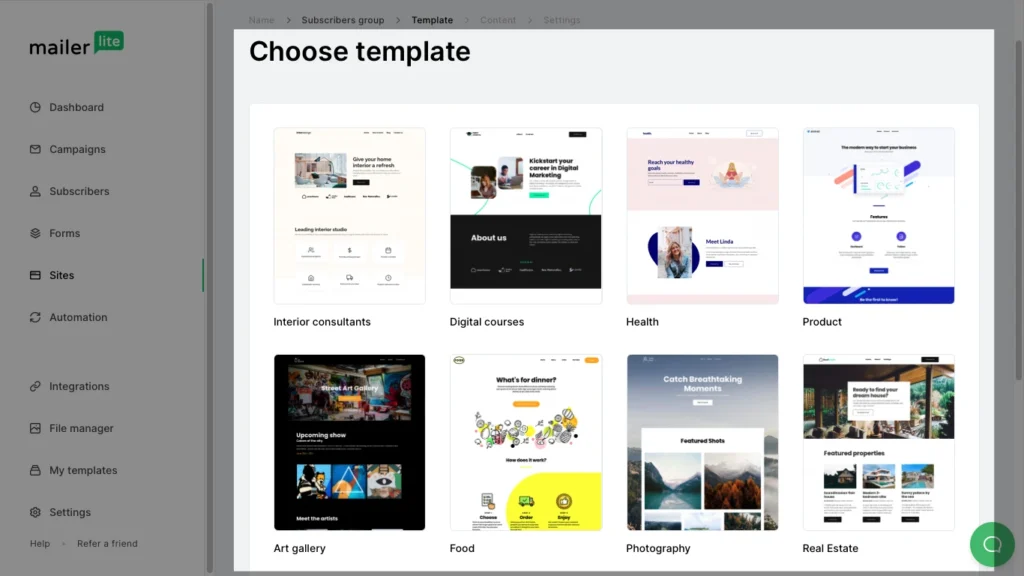
MailerLite built its following by doing the fundamentals extremely well at a low price. Its drag-and-drop editor is one of the cleanest in the category, and even lower tiers include landing pages, signup forms, and a simple website builder. If you want professional email marketing without complexity, it's a natural AWeber alternative.
MailerLite's drag-and-drop builder is a big part of the appeal for non-technical teams. One caveat worth flagging: in June 2026, MailerLite cut its free tier from 500 to 250 subscribers, so the once-generous free option is now smaller. The paid plans remain good value, but budget conscious marketers who relied on the old free plan should check the new numbers.
Best for: Small businesses and creators who want a clean editor and strong value on paid plans.
Free plan: Up to 250 subscribers and 2,500 emails per month, with basic automation, forms, and one landing page.
Pricing: The Comfort plan starts $12/month on monthly billing, removing branding and adding auto-resend and more automation; the Power plan from $25/month adds unlimited users, emails, automations and more.
Pros:
- Excellent drag-and-drop editor
- Landing pages and a website builder included
- Strong value on paid tiers
- Ecommerce blocks for online sellers
Cons:
- The free plan was cut to 250 subscribers in June 2026
- Fewer advanced automation capabilities than ActiveCampaign
- New accounts pass through an approval review before sending
How MailerLite compares to AWeber
Where it beats AWeber: Cheaper at comparable list sizes with a more intuitive interface. Unlike AWeber, it bundles a website builder and landing pages on lower tiers, and its intuitive drag-and-drop editor and focused key features launch email marketing campaigns fast. For most small businesses focused on design and price, it wins day to day.
Where AWeber holds up: Support by phone on every plan and free list migration.
Bottom line: one of the best AWeber alternatives for a clean editor and low-cost email marketing, if you don't rely on the old free tier.
3. Kit (formerly ConvertKit), best for creators
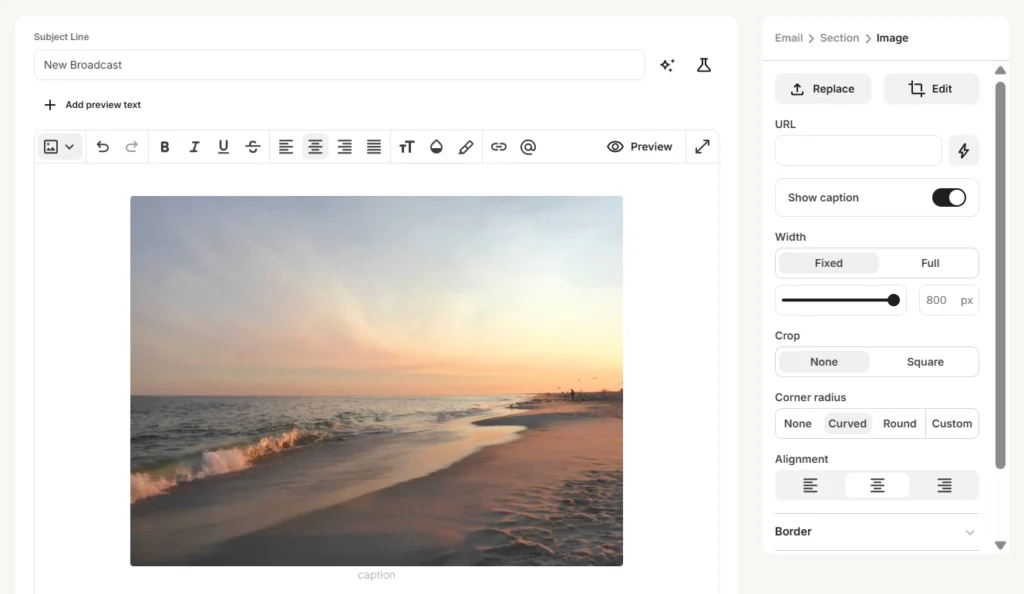
Among email marketing tools, Kit is purpose-built for content creators: bloggers, newsletter writers, course sellers, and podcasters. Its customer support and documentation are geared to that audience. It leans into tag-based subscriber management, a clean visual automation builder, and built-in monetization tools that let creators sell digital products directly through their emails.
If your audience is a newsletter you plan to monetize, Kit is designed for exactly that.
Best for: Creators and newsletter operators who monetize their audience.
Free plan: Up to 10,000 subscribers and unlimited emails, the most generous free tier here, though advanced features are limited.
Pricing: Creator from $39/month at 1,000 subscribers, rising steeply to $139/month at 10,000; Pro adds advanced features. Prices rose sharply in September 2025.
Pros:
- Very generous free plan
- Creator-specific tools like the Creator Network and built-in commerce
- Intuitive tagging for advanced segmentation based on subscriber behavior
Cons:
- Gets expensive quickly past the free tier
- Minimalist, mostly pre designed templates won't suit brands that want visually rich, dynamic content
How Kit compares to AWeber
Where it beats AWeber: A far larger free plan (up to 10,000 subscribers) and creator-focused monetization and segmentation.
Where AWeber holds up: Paid plans stay cheaper as your list grows, and it's a better fit for a general small business than a creator tool.
Bottom line: one of the best AWeber alternatives for creators who monetize a newsletter, with the most generous free tier here.
4. GetResponse, best all-in-one on a budget
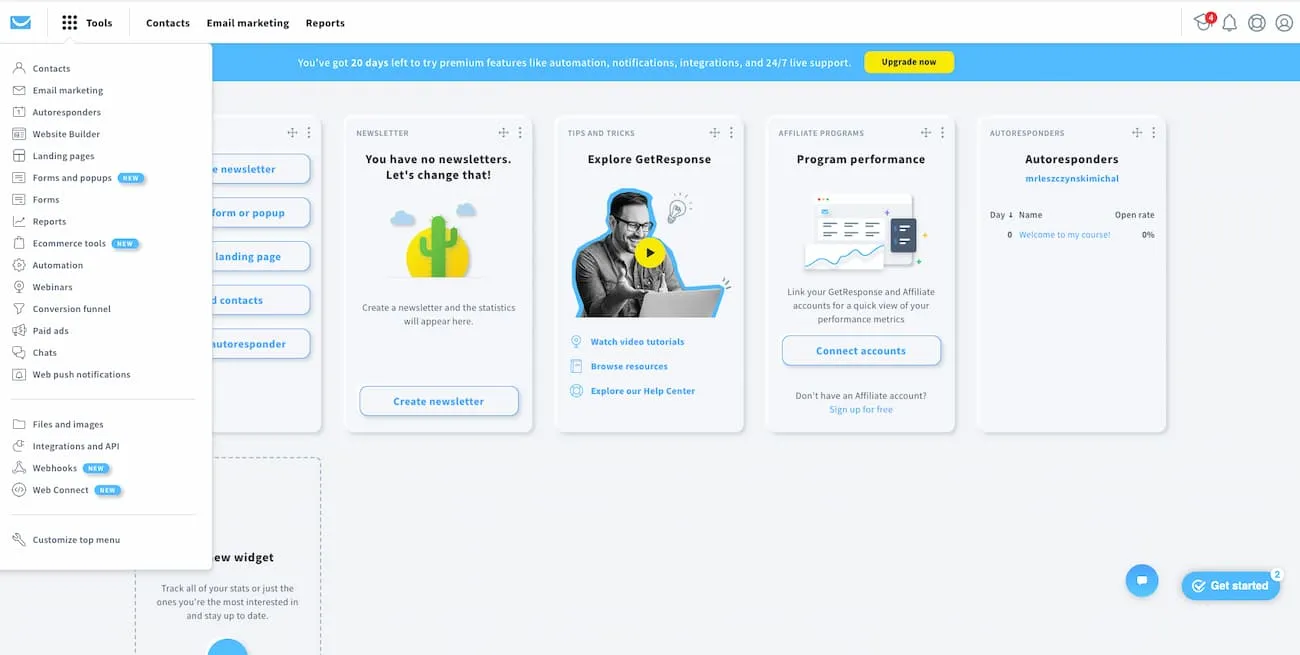
GetResponse packs a lot into one email marketing software suite: email marketing, marketing automation, landing pages, sales funnels, AI content tools, and native webinar hosting, which AWeber doesn't offer at all.
It also supports email delivery scheduling so campaigns go out at the right time. For a small business that wants an all-in-one marketing platform on a modest budget, it's a strong option.
Best for: Small businesses that want an all-in-one suite, especially if webinars matter.
Free tier: Up to 2,500 emails/mo and 500 contacts with limited features.
Pricing: Starter from $19/month; advanced marketing automation and webinars require the Marketer tier from $59/month.
Pros:
- Broad toolkit including webinars and sales funnels
- Generative AI for copy and landing pages
- Detailed analytics with spam testing
Cons:
- Advanced automation and webinars are gated behind higher tiers
- Contact-based pricing climbs as your list grows
- The entry plan includes only basic automation
How GetResponse compares to AWeber
Where it beats AWeber: Unlike AWeber, it bundles webinars, sales funnels, and advanced marketing automation, so it does more for a similar entry price.
Where AWeber holds up: Simpler to learn if you only need straightforward email.
Bottom line: one of the best AWeber alternatives for all-in-one marketing on a budget, especially with webinars and marketing automation included.
5. ActiveCampaign, best for advanced automation
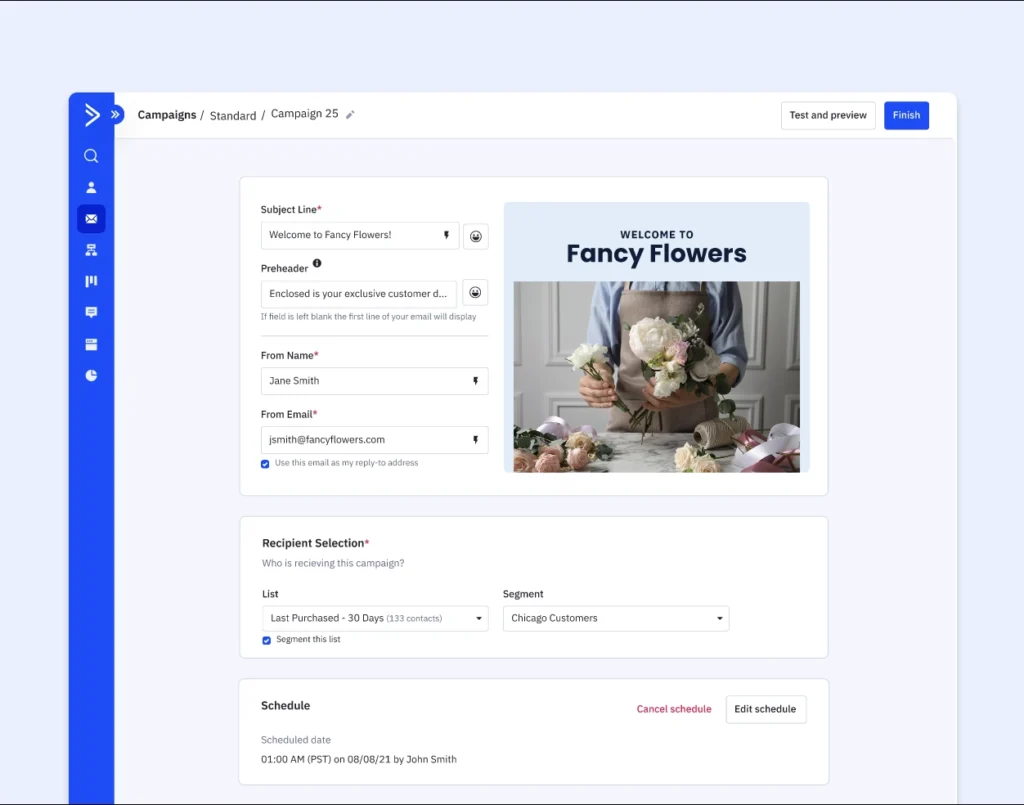
ActiveCampaign is the power user's choice. Its visual automation builder handles complex customer journeys and advanced automation workflows that most tools here can't match, and it includes a genuine CRM with sales automation. If sophisticated, behavior-driven email marketing automation is your priority, this is the platform.
Best for: Businesses that need robust automation, advanced segmentation, and a built-in CRM.
Free plan: None, though a free trial is available.
Pricing: From $15/month at entry level; the popular Pro tier is priced at $79/month, and costs scale steeply.
Pros:
- Best-in-class automation capabilities with AI features
- Strong CRM and sales tools
- Detailed reporting dashboards with click maps
- 900+ integrations
Cons:
- A steep learning curve compared with AWeber
- No free plan
- Gets expensive as your list grows
How ActiveCampaign compares to AWeber
Where it beats AWeber: A significant step up in automation and advanced segmentation, with the deepest visual automation builder here.
Where AWeber holds up: Easier to pick up, with no steep learning curve, and cheaper at the entry level. ActiveCampaign earns its price only if you'll use its advanced automation capabilities.
Bottom line: the most capable automation platform here, with automation workflows most email marketing tools can't match.
6. Mailchimp, best for brand familiarity
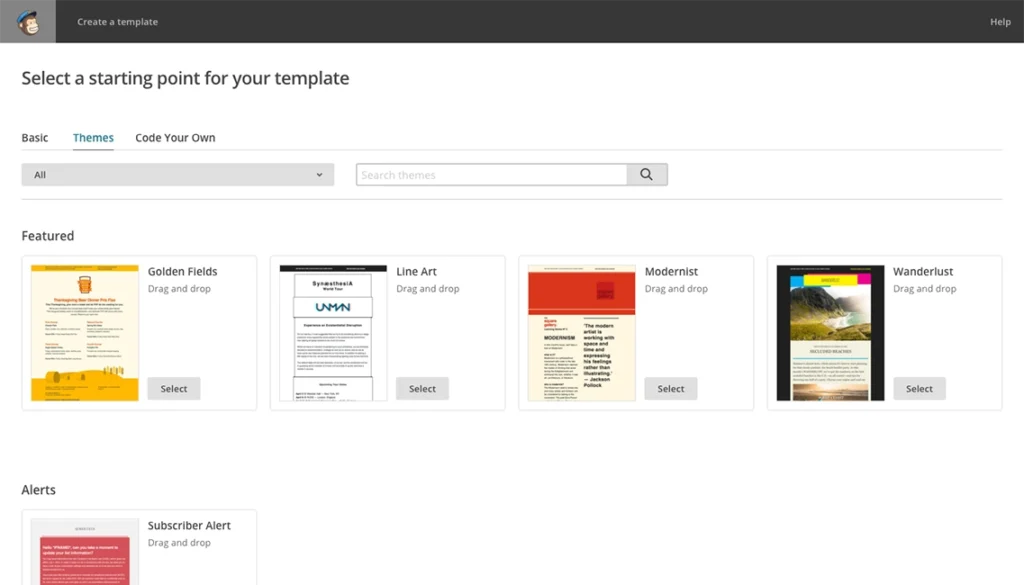
Mailchimp is the name most people know, with a huge template library, an intuitive interface, and seamless integration with nearly everything. For many small businesses it's the default first email marketing tool. But since Intuit acquired it in 2021, its pricing has climbed steadily and its free plan has shrunk sharply, which is a big reason people now search for alternatives.
Best for: Teams that value a familiar, beginner-friendly interface and a deep integration ecosystem.
Free plan: 250 contacts and 500 sends per month, cut from 2,000 contacts a few years ago, with automation removed from the free tier.
Pricing: Essentials from $13/month, Standard from $20/month (the cheapest tier with multi-step automation), Premium from $350/month.
Pros:
- Polished, intuitive interface
- Enormous integration library
- Recognizable brand
- Strong template selection
Cons:
- Charges for unsubscribed and non-subscribed contacts
- The free plan is now too small for real use
- Expensive at scale
How Mailchimp compares to AWeber
Where it beats AWeber: A slicker, intuitive interface and a bigger integration ecosystem for serious email marketing efforts.
Where AWeber holds up: AWeber's free plan is now larger, and Mailchimp still bills for unsubscribed contacts while its advanced features cost more.
Bottom line: the most trusted name here, with an integration ecosystem and template library that are hard to beat.
7. Constant Contact, best for beginners and events
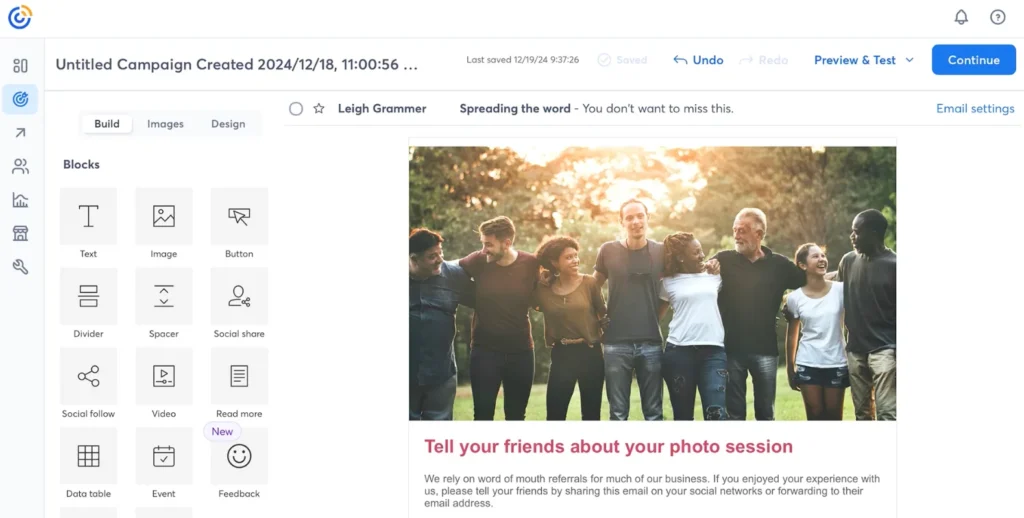
Constant Contact is another long-running tool aimed squarely at small businesses and nonprofits, with a friendly setup, responsive customer support, and standout event marketing tools for managing registrations and invitations. It's a gentle on-ramp for running email campaigns. If you run events and want email that's easy to learn, it's worth a look.
Best for: Beginners, local businesses, and organizations that run events.
Free plan: No permanent free plan, though a free trial is available.
Pricing: Lite from $12/month, scaling by contact count.
Pros:
- Easy to learn
- Strong event management and registration tools
- Reliable customer support
Cons:
- Per-contact pricing rises quickly
- Limited automation capabilities compared with ActiveCampaign or GetResponse
How Constant Contact compares to AWeber
Where it beats AWeber: Stronger event marketing tools for registrations and invitations, and both target small businesses that prioritize ease of use over advanced features.
Where AWeber holds up: A real free plan, where Constant Contact offers only a trial.
Bottom line: the easiest AWeber alternative for beginners and event-driven organizations, with standout tools for managing registrations and invitations.
More AWeber alternatives worth knowing
The seven above cover most needs, but a few other tools are strong in specific niches and worth a mention in any honest comparison.
Moosend
Moosend is a budget-friendly platform with a capable drag-and-drop email builder, advanced visual automations, and website visit tracking. Its reporting dashboard includes click maps and geolocation data that make campaign performance easy to read, and even its lower premium plan supports automated campaigns.
For budget email marketing with real automation, Moosend punches above its weight as an AWeber alternative.
Curious how this tool compares to other email marketing platforms? See our comparison of the best Moosend alternatives.
Omnisend
Omnisend is built for ecommerce. It combines email, SMS marketing, and web push notifications in one platform, with advanced workflows for cart abandonment and customer reactivation.
For ecommerce businesses, its ecommerce features and unlimited web push notifications help you capture leads and run automated campaigns tied to shopper actions, and it can sync customer data from your store. If you run an online store, its ecommerce tools go deeper than AWeber's.
EmailOctopus
EmailOctopus keeps things simple and cheap, and notably does not charge for unsubscribed contacts, which addresses one of the most common AWeber complaints directly.
It's a clean choice for straightforward email campaigns on a budget, and for basic email marketing without the per-subscriber penalty it's one of the cheapest AWeber alternatives around.
Systeme.io
Systeme.io is an all-in-one funnel and marketing platform with an unusually generous free tier: it includes 2,000 contacts, unlimited emails, and unlimited landing pages, plus funnels and course tools. You can create landing pages and run automations without paying, and its premium plan adds more.
For solopreneurs building an online business, it bundles a lot at no cost.
Klaviyo
Klaviyo is optimized for B2C ecommerce brands that want to leverage customer data and purchase history for highly personalized customer journeys. It reads user behavior and can sync customer data from your store in real time.
For ecommerce businesses with rich data it's a leader, though it's more specialized and pricier than AWeber.
Campaign Monitor
Campaign Monitor is known for high-quality templates, dynamic content, and a visual journey designer, plus advanced analytics on campaign performance for actionable insights. It's a polished email marketing pick for brands that care about design and reporting, and a capable AWeber alternative for design-led teams.
Drip
Drip specializes in behavior-driven marketing for ecommerce businesses, with robust automation, complex workflows, and behavioral triggers based on user behavior.
Like Klaviyo, it's aimed at online stores that want automation tied to shopper behavior and dynamic content that adapts to what each shopper does.
AWeber vs the alternatives: how billing models differ
The feature comparisons matter, but the billing model is often what decides the real cost, so it's the first thing to check. Here are the three approaches at a glance:
| Billing model | Who prices this way | Watch out for | Cheapest when |
|---|---|---|---|
| Per subscriber | AWeber, Kit, Constant Contact | Costs scale with every stored subscriber; some tools still bill for unsubscribed contacts | Small list, frequent sends |
| Per contact | Mailchimp, GetResponse, ActiveCampaign, MailerLite | Mailchimp counts unsubscribed contacts too | Small-to-mid list, frequent sends |
| Per email sent | Brevo | Daily-send cap on the free plan | Large list, occasional sends |
The rule of thumb: if you keep a large list but email it occasionally, per-send pricing is usually far cheaper. If you email a small list very frequently, a flat contact-based plan can work out better. Match the model to how you actually send, not just the headline price. For a growing list, that one choice can save or cost you hundreds of dollars a year, so it's worth settling before you commit to a platform.
Best AWeber alternatives by use case
If you want the short version, here are the best AWeber alternatives grouped by what you need most from your email marketing.
Best free AWeber alternative
For a genuinely free option, Brevo and Kit lead. Brevo's free plan covers 9,000 emails a month to up to 100,000 contacts, while Kit's free tier covers unlimited emails to up to 10,000 subscribers.
Both let you run real email marketing campaigns before paying. If you just want to send email campaigns at no cost, start with one of these.
Best AWeber alternative for ecommerce
Online stores are better served by ecommerce-first email marketing tools. Omnisend and Klaviyo build campaigns around purchase history and user behavior, with automations for cart recovery, while Drip focuses on behavior-driven workflows.
All three go well beyond AWeber's ecommerce features, and Brevo covers the basics if you also want SMS marketing and transactional emails from the same email marketing platform.
Best AWeber alternative for advanced automation
If automation workflows are the priority, ActiveCampaign offers the deepest visual automation builder and advanced segmentation as a dedicated automation platform. GetResponse is a more affordable email marketing platform that still bundles advanced marketing automation, and both easily outdo AWeber's limited automation capabilities.
Best AWeber alternative for small businesses
For most small businesses that want an all-in-one email marketing platform without per-subscriber billing, Brevo is the strongest pick. It combines email, SMS marketing, a CRM, and marketing automation with straightforward customer support, so growing email marketing campaigns don't mean juggling extra tools.
How to choose the right AWeber alternative
The best choice comes down to what you need, not the longest feature list. A few quick guides:
- Want an all-in-one platform (email, SMS, CRM) without paying per subscriber? Brevo is the strongest fit.
- Want the cleanest editor and strong value? MailerLite.
- You're a creator monetizing a newsletter? Kit is built for you.
- You need webinars and sales funnels bundled in? GetResponse.
- You need advanced automation and a CRM? ActiveCampaign.
- You run an online store? Omnisend, Klaviyo, or Drip for ecommerce-specific workflows.
- You want a familiar, beginner-friendly tool? Mailchimp or Constant Contact.
Whichever email marketing platform you choose, look for the key features that matter to you, test your email campaigns on a free trial, and check that the automation and email marketing automation fit your workflow.
Whatever you pick, take advantage of a free tier or free trial to test it with your own list before committing. The right tool is the one that fits your sending pattern, your budget, and your team's comfort with the interface.
Why Brevo is a strong alternative to AWeber
If AWeber's per-subscriber billing or its 2024 price increase is driving your search, Brevo answers both directly.
You pay for emails sent rather than subscribers stored, you keep up to 100,000 contacts on the free plan, and you get email, SMS, a CRM, marketing automation, and landing pages in one platform rather than paying for add-ons.
For a growing small business that wants room to expand beyond newsletters into multichannel marketing, that combination is why Brevo tops this list for the all-in-one use case.
That said, be honest about your sending pattern. If you email a small list daily, a flat contact-based plan elsewhere may cost less, and if you only ever want simple newsletters, MailerLite's clean editor might suit you better. The best AWeber alternative is the one that matches how you work, and for many businesses looking to do more than send email, that's Brevo.
Getting started
AWeber is a solid tool, but after the 2024 price changes it's no longer the obvious default. Whether you prioritize price, a clean editor, creator features, advanced automation, or an all-in-one platform, there's a well-matched option on this list, and the best AWeber alternatives above cover almost every case, from simple email campaigns to full multichannel marketing.
Most of the platforms here take only a few minutes to set up, so you can trial two or three side by side before deciding which one fits your budget, your list size, and your workflow best.
If you want to test the all-in-one route, Brevo's free plan lets you try email marketing, automation, and a CRM with up to 100,000 contacts and no credit card required. Import your list, send a real campaign, and compare the per-send model to what you pay AWeber today.