
Building an application is hard enough without worrying about email infrastructure.
If you need to send emails for password resets, order confirmations, or user notifications at scale, you need an email marketing API. An email marketing API allows your application to send transactional and marketing emails programmatically, without maintaining your own mail server or risking the spam folder.
In this guide, we'll cover what email marketing APIs do, how they work, pricing models, and how to choose the right provider for your needs.
The information in this article was last updated on February 27, 2026.
Try Brevo for free
Send 300 free emails a day. Perfect for bulk email, transactional messages, and testing.At a glance
What is an email marketing API?
A programmatic interface that connects your application to professional email infrastructure for sending emails at scale.
Why use one?
99%+ deliverability rates, high delivery speed, built-in analytics, and elastic scalability without managing your own mail server.
What are the best email marketing API providers?
Brevo, SendGrid, Mailgun, Postmark, Amazon SES, Elastic Email
Table of contents
- What is an email marketing API?
- Why you need an email marketing API
- 3 key features of email marketing APIs
- Email marketing API use cases
- REST API vs. SMTP relay: Which to use
- Email API pricing: Models & costs
- Email marketing API providers: Overview
- Why developers choose Brevo
- Start sending with a scalable email marketing API
What is an email marketing API?
An email marketing API (Application Programming Interface) is a programmatic bridge that connects your application to a dedicated email API provider.
Instead of your server trying to deliver emails directly to Gmail or Outlook (and likely getting blocked), your application sends a structured request to the API provider. The provider then facilitates the complex infrastructure: authentication standards (SPF/DKIM/DMARC), IP reputation management, and deliverability optimization.
Why you need an email marketing API
You could technically build your own email server, but the maintenance cost is massive. Here is why developers choose dedicated APIs instead:
1. Deliverability
This is the single most important reason. Email API providers spend years warming up IP addresses and building relationships with Internet Service Providers (ISPs) to ensure high email deliverability. They provide the DNS records you need (SPF, DKIM, DMARC) to authenticate your domain, ensuring your emails don't get flagged as spam.
Read more: 13 ways to improve email delivery.
2. Speed and latency
For transactional emails – like a 2FA code or a password reset – speed is critical. Users expect these emails in seconds, not minutes. Leading email APIs use distributed infrastructure to ensure near-instant email delivery.
3. Detailed logs and analytics
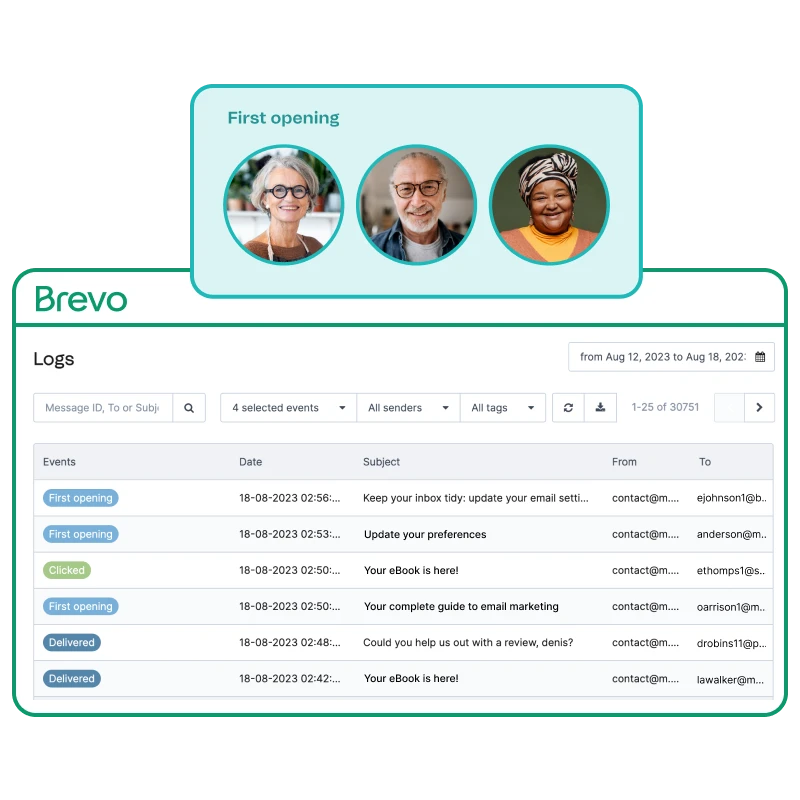
What happened to that email you sent? Did it bounce? Was it opened? Did the user click a link? An API provides webhooks and logs that feed this data back into your app. If a user complains they didn't get the receipt, you can look up exactly what happened in your own dashboard.
4. Scalability
Sending 100 emails a day is easy. Sending 100,000 in an hour requires serious infrastructure. APIs scale elastically, so you don't have to worry about server crashes during a marketing spike or a viral product launch.
3 key features of email marketing APIs
Not all APIs are created equal. When evaluating documentation, look for these three pillars:
1. Reliability & uptime
Your app depends on email. If the API goes down, your users can’t reset passwords. Look for providers with a 99.9% uptime SLA (Service Level Agreement).
2. Developer experience (DX)
A great API has great docs. Look for:
- SDKs (Software Development Kits): Official libraries for Python, Node.js, PHP, Ruby, etc.
- Clear Error Messages: "Error 400" is vague. "Error: Invalid email format" is helpful.
- Community: Active forums or Stack Overflow tags.
3. Security & compliance
If you have users in the EU, GDPR compliance is non-negotiable. Look for providers with ISO certifications and servers hosted in appropriate regions.
Email marketing API use cases
Now that you have a better understanding of what an email marketing API is, let’s discuss how an email API can be used to help businesses grow and develop better customer relationships.
Transactional emails
These are one-to-one messages triggered by a user action.
- Examples: Account verification, receipts, shipping notifications, password resets.
- Goal: Speed and reliability.
Good to know: Transactional emails often achieve click-through rates exceeding 5% – significantly higher than standard promotional emails. This makes them one of the highest-performing email types you can send.
Read more: The best transactional email services compared.
Marketing automation
These are one-to-many messages, often scheduled or triggered by behavior.
- Examples: Welcome sequences, abandoned cart emails (crucial for ecommerce), newsletters.
- Goal: Personalization and engagement.
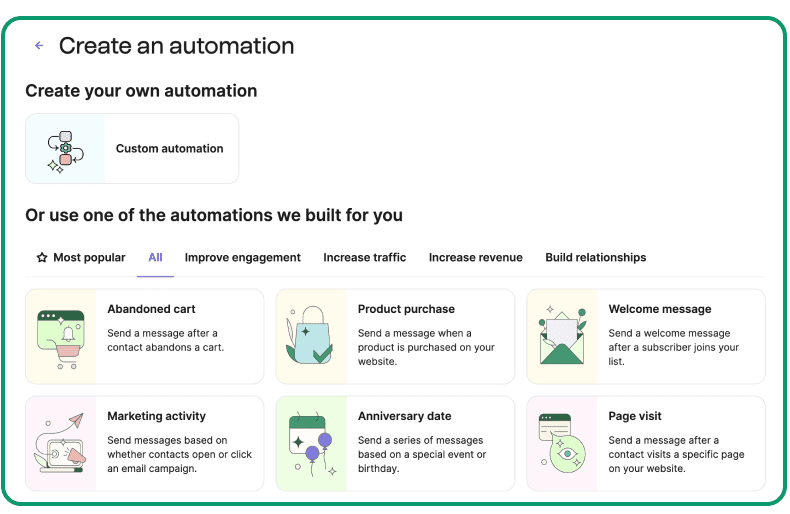
Brevo provides pre-built automation templates
Multichannel workflows
Advanced platforms allow you to cross channels based on user behavior.
- Example: A user receives a renewal email. If they don't open it in 2 days, the system automatically triggers an SMS reminder.
- Goal: Reach and conversion.
Note: This typically requires an all-in-one platform like Brevo, rather than a standalone email API.
REST API vs. SMTP relay: Which to use
Most providers offer both methods. Which one should you use?
REST API (HTTP)
This is the modern standard for developers. You send data via an HTTP POST request (usually JSON).
- Pros: Faster, more secure (uses HTTPS), avoids firewall issues, and supports advanced features like templates and analytics tags.
- Best for: Building email capabilities directly into your custom application.
SMTP relay
This uses the standard Simple Mail Transfer Protocol. You simply configure your existing software with a hostname, port, username, and password.
- Pros: Universal compatibility. It works with legacy systems, CRM software, and plugins (like WordPress) where you can't write custom code.
- Best for: Connecting existing 3rd-party software to a better email engine.
In short: Use the REST API for your custom app; use SMTP for integrating with tools you didn't build.
Read more: The best free SMTP servers compared.
Email API pricing: Models & costs
Email API pricing is usually determined by your sending volume. That means you pay a subscription fee for a bucket of emails (e.g., up to 20,000/month).
Most providers also offer a free tier. Free tiers are the perfect way to test API response times or validate deliverability without any upfront cost. The best free plans offer perpetual access (not just a limited trial) and allow you to authenticate your own domain immediately.
Email marketing API providers: Overview
The email API market serves different customer segments. Here is a high-level view of the major players.
Comparison table: Email API providers
Provider categories
To help you navigate the market, we’ve grouped the major email API services into four distinct categories based on their primary focus and target audience.
Read more: The best email API services compared.
1. Enterprise infrastructure platforms
Examples: SendGrid, Mailgun
These providers excel at high-volume sending (billions of emails per month). They offer granular technical controls, dedicated IP management, and enterprise SLAs. They are best for large engineering teams requiring custom deliverability controls. Note that some, like SendGrid, have moved away from forever free tiers to focus purely on paid volume.
2. Developer-first solutions
Examples: Postmark, Mailgun
These tools prioritize developer experience (excellent API documentation, fast APIs). They often focus exclusively on transactional email (no marketing features). This makes them ideal for technical teams who want a simple, specialized tool just for system alerts.
3. All-in-one platforms
Examples: Brevo, Elastic Email
These platforms combine a powerful API with a complete marketing suite. You get developer tools (REST API + SMTP) plus a visual email builder, email templates, built-in CRM, contact management, and often multi-channel options (SMS, WhatsApp). This is the best choice for businesses who want to consolidate their tech stack, and send transactional messages as well as email marketing campaigns from a single platform.
4. Infrastructure-only providers
Examples: Amazon SES
These offer raw sending infrastructure at the lowest cost but minimal features. You get sending power but no built-in analytics dashboard, support, or contact management. Best for teams with DevOps resources to manage the complexity.
Quick tip
Want to know how other companies use Brevo to build strong customer relationships? We’ve put together a wide range of case studies for you that show how it’s done. In one of them, Figaro Classifieds reveals how they secure their critical transactional emails with Brevo's email API – and key takeaways to replicate when volumes skyrocket.
Why developers choose Brevo
Brevo bridges the gap between developer power and marketing ease.
1. The generous free tier
You can send 300 emails per day on the free plan – no credit card required. This includes access to the full API, SMTP relay, and webhooks. It’s perfect for early-stage projects and testing.
2. Unified customer data (CRM)
Most dedicated email APIs focus on email sending and reporting. Brevo goes a step further by storing your users in a built-in CRM, linking API logs to marketing history and SMS activity in a single contact profile. This gives you a complete view of the user journey.
3. GDPR compliance by design
As a European-founded company, data privacy is in Brevo’s DNA. We are fully GDPR compliant, with servers hosted in the EU, giving you peace of mind regarding user data regulations.
4. Multichannel power
Need to send an SMS verification code? Or a WhatsApp order update? You don't need a separate provider. You can control email, SMS, and WhatsApp from a single set of API keys.

Excellent first experience with their support — Free account review
"I've been using Brevo since its Sendinblue days, mainly for email marketing and SMTP relay with our office printer [...] The transition to Brevo brought noticeable improvements. What stands out is their customer support - even as a free account user, I received personalized, non-canned responses to my queries. This prompt and considerate support, especially for minor issues like the SMTP key length for our printer, is commendable."
Pat B.,
Sales and Marketing Director

SMTP & Transactional email provider
"We've been using Brevo (Sendinblue) as an SMTP for our transactional Woo emails since 2021 and intend to continue even longer. And here's why. Recently, our account was postponed and all our transactional emails stopped being sent. We couldn't understand the reason behind it and appealed for support. Hats off to the Brevo team, we've received it quickly. The support team found a spam bot activity and helped us resolve this issue by advising us on our steps. Again, we never experienced any issues with the service itself. But it's great to know that Brevo's quick assistance is there if something goes wrong."
Tatiana Lebedeva,
Brevo user
Several sales and marketing tools in one system
"We stumbled upon Brevo by accident as we were using a system just for sending marketing emails. We discovered quickly that Brevo offered multiple different digital sales and marketing tools to enhance both our manual branded client engagement tasks, but also offered automation tools to aid our day to day sales efforts. Brevo has allowed us to move away from three other, separate systems and we now use Brevo for all our outbound sales and marketing endeavours. This has saved us a lot of time and money and has increased our output. The system is easy to use and the support is excellent and prompt."
Stephen Day,
Brevo user
Tip: Get your API key and follow our Getting Started guide to send your first email today.
Start sending with a scalable email marketing API
Email marketing APIs are essential infrastructure for modern applications. They provide the deliverability, speed, and scalability that self-hosted email servers simply cannot match.
Key takeaways:
- Don't build your own email server. The deliverability and maintenance costs aren't worth it.
- Choose based on your needs. Enterprise volume? Developer experience? All-in-one platform? Different providers excel at different things.
- Start with a free tier. Test deliverability and developer experience before committing to a paid plan.
Ready to get started? Brevo offers 300 free emails per day – no credit card required.