
For years, MessageBird was one of the most popular ways to send SMS, WhatsApp, and other messages through a single API. In February 2024 it rebranded to Bird and changed direction, moving from a developer-first communications API toward an "AI-native" omnichannel platform bundling CRM and marketing on top of its messaging layer.
That shift, plus layoffs and less transparent, sales-led pricing, has many teams weighing whether Bird still fits. If you're replacing MessageBird, the market is full of strong MessageBird alternatives, and the best one depends on which kind of buyer you are.
This comparison covers the top MessageBird alternatives for 2026, what each is best for, what it costs, and where it beats Bird. Treat the figures as a 2026 snapshot and confirm on each vendor's site.
The information in this article was last updated on September 1, 2026.
Table of Contents
- The best MessageBird alternatives at a glance
- Two kinds of MessageBird alternative
- Why look for a MessageBird alternative?
- What to look for in a MessageBird alternative
- Our methodology at Brevo: How we tested
- 1. Twilio, best overall MessageBird alternative for developers
- 2. Brevo, best for no-code multichannel marketing messaging
- 3. Sinch, best for enterprise and high-volume messaging
- 4. Infobip, best omnichannel enterprise platform
- 5. Vonage, best for messaging plus voice and video
- 6. Plivo, best budget messaging API
- 7. Telnyx, best for developer-friendly private-network messaging
- 8. Respond.io, best for AI-powered omnichannel conversations
- More MessageBird alternatives worth knowing
- How to choose the right MessageBird alternative
- Why Brevo is a strong MessageBird alternative
- Getting started
The best MessageBird alternatives at a glance
| Tool | Best for | Type | Starting price (2026) | G2 rating |
|---|---|---|---|---|
| Twilio | Developer-first messaging APIs | CPaaS | ~$0.0083/SMS (US), pay-as-you-go | 4.2/5 |
| Brevo | No-code multichannel marketing | Marketing platform | Free plan; SMS pay-as-you-go | 4.5/5 |
| Sinch | Enterprise, high-volume global | CPaaS | Custom / volume-based | 4.4/5 |
| Infobip | Omnichannel enterprise | CPaaS | Custom / sales-led | 4.4/5 |
| Vonage | Messaging plus voice and video | CPaaS | ~$0.00735/SMS (US) | 4.3/5 |
| Plivo | Budget SMS and voice API | CPaaS | ~$0.0077/SMS (US) | 4.5/5 |
| Telnyx | Developer-friendly, own network | CPaaS | Volume-based, negotiable | 4.7/5 |
| Respond.io | AI-powered omnichannel conversations | Omnichannel inbox | Starter plan from $79/month; custom for larger teams | 4.8/5 |
Two kinds of MessageBird alternative
Before ranking the MessageBird alternatives, it helps to split the field, because "multichannel messaging" means two different things:
- CPaaS / messaging APIs. To send SMS, WhatsApp, and voice programmatically at scale, you want a communications platform as a service like Twilio, Sinch, Infobip, Vonage, Plivo, or Telnyx: API-first, pay-as-you-go, built to embed messaging in your product.
- Multichannel marketing platforms. To run email, SMS, and WhatsApp campaigns with automation and a CRM without raw APIs, you want a marketing platform like Brevo, HubSpot, Klaviyo, or ActiveCampaign, which is where Bird has been heading.
Bird now straddles both, part of the confusion. Knowing which side you're on makes the choice easier.
Why look for a MessageBird alternative?
To be fair, Bird still has real strengths: aggressive SMS pricing, owned carrier infrastructure with powerful features, a unified Conversations API threading SMS, WhatsApp, Instagram, and email into one view, and SparkPost-powered email at scale. For a global enterprise with in-house engineers, it stays a credible Twilio competitor.
The reasons teams look elsewhere are specific:
- Rebrand upheaval. The 2024 shift from MessageBird to Bird came with layoffs, changed documentation, and reports of support quality issues during the transition.
- Pricing opacity. Bird pulled its public pricing calculator, and pricing is now largely sales-led, which makes it hard to budget without a call.
- Enterprise pivot. Bird repositioned around large enterprises and an all-in-one CRM stack, leaving smaller teams and developers who just want a clean messaging API feeling underserved.
- Roadmap uncertainty. Multiple acquisitions (SparkPost, Pusher) and product reshuffles have created uncertainty, and teams that need a stable platform and a reliable platform for critical messaging often look elsewhere.
If any of those apply, there's a better-fitting option below.
What to look for in a MessageBird alternative
Match these MessageBird alternatives to how you actually work:
- API vs no-code. Are you embedding messaging in your product (CPaaS) or running campaigns? This decides your whole shortlist.
- Channels. SMS is table stakes. Check the WhatsApp Business API (and the newer WhatsApp Business Calling API), Facebook Messenger, other social media platforms and communication channels, voice APIs, email, and chat across the multiple channels you use for customer communication.
- Pricing. Favor transparent pricing and published rates over sales-only custom pricing, and watch for hidden charges on numbers and support.
- Deliverability and coverage. Direct carrier relationships, global coverage, local numbers, opt outs handling, and 10DLC support matter for reliable delivery, especially for e-commerce businesses.
- Compliance and support. SOC 2, HIPAA, and GDPR vary by provider, as do support quality, your support needs, and response times.
Automation, AI agents, and customer engagement
The best messaging platforms do more than send texts. Many now add automation capabilities and AI agents that summarize conversations, answer customer questions, and route chats to human agents for complex issues, lifting customer engagement and customer satisfaction while cutting response times.
Bird leans on this with its Conversations API and flow builder, and Respond.io and Infobip offer similar customer engagement tools. If workflow automation and a visual flow builder matter to your customer experience, weigh them alongside raw messaging.
Our methodology at Brevo: How we tested
This article covers the best MessageBird alternatives including our own platform, Brevo. Our suggestions are based on our own research and testing. We don't earn commissions from any links on this page. To learn exactly how we evaluate tools, check out our dedicated methodology article.
Please note that the features listed here are just a selection of what each software offers. For exact pricing and a full, up-to-date feature list, check the providers' websites.
1. Twilio, best overall MessageBird alternative for developers
Twilio is the obvious swap for anyone replacing MessageBird for API reasons. The market-leading CPaaS covers SMS, voice, video, WhatsApp, and email, with the best documentation in the category and pay-as-you-go pricing that plugs into existing systems if you have the technical knowledge to build.
- Best for: Developers who want reliable, well-documented programmable messaging at any scale.
- Type: CPaaS / messaging APIs.
- Pricing: US SMS starts at $0.0083; SMS, voice, and video are pay-as-you-go, plus 10DLC brand and campaign fees.
- Pros: Best-in-class docs and developer experience; largest ecosystem; transparent pay-as-you-go pricing; huge channel and product range.
- Cons: Premium per-message rates; costs and add-ons climb at scale; more than you need if you don't want to build on APIs.
How Twilio compares to Bird
- Where it beats Bird: Clearer pay-as-you-go pricing, better documentation, and a far larger developer ecosystem.
- Where Bird holds up: Bird claims cheaper SMS on some routes and bundles CRM and marketing tools Twilio keeps separate.
Bottom line: the default choice for a pure, well-supported messaging API.
2. Brevo, best for no-code multichannel marketing messaging
If you used Bird more for campaigns than code, Brevo is the natural fit. It's not a CPaaS, and that's the point: instead of raw APIs, you get email, SMS marketing, and WhatsApp campaigns with a visual automation builder and a CRM, so a marketing team can streamline processes and handle launching campaigns in a few clicks. Automations fire on customer actions and inform future campaigns, and a transactional email, SMS, and WhatsApp API covers programmatic sends. It suits growing businesses and fast growing teams.
- Best for: Businesses that want to run email, SMS, and WhatsApp marketing without building on APIs.
- Type: Multichannel marketing platform.
- Pricing: Free plan for email (about 9,000 emails/month, up to 100,000 contacts); SMS and WhatsApp are pay-as-you-go credits; paid plans from $9/month.
- Pros: No-code campaigns and automation; email, SMS, and WhatsApp plus a CRM in one platform; a genuine free plan; transactional messaging API available.
- Cons: Not a full CPaaS for high-volume programmable voice or global carrier routing; SMS is billed as credits rather than raw per-segment API rates.
How Brevo compares to Bird
- Where it beats Bird: A no-code path to multichannel marketing, transparent plans, a free plan to start, and a genuine CRM built in.
- Where Bird holds up: Bird is the stronger choice for developer-grade messaging APIs, owned carrier infrastructure, and very high message volumes.
Bottom line: the best MessageBird alternative if your goal is multichannel marketing, not building messaging into a product. Try it on the free plan before paying.
3. Sinch, best for enterprise and high-volume messaging
Sinch is a global CPaaS built for scale, with direct carrier relationships and fraud protection that pay off at millions of messages. It owns email infrastructure (Mailgun and Mailjet), covering global messaging and email together for many businesses with critical support needs.
- Best for: Enterprises sending high volumes of OTPs, alerts, and notifications globally.
- Type: CPaaS.
- Pricing: Largely custom and volume-based, negotiated with sales.
- Pros: Excellent deliverability at scale; strong global carrier coverage; fraud protection; email infrastructure included.
- Cons: Sales-led onboarding; less friendly for small projects; pricing isn't self-serve.
How Sinch compares to Bird
- Where it beats Bird: Proven high-volume deliverability and carrier depth, with clearer enterprise SLAs.
- Where Bird holds up: Bird's unified omnichannel Conversations API and marketing layer are more turnkey for engagement use cases.
Bottom line: the pick for enterprise, high-volume, deliverability-critical messaging.
4. Infobip, best omnichannel enterprise platform
Infobip is another enterprise-grade omnichannel CPaaS with very broad channel support and global reach, often chosen by large organizations that want SMS, WhatsApp, RCS, email, and voice under one vendor with strong support.
- Best for: Large enterprises wanting a single omnichannel vendor with global coverage.
- Type: CPaaS.
- Pricing: Sales-led and custom.
- Pros: Very broad channels and coverage; excellent customer support; custom channels and omnichannel orchestration.
- Cons: Not self-serve; heavier than most SMBs need; pricing requires a sales conversation.
How Infobip compares to Bird
- Where it beats Bird: Comparable omnichannel breadth with a longer enterprise track record and support depth.
- Where Bird holds up: Bird's aggressive SMS pricing and owned carrier stack can win on cost for some routes.
Bottom line: a strong Bird alternative for enterprises that want one omnichannel vendor.
5. Vonage, best for messaging plus voice and video
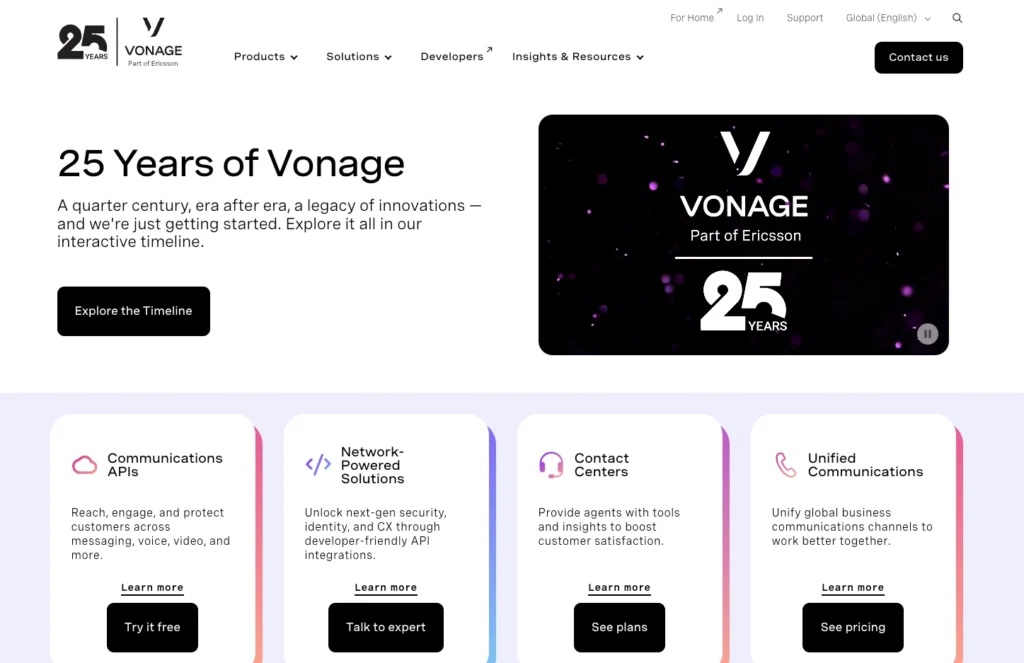
Owned by Ericsson, Vonage pairs messaging APIs (SMS, WhatsApp, Viber) with deep voice and video heritage. You can send and receive messages, place voice calls, and run video, a fit when your needs go beyond text into calls and a mobile app experience.
- Best for: Teams that need messaging alongside voice and video, or existing Vonage voice customers.
- Type: CPaaS (plus UCaaS and CCaaS).
- Pricing: US SMS around $0.00735 per message; SMS, voice, and video billed pay-as-you-go.
- Pros: Strong voice and video APIs; competitive EU SMS pricing; carrier-grade reliability via Ericsson.
- Cons: Pricing is sometimes less transparent than Twilio's; no iMessage support.
How Vonage compares to Bird
- Where it beats Bird: Deeper voice and video, plus unified communications and contact-center options.
- Where Bird holds up: Bird leans further into omnichannel chat and marketing than Vonage does.
Bottom line: the choice when voice and video matter as much as messaging.
6. Plivo, best budget messaging API
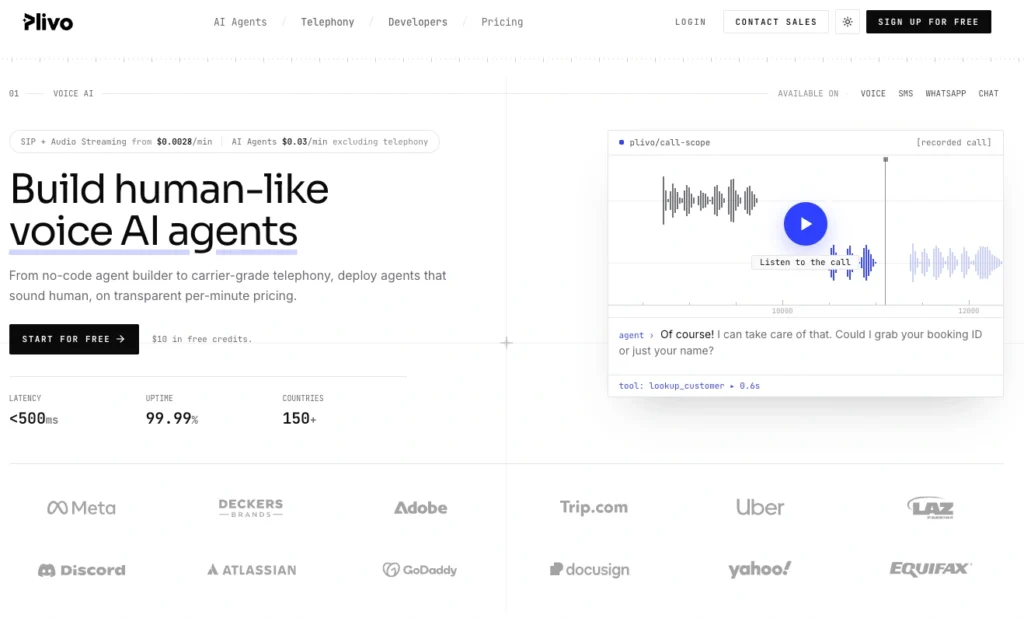
Plivo covers the core CPaaS job, SMS and voice, at lower rates than Twilio, with a clean API, local numbers, and solid global coverage. It's the value pick for cost-conscious developers and e-commerce businesses.
- Best for: Developers who want reliable SMS and voice APIs at the lowest sensible price.
- Type: CPaaS.
- Pricing: US SMS around $0.0077 per segment, pay-as-you-go, undercutting Twilio on some routes — up to about 40% on short codes.
- Pros: Very competitive per-message pricing; clean, developer-friendly API; good coverage.
- Cons: Fewer add-on products than Twilio; smaller ecosystem and lighter support.
How Plivo compares to Bird
- Where it beats Bird: Transparent, low pay-as-you-go SMS pricing and a simple API.
- Where Bird holds up: Bird offers more channels and an omnichannel engagement layer Plivo doesn't.
Bottom line: the budget CPaaS for straightforward SMS and voice.
7. Telnyx, best for developer-friendly private-network messaging
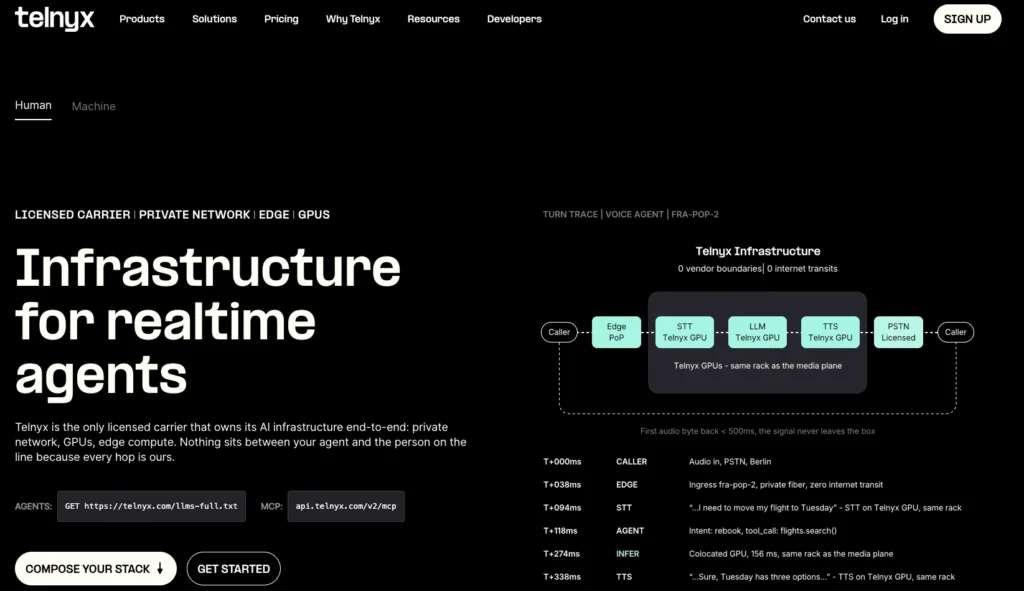
Telnyx runs its own private network and offers volume-based pricing with automatic discounts, which beat standard rates at scale. Its key advantages are SIP trunking, competitive pricing, and dedicated support that developers rate highly.
- Best for: Developers who want competitive, volume-based pricing and network-level control.
- Type: CPaaS.
- Pricing: Volume-based with automatic discounts; negotiable at scale.
- Pros: Own network for reliability; automatic volume discounts; developer-friendly with good support.
- Cons: Smaller ecosystem than Twilio; fewer higher-level engagement products.
How Telnyx compares to Bird
- Where it beats Bird: Transparent, volume-based pricing and network-level control.
- Where Bird holds up: Bird's omnichannel marketing and CRM layer is more turnkey for non-developers.
Bottom line: a developer favorite for competitive, scalable messaging on an owned network.
8. Respond.io, best for AI-powered omnichannel conversations
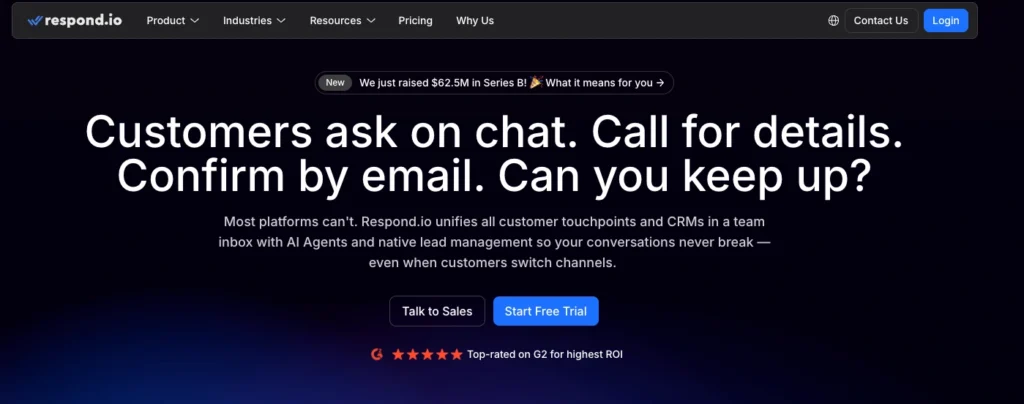
Respond.io pulls WhatsApp, Facebook Messenger, Instagram, Telegram, and SMS into one shared inbox, then adds AI agents to handle routine customer conversations. It fits a sales team and support teams that manage customer inquiries across many messaging channels from a single web interface and mobile app.
- Best for: Sales and support teams handling customer conversations across multiple channels.
- Type: Omnichannel inbox.
- Pricing: The Growth plan starts at $79 per month, with custom pricing for larger teams.
- Pros: AI agents that summarize conversations and route chats to human agents; broad messaging channels; strong customer support (24/5 live chat, 24/7 AI support).
- Cons: Priced per organization, not per message; more inbox than CPaaS API.
How Respond.io compares to Bird
- Where it beats Bird: Faster response times, published pricing plans, and AI agents with advanced routing for customer conversations out of the box.
- Where Bird holds up: Bird offers deeper messaging and voice APIs plus owned carrier infrastructure Respond.io lacks.
Bottom line: a strong pick for a sales team or support group that wants AI agents and an omnichannel inbox rather than raw APIs.
More MessageBird alternatives worth knowing
A few other MessageBird alternatives fit narrower needs.
On the messaging and voice side:
- Bandwidth owns its own carrier network in the US and is a strong choice for voice-heavy and enterprise messaging with direct carrier control.
- Sendbird focuses on in-app chat and messaging (chat, notifications, and AI agents inside your app) rather than SMS-first CPaaS.
- TextMagic offers a simple business SMS interface, including a bring-your-own-carrier option, for teams that want texting without building on an API.
On the marketing side, Brevo is not the only no-code option, and Bird competes here too. Weigh it against:
- Klaviyo leads for e-commerce email and SMS, with deeper store data and revenue analytics than Brevo for online stores.
- HubSpot offers a broader marketing, sales, and CRM suite than Brevo, though at a far higher price on its automation tier.
- ActiveCampaign goes deeper on automation than Brevo, at a higher price and with a steeper learning curve.
- Mailchimp is the most familiar option with a huge ecosystem, though it charges by contact and costs more at scale.
Among these, Brevo stands out on price and its all-in-one free plan, but the best marketing tool depends on your channels and budget.
How to choose the right MessageBird alternative
To choose between these MessageBird alternatives, work top-down:
- Building messaging into a product? Start with Twilio for docs and ecosystem, Plivo or Telnyx for cost, or Sinch and Infobip for enterprise scale.
- Running marketing campaigns? Brevo is the strongest no-code pick for email, SMS, and WhatsApp with automation and a CRM.
- Need voice and video too? Vonage.
- Sending millions of messages globally? Sinch or Infobip.
The biggest decision is API versus no-code. Channels, price, and coverage follow from that. Because several providers are sales-led, get a written quote for your real volume before committing.
Why Brevo is a strong MessageBird alternative
Bird's pivot toward an all-in-one marketing and CRM platform is telling: it's chasing the buyers who don't want to wire together raw APIs. Brevo serves that buyer more simply, with email, SMS, WhatsApp campaigns, a visual automation builder, and a CRM in one platform. A genuine free plan and published pricing keeps the customer experience simple.
Be honest about fit. If you need developer-grade programmable messaging, global carrier routing, or very high volumes, a true CPaaS like Twilio or Sinch is right, and Brevo isn't trying to be that. But for all-in-one multichannel marketing without an engineering project, Brevo is the cleaner path, which is why it tops this list for that use case.

Exceeding Expectations: A Five-Star Experience with Brevo
I recently had the pleasure of using Brevo's services, and I must say, my experience was nothing short of exceptional, meriting a full five stars. From the outset, the team at Brevo demonstrated unparalleled professionalism and dedication to customer satisfaction. Their attention to detail and commitment to providing tailored solutions truly set them apart in their field.
Bob,
Brevo user
Several Sales and Marketing Tools in One System
We stumbled upon Brevo by accident as we were using a system just for sending marketing emails. We discovered quickly that Brevo offered multiple different digital sales and marketing tools to enhance both our manual branded client engagement tasks, but also offered automation tools to aid our day to day sales efforts. Again, we never experienced any issues with the service itself. But it's great to know that Brevo's quick assistance is there if something goes wrong.
Stephen Day,
Brevo user
Brevo has most of the tools a small business needs
Brevo has most of the tools a small business needs for marketing and sales at a very reasonable price, without limiting your list growth. It has email marketing, CRM, transactional emails, SMS, live chat, Meta ad management, and WhatsApp messages. All this in a package that's easy to use and grows with your business.
Mor Mester,
Email Marketing Expert
Great range of features
We’ve been using Brevo ourselves for more than five years, and we’ve been really happy with it. It offers a great range of features (especially the automations) and makes creating beautiful emails very easy.
Robert Brandl,
Founder of EmailTooltester
Getting started
MessageBird's move to Bird changed what the platform is — reason enough to compare the top MessageBird alternatives in 2026. For programmable APIs, Twilio, Sinch, Infobip, Vonage, Plivo, and Telnyx each have a sweet spot. To run marketing across messaging channels without code, Brevo is the natural fit and one of the best MessageBird alternatives for that job.
Brevo's free plan lets you try email and SMS campaigns with automation and a CRM. You can store up to 100,000 contacts, no credit card required. Brevo also offers a transactional email and SMS API.