SUCCESS STORY
How the Vaillant Group secures and scales its transactional communications with Brevo
By structuring its usage into sub-accounts, the Vaillant Group aligned IT governance, GDPR compliance, and sending performance, without slowing down engineering teams.
About the Vaillant Group
The Vaillant Group is an internationally active family-owned business based in Remscheid. The global market leader in central heating units celebrated its 150th anniversary in 2024. It offers its customers technologies for heating, cooling and hot-water supply that contribute to successfully shaping the energy transition in the buildings sector. The focus is on eco-friendly electric heat pumps, efficient gas-fired boilers, intelligent systems and comprehensive services.
Results obtained with Brevo
- 15
isolated environments via sub-account
- Access
and permissions better controlled by team/app
- API quotas
dedicated to avoiding bottlenecks
The challenge
When a single account becomes a risk (and a bottleneck)
As an international group, the Vaillant Group operates multiple applications across different markets worldwide. Historically, all these applications and the associated development teams shared a single environment for their transactional mailings. This centralization created three major risks for their infrastructure:- A security and compliance risk: Impossible to partition user data according to the principle of least privilege, a key GDPR requirement.
- An operational risk: Shared access increased the probability of accidental changes impacting other countries or applications.
- A performance risk: A shared API quota where a load peak from one application could create bottlenecks for all others.
The solution
Distributed governance, centralized control
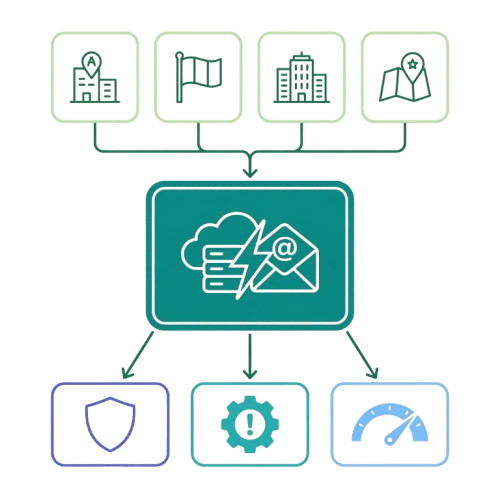
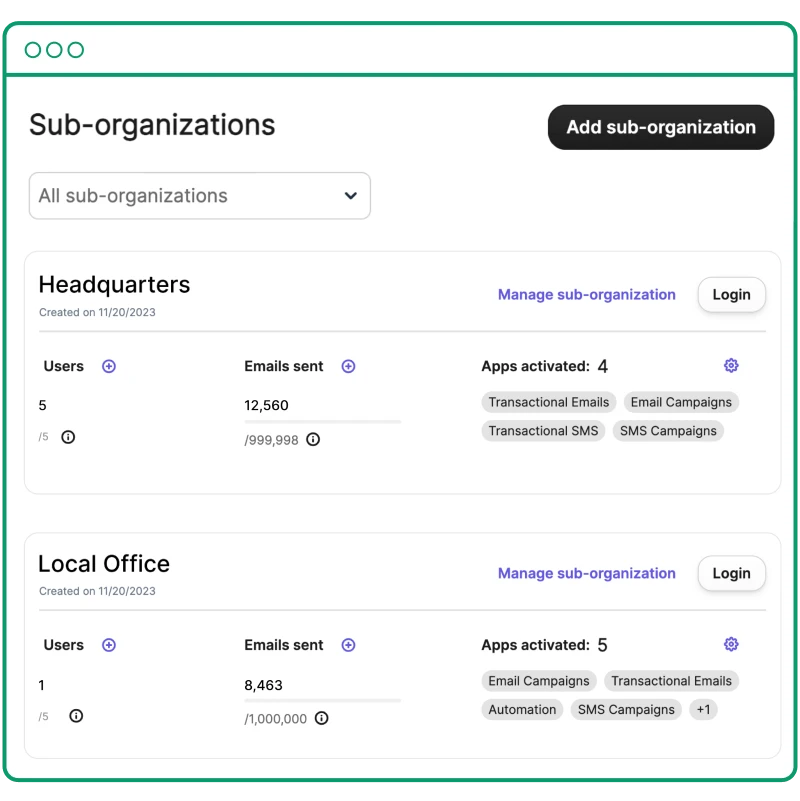
To meet these Enterprise-level requirements, the Vaillant Group's teams (led by Engineering) restructured their approach using Brevo's Sub-accounts feature. Rather than funneling everything through a single pipe, the Vaillant Group deployed 15 distinct working environments (sub-accounts). Each application and region now has its own separate space.What the multi-account architecture changed
- One sub-account per application/team/market
- More granular access rights
- Better separation of usage and configurations
The impact
Autonomous teams, smoother compliance
By switching to a sub-account architecture, the Vaillant Group partitioned its environments to reflect the reality of its applications, teams, and markets. Access is easier to manage and more secure, with permissions better controlled within the right scope.What the Vaillant Group gained
- Clear partitioning of usage and data by application / market
- More granular access management to limit risks
- More predictable API capacity, without bottlenecks related to a single account

Discover other customer success stories